


What is Social Well-being? Our Concept


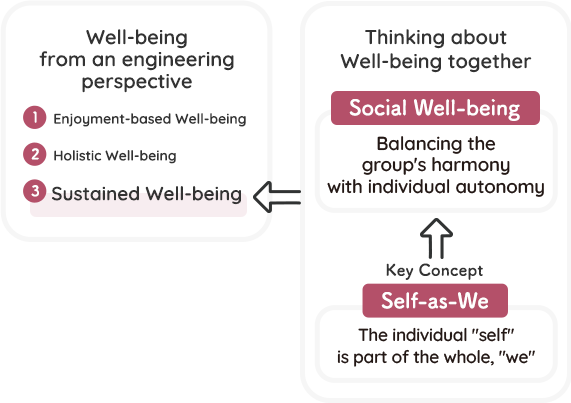
When discussing Social Well-being, we focus on philosophical concepts. For example, the concept of thinking about not only your own happiness but also the happiness of those around you. On this page, we will detail the relationship between the concepts of "Sustained Well-being", "Social Well-being", and "Self-as-We".
Well-being What is Sustained Well-being?
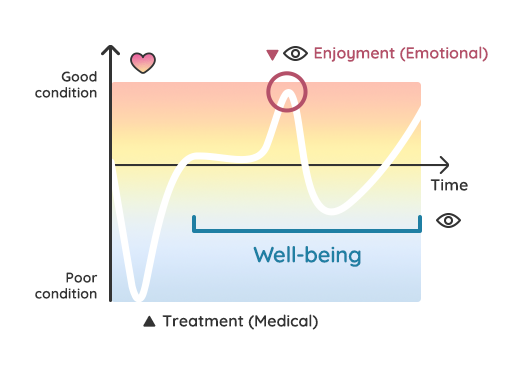
The term "Well-being"combines the words "well" and "being" to describe whether or not someone is living in a way that is true to oneself, enjoyable, and comfortable.
From an engineering perspective, Well-being is categorized into three distinct types:
From an engineering perspective, Well-being is categorized into three distinct types:
- Holistic Well-being (being healthy in both mind and body)
- Enjoyment-based Well-being (feeling good in the present moment)
- Sustained Well-being (living freely as one's authentic self)


Social Well-being What is Social Well-being?
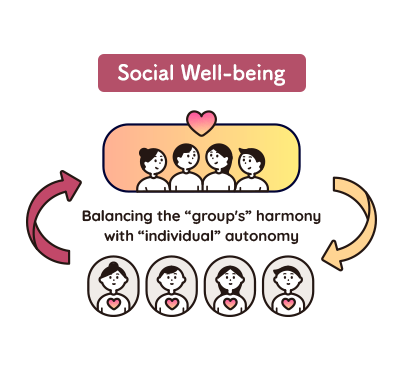
We do not believe that Well-being is something that can be achieved strictly at the individual level, irrespective to the Well-being of others. Rather, the term "Social Well-being" encompasses the belief that the Well-being of the community is connected to the Well-being of the individual. We aspire to design a society that enables Social Well-being by establishing a balance that values both the individual and their respective autonomy as well as the community as a whole.
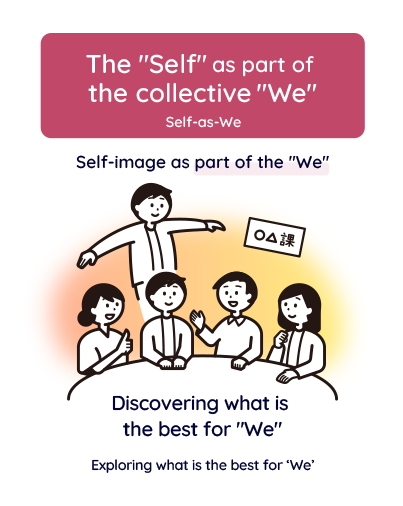
Different people want to interact within the community in different ways, and everyone has their own diverse skills and preferences. Therefore, we believe it is important to design a society where people can live true to themselves while also respecting the values and choices of other people in the same community. To achieve this, we are carrying out research based on the "Self-as-We" concept.
Different people want to interact within the community in different ways, and everyone has their own diverse skills and preferences. Therefore, we believe it is important to design a society where people can live true to themselves while also respecting the values and choices of other people in the same community. To achieve this, we are carrying out research based on the "Self-as-We" concept.
 Self-as-We
Specifically... As an example, how can we apply Social Well-being to soccer?
Let's consider Social Well-being while using a soccer team as an example.
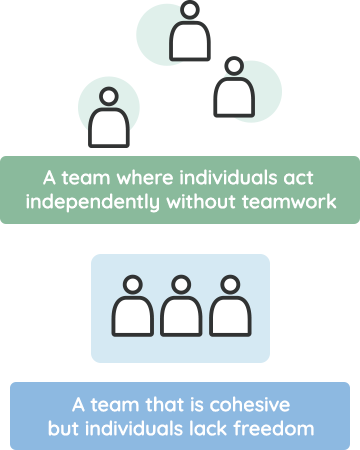
In a team where a stern coach carries out strict practice sessions without any freedom or flexibility, the team may appear to be unified on the surface but the individual Well-being of the members is overlooked. On the other hand, if each member practices what they want to individually, even if they achieve individual Well-being, the team will lack synergy and there may be no team-play or coordination when it matters the most.
In a team where a stern coach carries out strict practice sessions without any freedom or flexibility, the team may appear to be unified on the surface but the individual Well-being of the members is overlooked. On the other hand, if each member practices what they want to individually, even if they achieve individual Well-being, the team will lack synergy and there may be no team-play or coordination when it matters the most.
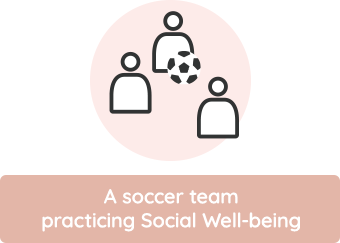
Instead, what if players autonomously set their own goals, propose training routines, and seek advice from the coach? We believe that this will positively impact the team as a whole. In soccer, while individual skills are important, synergy between the players is essential. During long training periods, players with different personalities constantly interact with each other, sometimes fighting, but gradually build trust in each other. Teamwork and synergy arise when each member understands and respects each other's values and behaviors, creating mutual respect and trust.
In other words, the goal is to create a state where individual autonomy is respected while leading to the success and Well-being of the group as a whole.
In other words, the goal is to create a state where individual autonomy is respected while leading to the success and Well-being of the group as a whole.


Research Strategy
Our
Approach
Our research focuses on ways to realize a society that prioritizes Social Well-being by rethinking social systems and services. We look at how to support personal connections and measure a group's state of Well-being while testing out practical applications with various stakeholders.

Read more articles about Social Well-being here
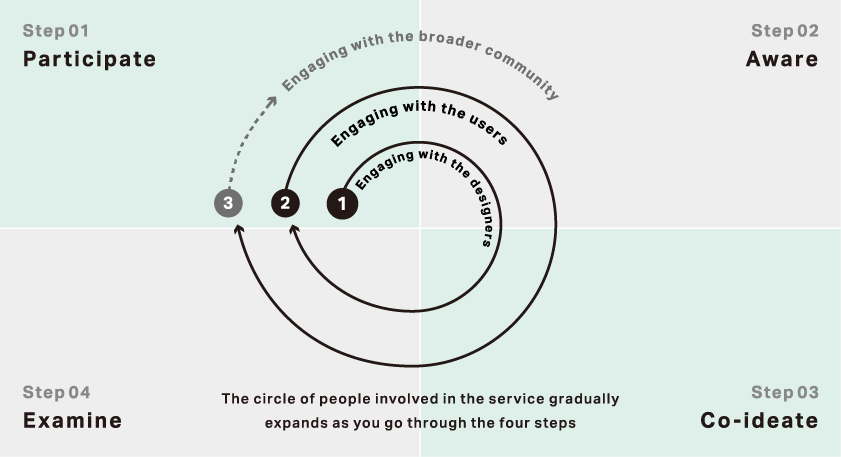
Well-being Design Framework: Designing Services to Achieve Social Well-being
How we co-create services and social systems
NTT Social Informatics Laboratories' Well-being Research Project
Read more here

Company Team Building Using Our "Collective Well-being Cards"
Fostering mutual understanding among team members to enhance problem-solving and to improve the workplace
NTT Social Informatics Laboratories' Well-being Research Project
Read more here