


2023.09.21
Well-being Design Framework: Designing Services to Achieve Social Well-being


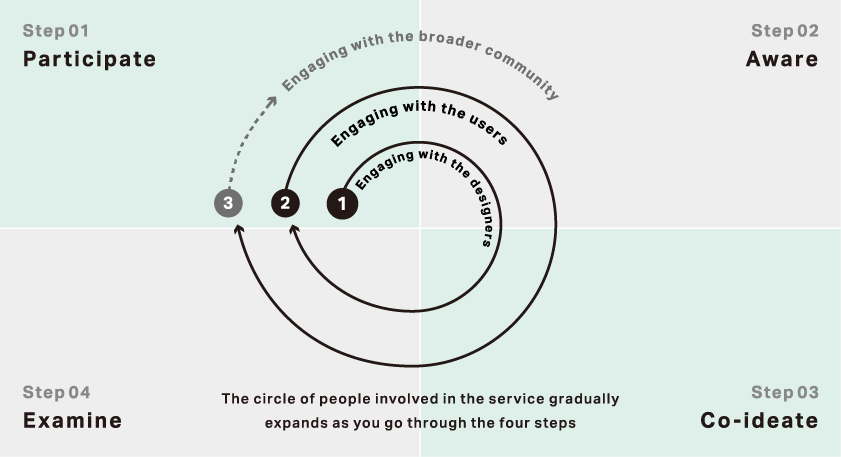
How might we design services centered on Social Well-being? To answer this question, we analyzed previous cases and came up with a four-step process. The circle of people involved in a service's design gradually expands as you go through each step. This way, more people will be able to achieve a better state of being.
For example, at first, service designers think about and design services while prioritizing their own beliefs and values. Later on, the people who actually use the service will gradually also become something similar to service designers themselves. Therefore, instead of separating people into the roles of "service designer" and "user," we believe that designing services with everyone, irrespective of their role will ultimately lead to the long-term creation of a state of Well-being for the largest number of people. Next, let's explore each step more in depth along with examples of how we can better design services in the workplace.
We will show how the design framework may be completed in two cycles in the following example.
For more details, please download the brochure from the link below.
For more details, please download the brochure from the link below.
NTT Social Informatics Research Laboratories: Examining the Well-being Design Framework
The First Cycle: Gather Service Designers to Establish and Align the Project's Direction
01. Participate: Gather the service designers
Assemble a like-minded team with diverse backgrounds and expertise.
02. Aware: Understand the values of each designer
Each member should share their expectations and desires for the project with the group. By understanding everyone on an individual level, in addition to on an organizational level, participants will have a deeper understanding of the project as a whole.
03. Co-ideate: Create a well-balanced vision
Based on the mutual understanding that was reached in the previous step, establish the group's shared goals and ideate to come up with specific ideas for the service in order to define the project's direction.
04. Evaluate: Assess the ideas
After confirming if the current direction for the project is suitable, present the group's ideas to people who have not been involved in the discussion so far, such as the people who will actually be using the service, and evaluate the ideas.
The Second Cycle: Design the Service Alongside Its Users
01. Participate: Involve the people who will actually use the service
Identify the service's stakeholders and invite them to participate. Involve the primary beneficiaries (users) who will receive value from the service as if they were designers as well.
02. Aware: Understand the values of the new members
Include the new members and have everyone share their thoughts. By understanding the values of both the people who are designing the service and those who will use it, we can foster mutual understanding between all members.
03. Co-ideate: Sharpen the vision
Building on the understanding developed in the previous steps, consider how the service can encompass and address the varied feelings of its users. In doing so, we can improve everyone's Well-being.
04. Evaluate: Expand the target audience and re-assess
Assess the ideas as a whole. Take into account not only the service's direct users, but also the impact and influence it may have on the people around them.

