[基礎数学セミナー] 【特別講演】「Theta Correspondence-Origins, Results and Ramifications」開催のお知らせ
タイトル:Theta Correspondence-Origins, Results and Ramifications
日時:2022/6/23
講演者:Roger Evans Howe (Yale University, Texas A&M University)
会場:NTT武蔵野研究開発センタ プレゼンテーションホール(対面開催)
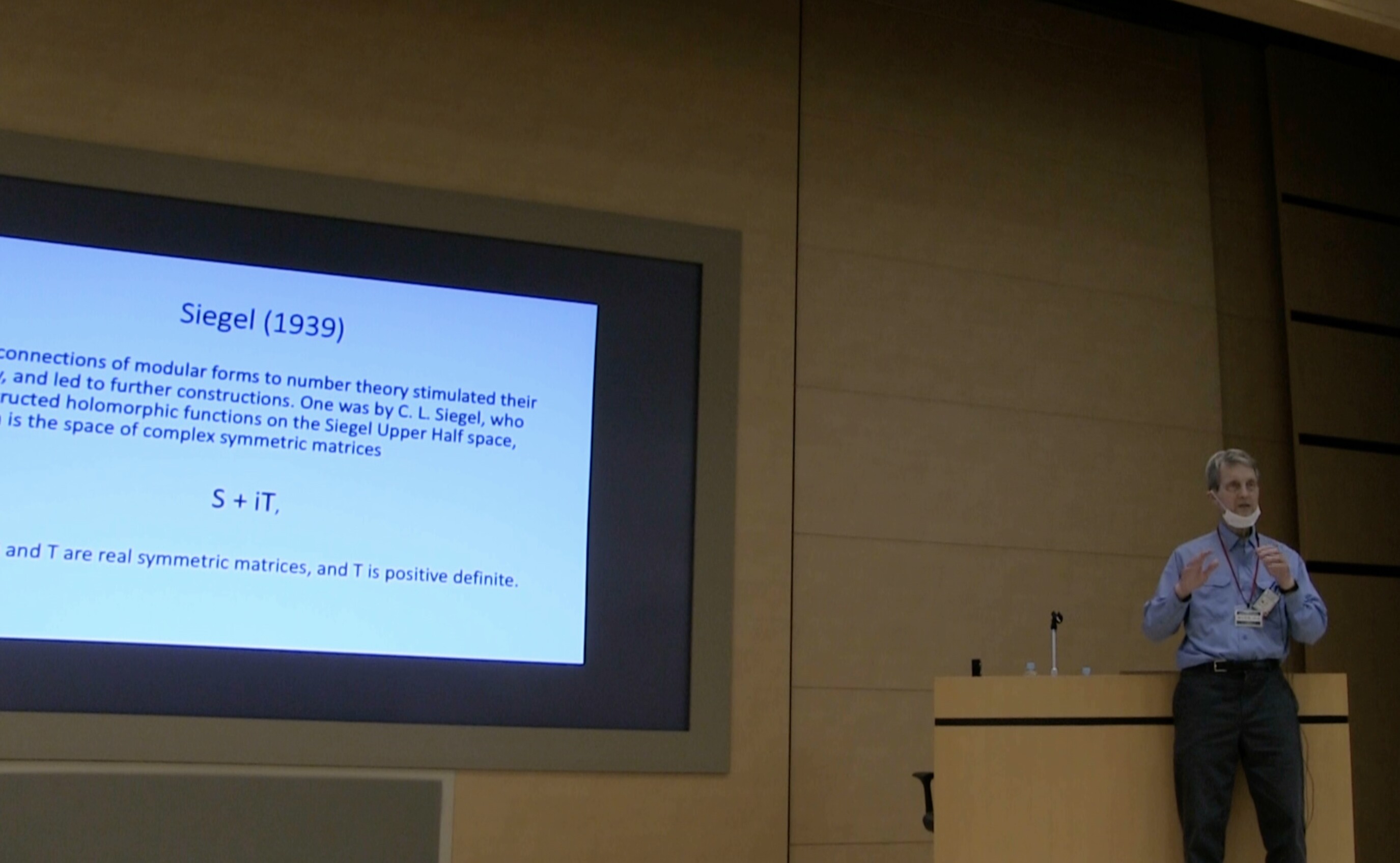
Around 1830, C. G. Jacobi wrote down his original theta function θ(z) as a Fourier series, and used it to give a striking new proof of the theorem of Lagrange, from the late 18th century, that every whole number is the sum of four perfect squares. It is easy to see that number of ways to express a given number as a sum of squares of four integers is given by the Fourier coe$FB03cients of θ4, and Jacobi was able to give an explicit formula for these. Both θ and θ4 are modular forms, functions on the complex upper half plane defined by certain transformation conditions. Later in the 19th century, the identification by G. Eisenstein of θ4 as a special type of modular form (now known as an Eisenstein series) shed further light in Jacobi’s formula. The strong connection between modular forms and number theory, as well as the geometry of Riemann surfaces, led to further investigations by Hecke, Maass, Siegel, Shimura and others into modular forms, and analogous
functions of many variables, called automorphic forms.
Also in the first half of the 19th century, investigations into the solutions of algebraic equations led to the study of groups of transformations, and of invariants - functions that were not changed by relevant transformations. This developed into a huge field, especially in England, and eventually led to the development of abstract algebra, especially by Hilbert and Noether. In the first half of the 20th century, interest in invariant theory subsided, but was partly preserved and extended by Weyl, in his book The Classical Groups, which established two basic results, which he called the First (resp. Second) Fundamental Theorem of invariant theory.
Partly through the above work, but also through developments in mathematical physics, especially quantum mechanics, attention to the way functions behave under transformations led to the development of representation theory, which describes how a given group can act on a vector space. At first, the vector space was presumed to be finite dimensional, but under the influence of physics, infinite dimensional representations also came under study.
All of these paths helped lead to theta correspondences, which tie many examples from all these fields together into tight packages.
This talk will to survey some of this history, and will describe the basic structure of theta correspondences.