2024/01/19
Hybrid State of Electrons Resonating at an Optical Communication Wavelength and a Gigahertz Ultrasonic Wave
-Anticipates the Development of Energy-saving Quantum Optical Memory Devices Using Ultrasonic Waves-
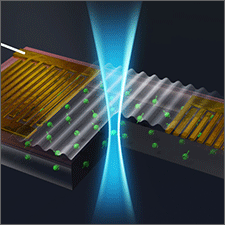
Nippon Telegraph And Telephone Corporation (NTT) and Nihon University (Nihon University) have successfully created a hybrid state of photoexcited electrons having a long lifetime of several milliseconds and a gigahertz ultrasonic wave by fabricating an ultrasonic device doped with a rare-earth element resonating at an optical communication wavelength. This achievement enables rare-earth electrons with high coherence to be controlled using low-voltage ultrasonic wave excitation, which shows promise for application to future energy-saving quantum optical memory devices.
This research achievement was published online in the American science journal Physical Review Letters on January 18, 2024, Eastern Time in the United States.
Background
Erbium (Er), a rare-earth element, possesses inner-shell electrons*1 that resonate at an optical communication wavelength. Inner-shell electrons that are shielded by outer-shell electrons are not easily affected by the external fields, so Er can be used for quantum optical memory as an element for which high quantum coherence can be obtained. At the same time, there is a negative side to this shielding effect of outer-shell electrons since it makes it difficult to externally control the inner-shell electrons. In actuality, a one-gigahertz shift of the optical resonance frequency of Er added to crystal materials by electric fields requires more than one hundred volts, so poor controllability has been an issue here. In the face of this problem, NTT has been researching the development of an energy-saving quantum optical memory device using mechanical resonators that can obtain large frequency shift by low voltages. This requires that the electron optical response be controlled by mechanical vibration, but how to create an electron/vibration hybrid state*2 to make this possible has been a problem up to now.
Achievement
NTT and Nihon University have successfully concentrated an approximately 2 GHz oscillatory strain on a crystal surface and performed high-speed modulation of the optical resonance frequency of Er by fabricating a device that generates a surface acoustic wave*3, a type of ultrasonic wave, on an Er-doped crystal substrate. The speed of this modulation is faster than the lifetime of excited electrons, that is, the electrons are modulated with frequency higher than the resonant linewidth, so a hybrid state arises consisting of electrons resonating in a communication wavelength band and a gigahertz ultrasonic wave. This state can be used to perform low-voltage control of the optical response of high-coherence Er excited electrons using ultrasonic waves, which should lead to the development of energy-saving quantum optical memory devices.
Experiment
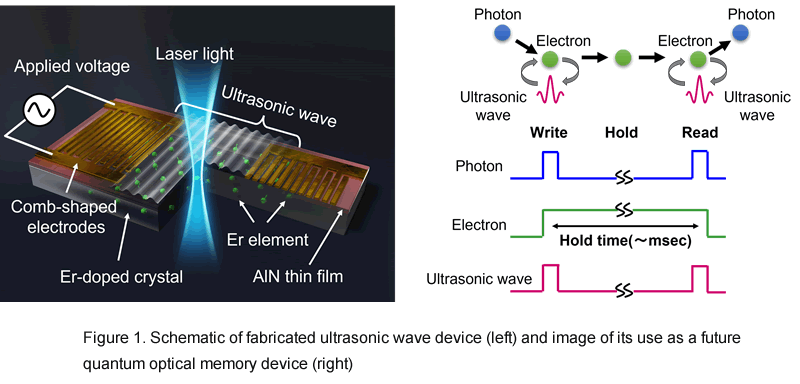
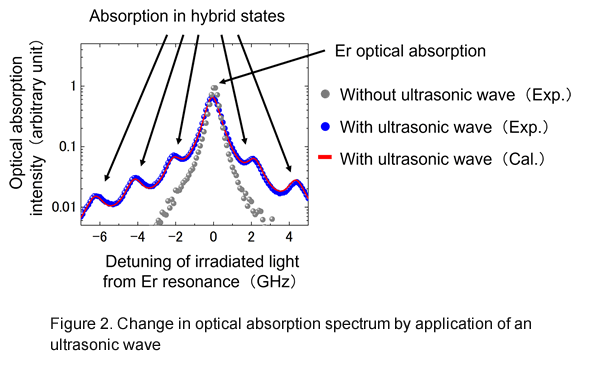
The ultrasonic wave device used in our experiment (Figure 1) consists of an Er-doped crystal*4, a piezoelectric thin film*5 formed on that crystal, and a comb-shaped electrode arranged on top of that film. Applying a voltage to the electrodes deforms the piezoelectric thin film according to the electrode pattern, so an ultrasonic wave with a frequency corresponding to the period of the comb-shaped electrodes can be generated. This induces strain near the crystal surface so that the Er resonance frequency receiving that strain becomes modulated by the frequency of the ultrasonic wave. As a result, multiple peaks separated at equal intervals appear in the optical absorption spectrum in addition to the inherent Er absorption peak (Figure 2).
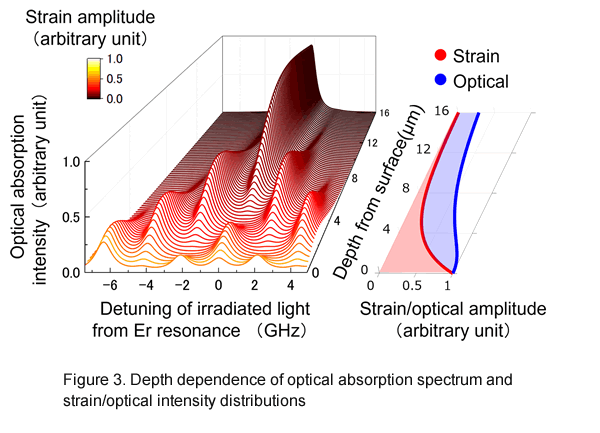
The interval between these absorption peaks matches the frequency of the ultrasonic wave indicating absorption due to a hybrid state mixing the Er electron state and an ultrasonic wave. Analysis based on this experimental result and the strain intensity distribution in the depth direction of the ultrasonic wave showed that the extent of this hybridization is sufficiently large near the outermost surface of the crystal, which indicates the possibility of manipulating the number and phase of excited electrons using an ultrasonic wave (Figure 3).
Technology
- Fabricating an ultrasonic wave device doped with isotopically purified Er
Achieving an electron/ultrasonic-wave hybrid state requires a structure that generates a high-frequency ultrasonic wave on an Er-doped crystal. In this experiment, the Er-doped crystal has no piezoelectric characteristics, so electrically generating an ultrasonic wave required the deposition of a piezoelectric thin film on the crystal surface. NTT possesses technology for forming high-quality aluminum nitride (AlN) film having both high piezoelectric and high frequency characteristics. This technology was used to successfully fabricate a high-frequency ultrasonic wave device having AlN piezoelectric film formed on an Er-doped crystal. In this device, a one-gigahertz shift of the optical resonance frequency of Er located near the crystal surface requires only 0.3 V, so high controllability is its advantage.
Here, achieving an electron/ultrasonic-wave hybrid state requires high-speed modulation of Er electron levels at frequencies exceeding the Er resonance line width, so Er that gives as narrow a linewidth as possible must be used. Since multiple Er isotopes having slightly different resonance frequencies exist, the resonance linewidth that can generally be obtained exhibits a breadth of several GHz, but using isotopically purified Er narrows the resonance linewidth as far as 500 MHz. As a result, letting a 2 GHz ultrasonic wave act on this Er achieved an electron/ultrasonic-wave hybrid state. - High-accuracy stabilization of laser-light frequency
To evaluate the optical absorption of such a narrow resonance linewidth, the frequency of the laser light used in the experiment must be stabilized with high accuracy. NTT and Nihon University jointly developed a laser-light frequency-stabilization mechanism using an optical frequency comb*6. This mechanism made it possible to perform experiments with high frequency accuracy three orders of magnitude greater than existing values.
Future plans
The experiment presented here used a surface acoustic wave that concentrates oscillatory strain near the surface of a crystal, but since the magnitude of this strain depends on depth from the surface, the extent of hybridization differs according to this position. In future research, NTT and Nihon University will work to improve the uniformity of this hybrid state by using material doped with Er only at the outermost surface and by introducing a structure that enables optical access selectively to only Er at the outermost surface. By enhancing hybrid-state uniformity and controllability, we aim to achieve energy-saving quantum optical memory devices operating in the communication wavelength band for application to long-distance quantum communications.
Paper information
Journal: Physical Review Letters
Title: "bservation of Acoustically Induced Dressed States of Rare-Earth Ions"
Authors: Ryuichi Ohta, Grégoire Lelu, Xuejun Xu, Tomohiro Inaba, Kenichi Hitachi, Yoshitaka Taniyasu, Haruki Sanada, Atsushi Ishizawa, Takehiko Tawara, Katsuya Oguri, Hiroshi Yamaguchi, and Hajime Okamoto
Terminology
- *1 ... Inner-shell electrons
- Electrons surrounding an atomic nucleus normally fill the inner-shell orbitals near the nucleus, but in rare-earth elements, electrons fill from the outer-shell orbitals, so the electrons that contribute to optical absorption are those on the inner-shell orbitals. Due to the electrostatic shielding effect of the outer-shell electrons, external fields do not easily affect these inner-shell electrons making for a stable electron state.
- *2 ... Hybrid state
- Intense modulation of electron resonance frequency by an external field such as an electromagnetic field or strain field results in a hybrid state called a dressed electron state wrapped by an external field. Such a hybrid state can be used to control the optical response of electrons using ultrasonic waves. Generating this hybrid state requires a modulation frequency higher than the electron's optical resonance linewidth.
- *3 ... Surface acoustic wave
- An ultrasonic wave concentrated and propagating near the surface of an object is called a surface acoustic wave. A surface acoustic wave device can be used to give a crystal an oscillatory strain having a maximum frequency of about 10 GHz.
- *4 ... Er-doped crystal
- Er coherence time differs greatly according to the crystal doped with Er. In the device of this research, we use yttrium silicate (Y2SiO5) widely used in the field of quantum optics as the host crystal.
- *5 ... Piezoelectric thin film
- Exciting a surface acoustic wave electrically requires a piezoelectric layer that converts voltage to stress and strain. Since Y2SiO5 is non-piezoelectric material, an AlN thin film having high piezoelectric characteristics is formed on top of Y2SiO5.
- *6 ... Optical frequency comb
- Laser light having frequency-wise equally spaced peaks like the shape of a comb is called an optical frequency comb. Since the peak frequency intervals are equal to each other with high accuracy, the optical frequency comb can be used for frequency stabilization in various types of devices as a frequency ruler. https://group.ntt/en/newsrelease/2023/07/21/230721a.html (English)