Advancing Real-World Deployment of AI-Powered Robotics
Introduction
Artificial intelligence (AI) is evolving beyond analyzing and generating information such as text, images, and audio. Through robots, AI is now entering a stage where it can perceive the physical world, make decisions, and manipulate objects. Physical AI, which enables robots to follow human instructions and adapt flexibly to their surroundings, is expected to be used across a wide range of fields, including manufacturing, logistics, construction, hospitality, healthcare, and nursing care.
This evolution is driven by social and industrial challenges such as labor shortages, a decline in skilled workers, and the need to improve workplace safety and productivity. Robots that can perceive constantly changing environments and perform tasks according to the situation, rather than simply repeating predefined motions, could expand the use of robotics to unstructured tasks that have traditionally been difficult to automate.
In recent years, Vision-Language-Action (VLA) models and World-Action Models (WAMs) have been proposed to enable this type of advanced robot control. However, these AI models require substantial computing power. Installing high-performance GPUs directly on robots creates constraints related to cost, power consumption, and onboard space.
At the Technology Innovation Center, we are connecting AI and robotics research, development, and business while identifying customer needs in the robotics market. Our goal is to develop technologies into solutions that can be used in real-world settings. To achieve this, we are designing robotics architectures, conducting technical evaluations, and advancing real-world deployment by combining technologies from NTT laboratories with commercially available technologies.
This article introduces one of these initiatives: a GPU-offloaded robot inference platform that enables robots to use cloud-based GPUs and large-scale AI models over a network, with the aim of achieving highly reliable robotic operations.
Exploring Highly Reliable Robotic Operations Using Large-Scale AI Models on High-Performance Cloud GPUs
Moving the Robot’s “Brain” to the Cloud
Large-scale AI models for robotics generally use camera images and sensor data captured by the robot to understand its current state. The models then infer, or predict, how the robot should act to complete the task specified by an instruction, and generate concrete robot actions such as motor control angles.
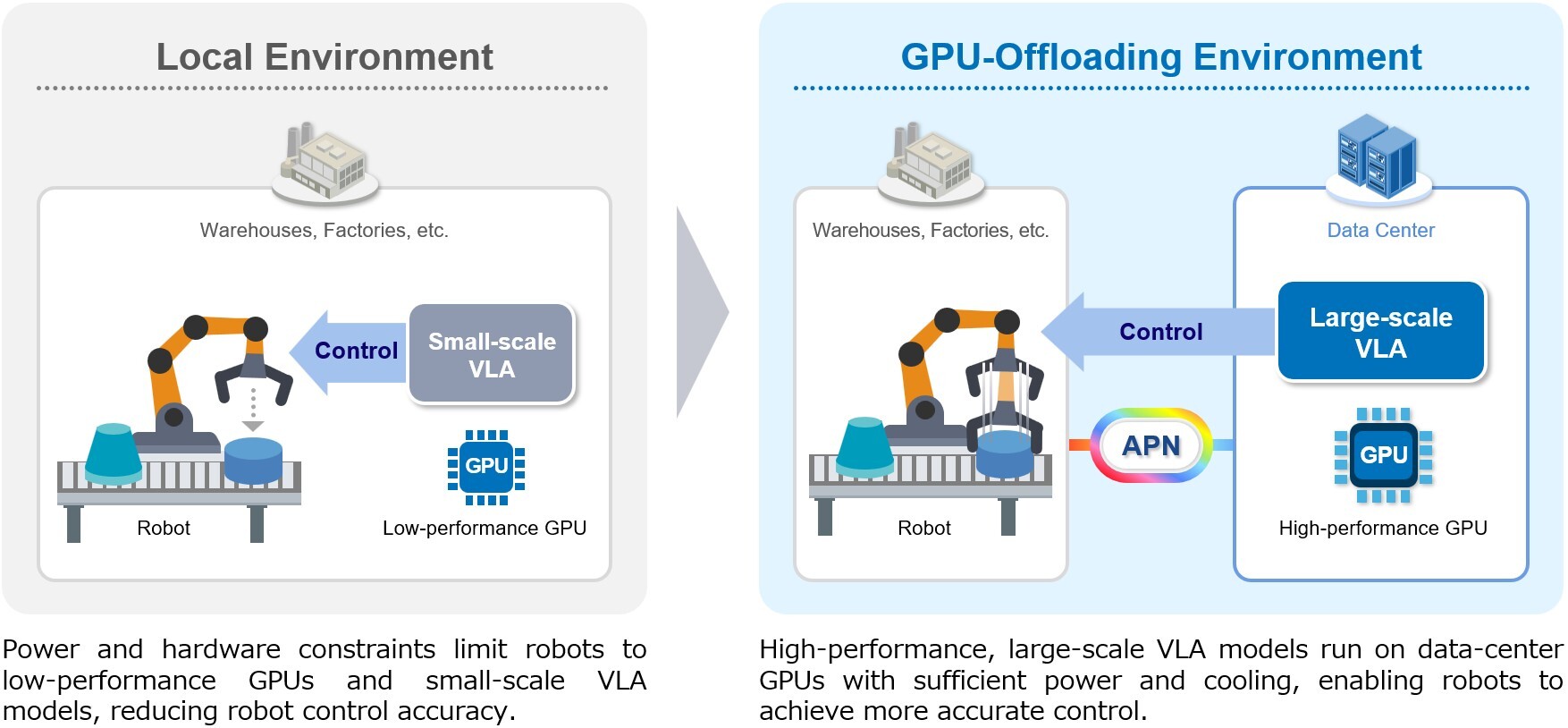
To perform state understanding, inference, and action generation within the time available for real-time robot control, high-performance GPUs are required. However, installing such GPUs directly on a robot may be difficult because of constraints such as power consumption, onboard space, and weight. We are therefore working to realize a GPU-offloaded robot inference platform that runs large-scale robotics AI models on high-performance cloud GPUs, enabling real-time, high-precision perception, decision-making, and action according to the surrounding environment. By reducing dependence on the robot’s onboard computing capacity and power constraints, this approach expands the potential to apply larger and more capable AI models to robot control.
Technical Evaluation for Highly Reliable Robotic Operations
To ensure the reliability required for real-world robotic operations, it is important not only to run AI inference in the cloud, but also to evaluate the response performance and task quality of the entire system, including the robot, network, GPU, and AI model. Using real robots, we compare the processing speed and task success of operations such as pick and place when executed on high-performance cloud GPUs versus onboard GPUs. Through these evaluations, we aim to clarify the relationships among GPU placement, network conditions, AI model scale, control cycle, and task accuracy, and to establish practical system configurations and evaluation methods.
Real-Time AI Processing Using APN and a GPU Computing Platform
To realize the GPU-offloaded robot inference platform, the cloud must rapidly process video and sensor data sent from the robot and return the computation results at the appropriate time. The system must therefore be designed with network latency, latency variation, and data-transfer capacity in mind. We are exploring an architecture that combines low-latency communication over the All-Photonics Network (APN) with GPU resources provided by the AI Computing Platform, enabling the use of large-scale VLA models while meeting robot control-cycle requirements.
Approach to Real-World Deployment
Delivering new value to society by combining Physical AI and IOWN requires the integration of expertise across diverse fields, including robotics, AI, networks, GPU infrastructure, security, and on-site operations. In addition to technologies from NTT laboratories, Technology Innovation Center evaluates commercially available products and technologies and selects configurations suited to customer needs and business models. Through discussions and demonstrations with NTT Group companies, laboratories, partner companies, and customers, we will define target industries and use cases and advance real-world deployment in a form that can be sustained as a business.