Super-wide-area atmosphere and ocean observation technology

Technology for continuous in situ atmospheric and ocean observations across wide ocean areas
Current research
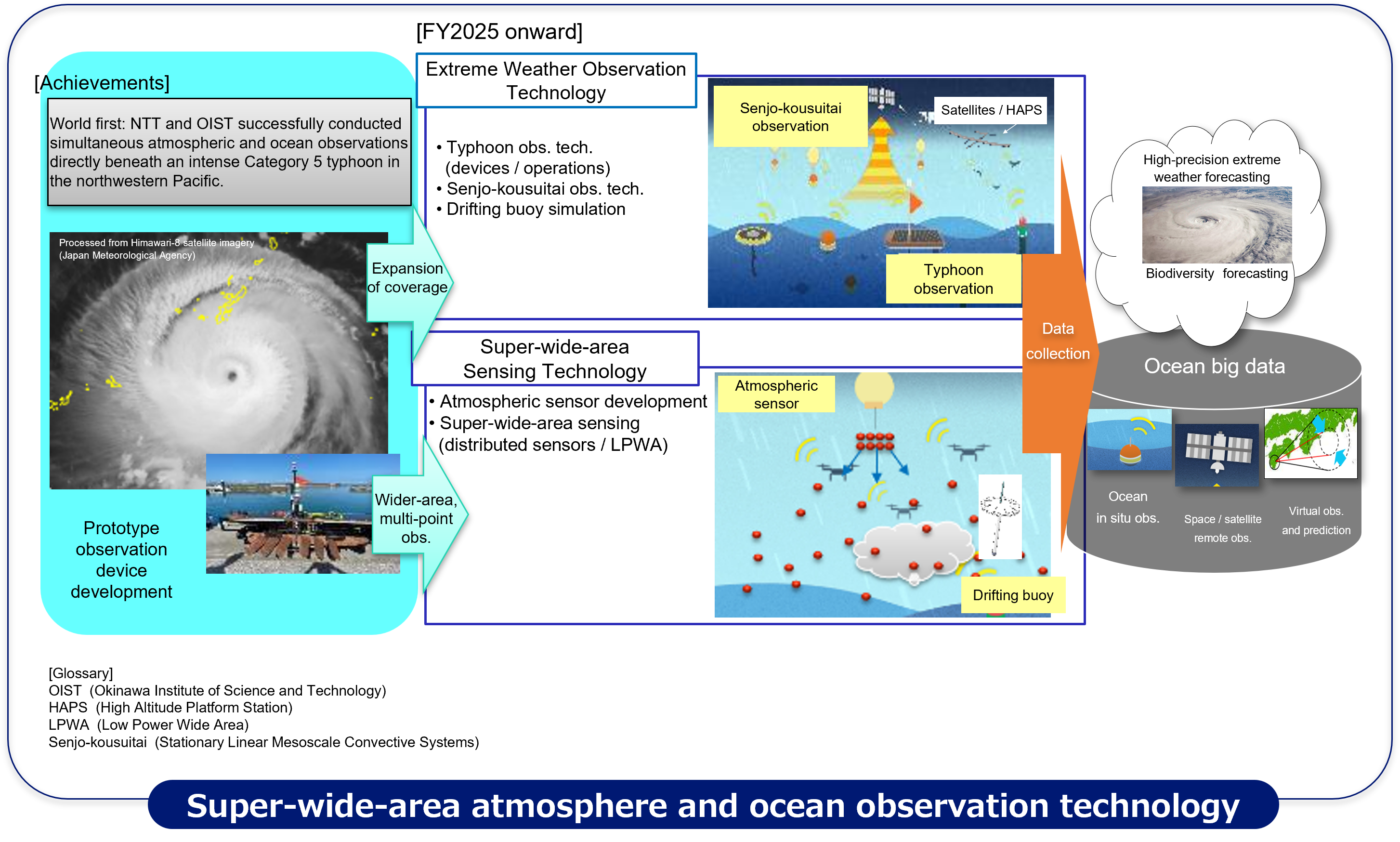
"Super-wide-area atmosphere and ocean observation technology" enables the collection of in situ atmospheric and ocean observation data with low power consumption and at low cost by deploying observation sensors across wide ocean areas where continuous direct observation has traditionally been difficult.
Water vapor supplied from the ocean surface is considered to play a significant role in the formation and development of extreme weather phenomena such as typhoons and Stationary Linear Mesoscale Convective Systems ("Senjo-kousuitai"). However, continuous in situ observations over the ocean remain challenging. In particular, under severe conditions such as those encountered when typhoons approach, reliable means of collecting in situ observation data and the necessary communication infrastructure are not yet sufficiently established.
To address these challenges, our research team is conducting research and development to combine atmospheric and ocean observation instruments with communication technologies, enabling the continuous collection of in situ observation data over wide areas to help improve the accuracy of extreme weather forecasting.
This technology consists of two main components: "extreme weather observation technology" and "super-wide-area sensing technology."
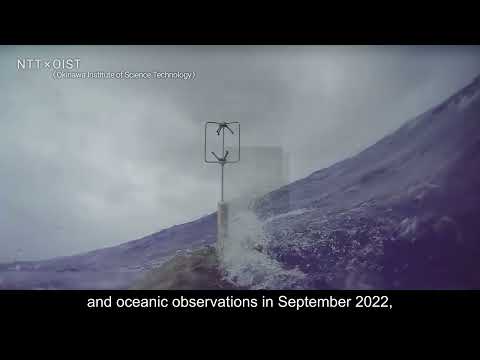
"Extreme weather observation technology" focuses on the research and development of observation platforms, sensors, and observation operations capable of continuously collecting in situ atmospheric and ocean observation data even under severe conditions involving high waves, strong winds, and heavy rainfall. NTT has already demonstrated the collection of in situ observation data under typhoon conditions.
"Super-wide-area sensing technology" aims to collect in situ atmospheric and ocean observation data in ocean areas where communication infrastructure is limited, using low-power, long-range communications spanning several hundred kilometers or more. We are conducting research on technologies for continuous sensing in observation gaps by utilizing LPWA (Low Power Wide Area) communications, communication systems designed for wide ocean areas, and coordination among distributed sensors.
Starting in fiscal year 2025, we have expanded our observation targets to include Senjo-kousuitai and are advancing research and development to collect stable, high-quality in situ atmospheric and ocean observation data that can contribute to understanding their formation and development mechanisms and improving forecast accuracy.
In the future, through collaboration with satellites and HAPS (High Altitude Platform Stations), we aim to establish a global-scale, super-wide-area sensing infrastructure and realize an ocean observation platform that is essential for Japan.
Furthermore, through joint research and demonstration experiments with national and corporate research institutes and universities, as well as alliances with manufacturing companies, we will verify use cases and the applicability of the technologies and contribute to creating new businesses for the NTT Group in the space and ocean domains.
Related videos
-
Global Environmental Futures Forecasting Technology Proactively Adapts to Extreme Weather Events
-
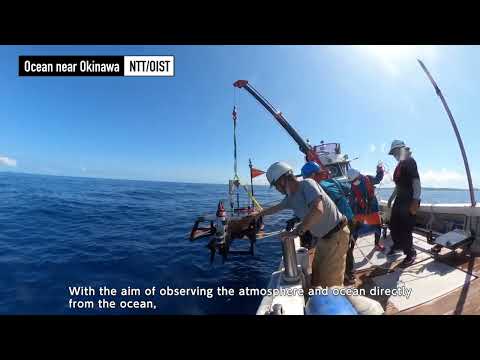
Super-wide area atmosphere and ocean observation technology
-
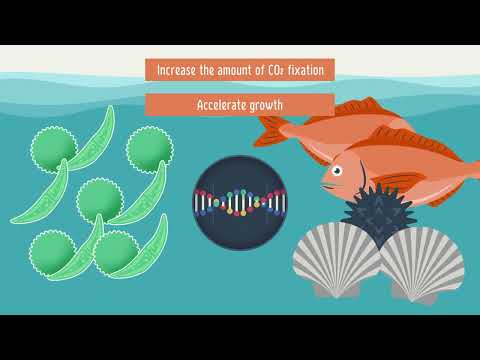
Constructing a society that can adapt to the future global environment
Related contents
-

03/29/2024
Forefront Research Ini...
NTT Space Environment and Energy Laboratories aims to ...
-

09/01/2023
Position-control Techno...
NTT Space Environment and Energy Laboratories is investigating...
-

03/03/2023
Technology for Forecast...
NTT Space Environment and Energy Laboratories aims...
-

12/03/2021
Earth Information Analy...
We are studying for the realization of real-time, ...
Press releases