09/17/2021
A Glimpse of the Information Communication Networks of the Future:
Research on Optical Path Design for Large-Scale Computing InfrastructureTakeru Inoue
NTT Network Innovation Laboratories
Distinguished Researcher
One of the current challenges with information and communication networks is their lack of flexibility. It takes a lot of work to set up a new optical path between sites; Moreover, it is very difficult to establish optical paths if each site uses different optical transmission devices. If we were to compare a conventional network to a fixed road, what Distinguished Researcher Takeru Inoue aims to construct is a network more like a flexible railroad, with tracks that we can freely switch between. Here, he tells us more about his field, optical path design for large-scale computing infrastructure.
Technology Development for Networks Five or Ten Years Down the Line
What kind of research do you do at the Network Innovation Laboratories?
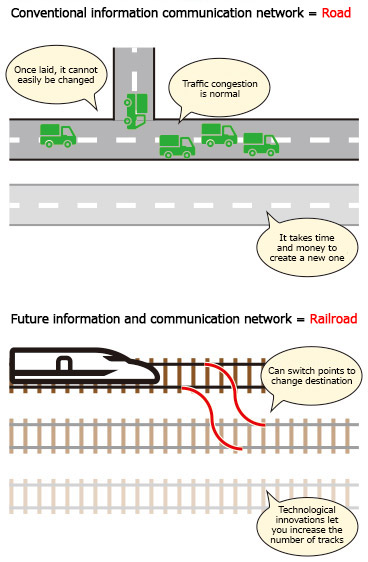
Up until now, the communications channels managed by NTT have been like roads. We establish a fixed optical transmission path, and customers' data—the cars—are split into little "packets" and sent to their destinations. This wasn't a problem when there was a low volume of communication — that is, when the road, shown in figure 1, was wide enough for the trucks carrying the packets. What's more, while the usage situation varied from person to person, if we looked at the bigger picture, e.g. per town or per 10,000 people, we were able to observe certain trends. For example, maybe communication volume gradually increased starting in the morning, peaked immediately before people went to bed, and then dropped late at night, or maybe there was a lot of traffic to major search engines or popular video streaming sites. These trends allowed us to predict usage to a certain degree.
In recent years, however, user behavior has diversified and the volume of traffic is growing by tens of percentage points every year. This naturally causes concerns about congestion — but roads can't be easily rebuilt once they have been laid. It takes several months to build new transmission paths, too. So there's now an idea that this perception of "fixed roads" is actually limiting the possibilities of communication.
Compared to a traditional road, the model for future networks will be more like flexible railroads. As you'll know if you picture a train, the tracks are for trains only, so there is no traffic congestion. However, you can't run as many vehicles as on a road, so you need to lay lots of tracks so that many people can use them at the same time.
You also need to metaphorically switch the track points when necessary in a period of time much shorter than before: in a minute, or an hour, say.
In order to make this network a reality, Network Innovation Laboratories are researching configuration technologies.
The Transport Innovation Laboratory, which gathers together experts in optical technology, is conducting research on transmitting broadband optical signals and increasing the number of "tracks" as shown in figure 1. To give you a picture, we are researching how we can lay hundreds or thousands of tracks in a space where we could previously only lay tens.
I'm part of the Frontier Communication Laboratory, which is responsible for researching and developing technologies that will allow us to switch between tracks smoothly. Today, I will briefly introduce two of these technologies: efficient network design using optical fiber cross-connects for communications buildings, and automatic optical path provisioning.
What is "efficient network design using optical fiber cross-connects "?
Consider a situation where you want to run a new optical path from a communications building to another building or company.
For example, on the left-hand diagram in figure 2, say you want to connect the red optical fiber coming in from the bottom left to the optical fiber in the bottom right. However, the fiber cross-connect in between those points cannot be connected to the bottom right, as indicated by the three crosses. This is referred to as a "block." The conventional approach would be to open up the network by adding another crossconnect, as shown in the right-hand diagram. However, this method requires installing lots of expensive optical fiber cross-connects, which is not desirable from a business point of view.
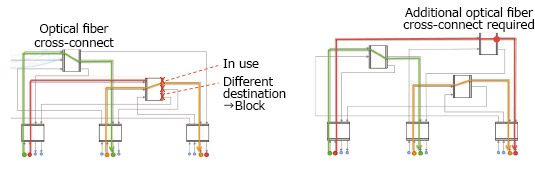
We have therefore developed technology to mathematically determine the optimum number of cross-connects. Specifically, this is a redesign of the existing standard hierarchical network structure. It allows lower-level optical signals to loop back without going via higher levels, and rather than preventing blocks altogether, we're looking for an efficient network structure where we permit them at such a low level—say, one in a million—that they will almost never occur.
We made particular use of mathematics from fields like puzzle-solving. You may have heard of things like "discrete mathematics" and "graph theory."
This technology has demonstrated that in a hypothetical network with 20,000 optical fibers and several thousand connections required every year, a five-hour calculation can reduce the number of switching devices by 42%.
What is "automatic optical path provisioning technology"?
Even if the network configuration technology for fiber-optic switching equipment guarantees that one or more destination ports are always free, it is not always possible to open an optical transmission path immediately.
First, if the vendors of the devices transmitting and receiving optical signals are different, they will have different standards, so ordinarily they will not be able to communicate. However, given the need to switch destinations, we need to be able to use a standard interface to control equipment, even from different vendors. We also need to optimize communication according to the required speed, the distance and the quality. For example, firing a powerful laser at short distances can break the receiver. We also need to prevent interference from adjacent signals.
To do this, we have developed technology that can automatically optimize the transmission mode used for communication using only standard interfaces.
Specifically, we need to first understand the condition of the transmission path using the initial optical path, which is a weak signal, as shown in figure 3. The process is then to collect information about the parameters of communication from Location A and Location B to the optical coordination controller, calculate the optimal combination of parameters, then open the optical path according to the end user's requirements.

In addition to the rise of software-defined networks (SDNs), there is a trend toward open source in all fields, and the current need for these technologies is increasing.
While the technology before involved a mathematical approach, this one involves a software approach.
Working on Yet More Practical Technologies
What kinds of possibilities will these two technologies unlock?
These technologies will allow you to deliver a non-congested communications path to those who need it, when they need it. I think the All-Photonics Network (APN), one of the three main technological fields of IOWN, is also based on the same kind of principles.
Let's take teleconferencing systems as an example. While image quality has improved significantly over time, they are still very different from actual meetings. I personally believe that these slight delays in conversations and overlaps in speech mean there is still this feeling of separation. APNs are capable of sending and receiving all the information that a human can process, so I hope that the era of just being able to manage remotely will shift to an era of not even noticing that things are remote. I also think it will be possible to use the network for applications that are still difficult at this time — things that are very sensitive to communication delays, like remote surgery.
What do you think about the future direction of your field?
We've talked about two technologies here, but neither of them has been put into practical use yet. It would probably be more accurate to say that we are finally reaching the start line.
For example, network design using optical fiber cross-connects is useful when there is a fixed number of optical fibers—but networks are constantly growing. As the network gets bigger you need to add or rearrange cross-connects, but optical signals are already traveling through them. Optical communication is more difficult to stop and migrate than packet communication, so I believe we need to find methods to expand networks while keeping them running. It's a tricky problem.
There are also challenges with automatic optical path provisioning technology. These examples I gave were limited to the setup of the two endpoints of the transmission line, the transmitter and receiver, but in reality it takes more than those to achieve optical communication. For example, above a distance of 12 to 19 miles, the optical signal becomes weaker and must be boosted with an amplifier. Additionally, to achieve optimal communication, all devices along the route generally need to be controlled together using devices such as filters.
When you think, too, about the daily maintenance and operation processes, you can see this is a complex problem with a large number of considerations. Everyone working on these things has probably felt this at some point.
What would you say to anyone hoping to become involved in information communication network research?
NTT's research environment is extremely well-equipped. It's fair to say we have almost all the necessary equipment when it comes to information communication networks in particular. Optical transmission equipment and optical signal transmission equipment may be much cheaper than in the past, but it's still difficult to assemble them all in a single university laboratory.
NTT's setup means we are able to conduct research and testing using actual equipment. This is one of the major strengths of the NTT Group.
When you think of information communication networks, you may picture electronic engineering, which deals with electrical signals. However, as you can see from my research, which mixes mathematics, information science and other fields, it is an incredibly broad discipline. Of course, electronics is an important area, but today's information communications networks are more than just a means to transmit signals, so we need a variety of expertise, including the software and programming technology to manage the networks, the mathematics to back up the concepts, and occasionally, other perspectives such as economics.
If you are interested in making the most of your expertise to support the social infrastructure, I encourage you to take on the challenge.
(This interview was conducted remotely.)
◆PROFILE:
Joined NTT in 2000. Researcher, ERATO, Minato Discrete Structure Manipulation System Project, Japan Science and Technology Agency (June 2011 to June 2013)
NTT Network Innovation Laboratories (July 2013 to present)
Visiting Lecturer, Waseda University School of Fundamental Science and Engineering (September 2016 to present)
NTT Communication Science Laboratories (March 2020 to present)