02/19/2021
It's not just about predicting the future, it's about guiding someone toward a future that is better for them.
Personal assistants made possible by behavioral models
*The names of the laboratories mentioned in the article may have changed since the time of writing/interview.
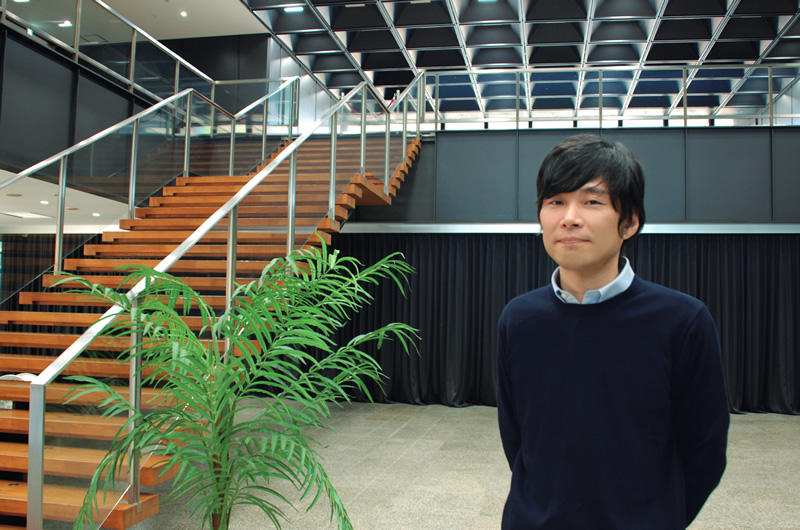
Takeshi Kurashima
Distinguished Researcher, NTT Service Evolution Laboratories
A personal assistant that changes human consciousness by presenting the right information at the right time, and encourages actions that will lead to a better future. To achieve this, you need to accurately predict the future and understand how to influence changes in human behavior. We spoke with distinguished researcher Takeshi Kurashima, who is working on the construction of a behavioral model that can simulate human-like behavior with a mechanism for human decision-making which also includes irrational decisions.
What is the behavioral model that reproduces human decisions and behaviors?
Please tell us about your research.
We study human behavioral mechanisms and conduct research on mathematical human behavior modeling.
The project aims to promote better human decision making by building a behavioral model that can simulate human behavior through the leveraging of human and social insights such as behavioral economics, or insights from the perspective of human behavior, and real data such as movement and purchasing data.
The research is divided into three parts: The first, "mechanism identification" is used to explain the mechanisms of human decision-making, including irrational decisions. The second, "modeling and predicting" involves building a behavioral model that reproduces human decision-making and behavior using a framework of identified mechanisms, and predicts and simulates behavior. Finally, "exploration of behavioral changes" involves identifying the relevant factors when a negative future is anticipated, and explores ways to change human consciousness naturally to drive action and lead to better futures.

For example, suppose someone goes for a run near their home every morning. But one day, they are unable to do this due to a business trip. People find value in continuing something, so if they break their routine, they may stop that activity altogether. A personal assistant that knows people well will be aware of this possibility. So, it automatically finds attractive walking routes around the area where the person is for their business trip, and at an appropriate time will say, "You weren’t able to go for a run this morning," and propose, "Why not go for a walk on this route tonight?" This then encourages the person to maintain their exercise routine comfortably—our research may make this possible in the future (Fig. 1).
How far has this research progressed?
We are currently focusing on "modeling and prediction," while still keeping "mechanism identification" in mind.
Modeling involves research on model-making. Models are usually created based on the hypothesis that humans will act a certain way, but this tends to reflect the analyst's own biases and hinder the model from being built accurately. Therefore, as a pre-modeling step, we must carefully perform data analysis to verify that a hypothesis is correct. Sometimes we end up with thousands of plots and diagrams as evidence. When you analyze humans based on a hypothesis, you only get answers that are within your imagination. To make unexpected discoveries you might not think of, it's also important to look at data and patterns without a hypothesis, and to analyze and record various data from different angles.
Machine learning technology is also used to build real-world behavioral models. There are two types of models: black box and white box. A black box model, representative of deep learning, is an approach for automatically creating models with large amounts of data without any pre-requisite knowledge. I often compare this to creating a human body from scratch without a skeleton to build on. Meanwhile, a white box model is like creating the skeleton first, and then adding flesh to it. In this approach, the skeleton represents identifying the underlying mechanisms and describing them mathematically. Then we use machine learning technology on that person's data to build up the flesh and develop a model that is a good match.
Although the choice of approach may vary between research fields, our research takes the easy-to-explain white box approach because we focus on supporting personal health care and lifestyles. In addition, white box models have the advantage of being able to leverage knowledge in mechanism identification before in the pre-model stage, such as "In this situation, humans tend to take this action." Furthermore, it has the advantage that the amount of learning data can be reduced since the skeleton portion does not need to be based on data.
This is why we believe that it is constructive to conduct our research through both "mechanism identification" and "modeling and prediction."
Tell us about the project’s future development.
In the future, we want to create a more 'human-like' and realistic behavioral model. It would be ideal to include the mechanisms of human intuition. The goal is to make more accurate predictions by getting closer to real-world human decisions and actions. We will then use the insights from data analytics to help us effectively promote positive changes. We want to connect this to the "exploration of behavioral changes."
In the past, we mainly researched AI to predict a user's future, but we want to transition into research on AI that changes the future. For example, if behavioral model simulations predict an undesirable future, you might want to encourage behavior and decision-making that leads to a state of better well-being. Ultimately, we expect to be able to better understand well-being conditions for each user, and build a personal assistant that will lead them successfully while considering their personal mindset and the experiences.
Of course, the right to choose is important for each individual, so care must be taken to encourage voluntary decisions without being forceful.
Combined inspiration is important for future research
What do you think about research trends in AI?
I believe that big data and neural networks continue to have a significant impact in areas such as behavioral forecasting, informed recommendations, and information searches. On the other hand, in a more scientific aspect, it is interesting to see how much data about a very large number of people is available. By analyzing these so-called big data, you gain a deeper understanding of the theory and phenomena that have been studied in that field over the years. We also expect that behavioral economics' prospecting theory and decision-making theory will be able to gain a number of insights that will lead to white box behavioral models and effective behavioral changes, especially as data is accumulated and observed at the individual level over a long period of time.
Have you ever felt "NTT's strengths" in your research?
Service Evolution Laboratories is relatively close to the end-users as a lab, compared to the other NTT Group laboratories. This allows us to listen to people in our group who are actually involved with this service to get research tips and understand what technologies will be needed in the future. Previously, I worked on a system that recommended a local tourism routes using collective behavioral history. In fact, this idea was inspired by discussions with people who are close to the business.
In addition, I worked as a visiting researcher at Stanford University in the US from April 2016, for a little over one year. I think this is a testament to the fact that if the resources necessary to carry out the research are unavailable within the NTT Group, we can establish a research partnership with someone from outside of the group.
Truthfully, it feels like the long history of commitment to creating parts from scratch has been exhausted. Going forward, I think it will be important for us to skillfully bring together ideas from different areas that create more Aha! moments. In this context, NTT has an environment in which employees can work creatively while having discussions with a variety of experts. I think that this magnanimous spirit is NTT’s strength.
Please share a message for those who are interested in this research.
This research project involves a variety of research areas, including mathematical statistics, machine learning, and data mining, as well as behavioral economics, social science, and psychology.
Working with people with different knowledge and backgrounds can be challenging in terms of how research is done and sharing our knowledge and backgrounds, but respecting each other and being tenaciously aligned feels worth it. Collaboration boosts our motivation and it's exciting to see what surprising ideas pop up. We enjoy working on our research every day.
While "media" generally refers to things like voice, language, and video, I also see "behavior and choice" as one of the media that implicitly communicates who we are as people. Whether old or new, I think these ideas will continue to be growing research areas as more data is collected. We would love to work with those who are interested in thinking about people's past behavioral patterns, inner actions, and values. Our team wants people who are eager to try creating new academic fields.
◁EROFILE:
NTT Cyber Solutions Laboratories (2006-2012); Visiting Scholar at Computer Science, Stanford University (2016-2017); NTT Service Evolution Laboratories (2012-). DBSJ Kambayashi Young Researcher Award from the Database Society of Japan in 2015; Best Paper Award from IEICE Life Intelligence and Office Information System (LOIS) in 2011; Best Paper Award from IEICE Data Engineering Workshop (DEWS 2008) in 2008.