08/13/2020
NTT successfully demonstrates the world's first 100 Gbps large-capacity wireless transmissionsNTT Network Innovation Laboratories
Articles: NTT successfully demonstrates the world's first 100 Gbps large-capacity wireless transmissions.
What is the innovative wireless communication technology that will underpin the dreams of 2030?
Wireless communications are an essential foundation for our livelihoods. Demand for wireless communications will continue to grow in the coming years. To address present wireless communications demand, full-scale 5G is being rolled out in wireless communications markets.
Nevertheless, if wireless demand continues to rise at the present rate of 1.5 times per year, demand will reach about 60 times current levels in ten years' time. It is essential, therefore, that next-generation wireless communications systems have even greater capacity than today.
NTT conducts R&D with the goal of achieving terabit-class wireless transmissions in preparation for future wireless communications demand. This article looks at one of the projects in this area, a technology called OAM multiplexing transmission from NTT Network Innovation Laboratories.
The research team working on OAM multiplexing transmission technology successfully demonstrated the world's first 100 Gbps wireless transmissions. Mr. Sasaki, Mr. Yagi, and Dr. Lee are three researchers on this team who are aiming to make NTT a center of excellence in the wireless communications field (i.e., a research base that is a global center for research, industry generation, and training in its specific field). We spoke with them about the process of this R&D project and its future prospects.
Interviewees

- Hirofumi Sasaki
- Researcher
Wireless Systems Innovation Laboratory
NTT Network Innovation Laboratories

- Yasunori Yagi
- Researcher
Wireless Systems Innovation Laboratory
NTT Network Innovation Laboratories

- Doohwan Lee
- Distinguished Researcher
Wireless Systems Innovation Laboratory
NTT Network Innovation Laboratories
Research background
Aiming to increase wireless transmission capacities
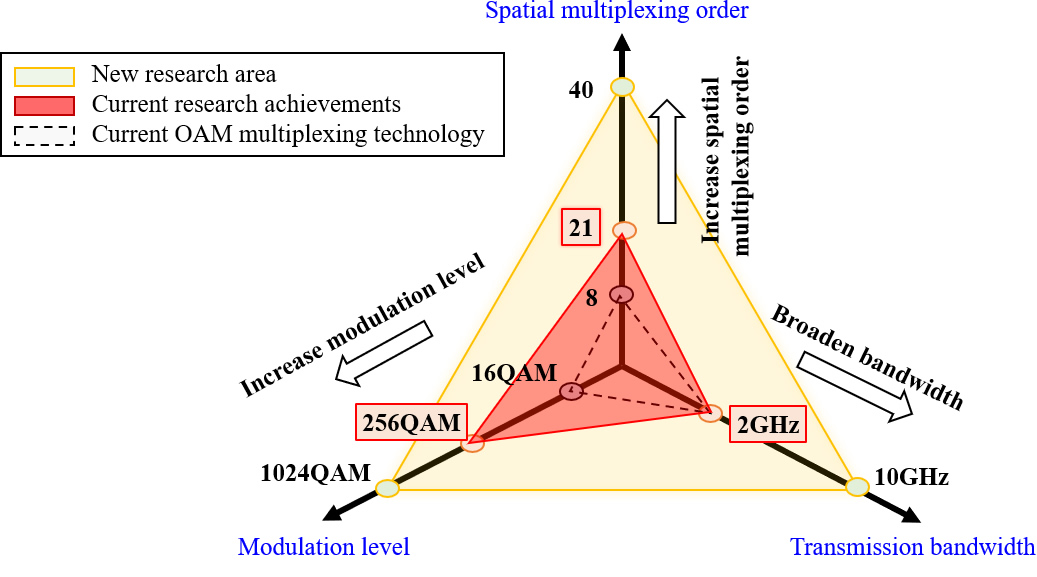
We have been conducting R&D with the goal of achieving terabit-class wireless transmissions in preparation for future wireless communications demand, which will continue to grow rapidly. There are three directions that can be taken to increase capacity in wireless communications: increase the spatial multiplexing order, broaden the transmission bandwidth, and increase the modulation level. Figure 1 illustrates these three directions as perpendicular axes. To put it simply, the larger the triangle shown in Figure 1, the larger the capacity of wireless communications. Our research into OAM multiplexing transmission technology takes the approach of increasing the spatial multiplexing order and broadening the transmission bandwidth.
Our aim with OAM multiplexing transmission technology is to help expand transmission capacities, one of the key research themes in the Innovative Optical and Wireless Network (IOWN) concept*1 that the NTT Group announced in 2019.
- *1The Innovative Optical and Wireless Network (IOWN) concept is a new ICT platform that the NTT Group announced in 2019. The concept comprises three main components: All-Photonics Network (APN) - the end-to-end deployment of photonics technology from networks to devices; Digital Twin Computing (DTC) - a computing paradigm that enables future forecasting and other functions by combining the real world and the digital world; and Cognitive Foundation (CF) - a platform that connects and controls all manner of things.
Research results
Successfully demonstrated the world's first 100 Gbps large-capacity wireless transmissions
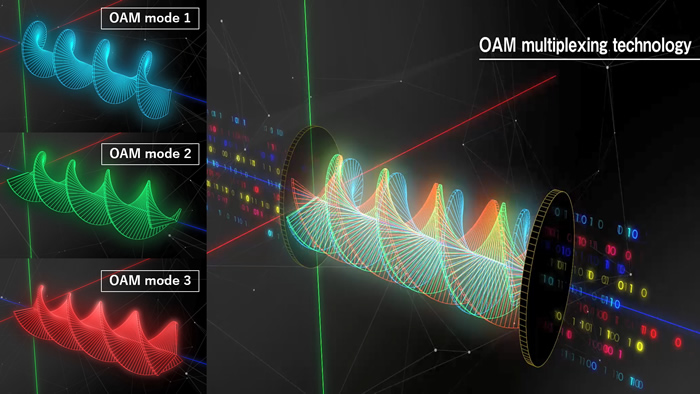
Orbital angular momentum (OAM) is a physical quantity that expresses a property of electromagnetic waves in electromagnetics and quantum mechanics. The property of electromagnetic waves expressed by OAM is the wave's phase rotation in the plane perpendicular to the wave's direction of propagation. The number of phase rotations is called the OAM mode. A key feature of electromagnetic waves differing in OAM modes is that they can be separated after being superimposed.
Wireless transmission technology exploiting this feature is called OAM multiplexing transmission technology. Figure 2 illustrates the principles behind OAM multiplexing transmission technology. Electromagnetic waves intrinsically travel as planes (plane waves), but as shown by Mode 1, Mode 2, and Mode 3 in Figure 2, twisted or helical electromagnetic waves can also be generated. Electromagnetic waves with different OAM modes, such as modes 1 through 3, each carrying a different signal can be multiplexed and transmitted and still allow for each signal to be separated at the receiving side.
OAM multiplexing transmission technology itself is not novel. Our research, however, has two distinct advantages over prior research. The first advantage is the use of analog circuitry to generate and separate OAM modes instead of relying on digital processing alone. Multiplexed transmission of signals using just digital processing leads to astronomical processing loads, prompting fears that signal processing will not keep up with transmission speeds. Using analog circuitry, we succeeded in achieving multiplexed transmissions with gigabit speeds.
The second advantage was a dramatic increase in the multiplexing order by combining OAM technology and MIMO technology*2, We described above that the receiving side can separate different signals carried on electromagnetic waves with different OAM modes that are multiplexed and transmitted together. What we devised, however, was OAM-MIMO multiplexing transmission technology, which combines widely used MIMO technology with OAM multiplexing transmission. Cleverly integrating MIMO technology allowed us to achieve simultaneous processing of multiple sets of OAM multiplexing transmissions while maintaining the OAM property that different OAM modes do not interfere with each other. Thus, OAM-MIMO multiplexing transmission technology has the potential for achieving multiplexed transmissions that far exceed the capacity of existing systems.
We prototyped a transceiver operating in the 28 GHz band capable of wireless transmissions using OAM-MIMO technology and conducted transmission experiments over a distance of 10 meters in the laboratory. These experiments confirmed that data signals could be carried by multiple OAM-multiplexed electromagnetic waves and that the wireless transmissions worked in accordance with their theoretical principles. We also developed signal processing technology capable of processing 11 data signals simultaneously each at a bit rate of 7.2 to 10.8 Gbps*3, thereby successfully achieving the world's first 100 Gbps large-capacity wireless transmissions.
- *2Multiple-Input Multiple-Output (MIMO) technology is a wireless signal processing technology that achieves higher communication quality by using multiple antennas at both the transmitter and the receiver. MIMO can greatly improve throughputs and communication distances without having to increase bandwidth or power consumption. For this reason, the technology has caught the interest of the wireless communications industry, which already uses MIMO in LTE and Wi-Fi networks.
- *3Bits per second (bps) is the unit of transmission capacity (in bits) per second. 1 Gbps represents the ability to transmit one gigabit of information per second, whereas 1 Tbps represents the transmission of one terabit (1000 gigabits) per second.
We have performed two further experiments after the 100 Gbps large-capacity wireless transmission experiment. The first of these, in February 2019, successfully achieved wireless transmissions at 20 Gbps over a distance of 100 meters in an outdoor environment, after having experimented with transmissions at a distance of 10 meters inside the laboratory. Prior research suggested that OAM multiplexing transmission technology could be used only for short distances, and the longest distance previously reported was 40 meters. We demonstrated that the technology could be used at the longer distance of 100 meters.
The major premise of this technology is to see just how large a pipe can be made for point-to-point connections. In the 3G and 4G era, a single base station covered kilometer-scale areas. For the 5G and 6G era, the idea is to make base stations even smaller and connect areas as small as 100 meters with high frequencies (such as 28 GHz). The maximum capacity of small 5G base stations is 20 Gbps. The only method of achieving this capacity at the present time is optical fiber connections. OAM multiplexing transmission technology, however, offers the possibility of connecting base stations wirelessly. In other words, this experiment, which successfully achieved wireless transmissions at 20 Gbps over a distance of 100 meters, indicates the feasibility of OAM multiplexing transmission technology in this application.
The second experiment, in June 2019, used OAM multiplexing transmissions combined with polarization multiplexing. This experiment achieved wireless communications at 200 Gbps over a distance of 10 meters inside the laboratory and successfully increased the spatial multiplexing order substantially from 11 to 21 signals. In theory, it was surmised that OAM multiplexing transmissions could be used simultaneously with polarization multiplexing. Our experiment demonstrated that the two schemes can indeed be combined. Electromagnetic waves have several degrees of multiplexing freedom, such as left-handed and right-handed helixes or horizontal and vertical polarization. Up to now, only one half of polarized waves were used, but we were able to increase the multiplexing order without interference by using both halves of polarized waves through meticulous antenna design.

Future prospects
Supporting everyone's dreams for 2030!
Mr. Sasaki: Looking ahead, we hope to broaden transmission bandwidths and further expand capacities by using even higher frequencies (over 100 GHz). To quote specific numbers, we would like to achieve wireless communications with large-capacity 1 Tbps-class transmissions with 40 multiplexed signals and a bandwidth of 10 GHz over distances in excess of 100 meters.
Moreover, our goal is not just unilateral announcements of groundbreaking research outcomes. Our aim is to become a center of excellence (i.e., a research base that is a global center for research, industry generation, and training in its specific field) in the field of large-capacity wireless communications technology, by, for example, holding workshops at international conferences. Developing practical technologies drives further world-class research outcomes, which goes a long way in becoming a center of excellence. I would be thrilled to work together with readers at business firms interesting in building on our implementation of this technology.
Mr. Yagi: To compete with the best players in the world in the field of large-capacity wireless transmissions, investigating only parts of the system will not do. You must plan from the inception of research to the demonstrations of your findings while accounting for the entire wireless transmission system. Pulling this off was extremely hard. Running experiments generating actual electromagnetic waves and demonstrating our groundbreaking world-first research outcomes is what I believe attracted attention from around the world. Although we faced many challenges, it feels rewarding because we raised our profile among prominent global research institutions and because we acquired greater knowledge and skills as researchers.
Dr. Lee: Although the technology is still in the research stage, practical 6G systems are expected to be launched around 2030, based on the past trajectories of the 4G and 5G markets. I believe large-capacity wireless communications technologies like ours will become very important at that time.
It will be exciting if wireless backhaul connections can be achieved for 6G small cells (small base stations). Increasing the capacity of wireless communications, in my opinion, will bring to life everyone's dreams of the future. We tackle R&D with the goal of supporting all the dreams envisioned for around 2030. We will endeavor to gain more recognition and make our technologies commercially viable. Thank you for your gracious support.
Editor's Note
The NTT Group announced the new ICT platform IOWN in 2019. IOWN positions increasing transmission capacities as a key research theme. Thus, it is no exaggeration to say that the OAM multiplexing transmission technology we looked at in this article is research that bears the future of the NTT Group.
The COVID-19 pandemic has brought with it a sense of fear and impending crisis, but it has also brought lessons. For one, it has made us keenly aware of how essential wireless communications technology is for our lives, particularly through remote work and distance learning. We have learned that when we lose opportunities to go outside or meet and talk with people in person, online conversations provide nourishment for the soul, despite the odd sound or video disruption. COVID-19 has taught us new ways of connecting with other people.
Provision of 5G is rolling out around the world, and the 6G era is drawing near. What kind of digital life will we be living in 2030, when large-capacity wireless transmissions and communications will likely be feasible? Advances in wireless communications technology provide humans with hopes and dreams. We hope to realize the future you envision.
Interview by Natsuo Toyama
on March 10, 2020