03/12/2021
CooBIT: New concept RPA tool improves operational efficiency beyond conventional RPANTT Access Network Service Systems Laboratories
RPA tools are essential software that boost operational efficiency by automating repetitive PC operator tasks, which reduces labor time and costs, and reduces input errors. WinActor® from NTT is a well-known RPA tool, but research on CooBIT hopes to apply RPA (Robot Process Automation) to tasks that conventional RPA can't cover and boost efficiency even higher. This tool collect and analyze operational logs, extract workflow elements that can be automate, and then automate the elements only. One of its major features is the use of technology that can perform automatic operation in tandem with the user during operation. We spoke with Mr. Nagatoshi Nawa, developer of CooBIT, who has been involved with Business Navigation Technology for many years at NTT Access Network Service Systems Laboratories, about the current technology and its features.
Interviewee

- Nagatoshi Nawa
- Senior Research Engineer,
Navigation Technology Group,
Access Network Operation Project,
NTT Access Network Service Systems Laboratories
* The above is the affiliation at the time of the interview.
CooBIT works beyond the reach of conventional RPA tools
"We’re aiming to gradually automate tasks that still rely on human hands with CooBIT."
RPA is an operational efficiency tool that can record operations such as repetitive terminal operator tasks to automatically create scenarios and execute scripts, which reduces work time, reduces input errors, and reduces costs. In recent years, the introduction of RPA has progressed in many business areas, and NTT Advanced Technology's WinActor® is one of the best-known products developed by NTT. Automation becomes possible when RPA is easier to use. It can extract similar task from a relatively standard procedure, like operation history, then summarize it, adjust the operation flow, and process summarized data in one day units. However, there are still many non-routine tasks that are not automated due to the low frequency of occurrence in the system, which are still human-dependent. We are carrying out research and development on CooBIT to see if RPA can be applied to these areas as well to further improve operational efficiency. Its name is based on the concept of a little helper elf (kobito in Japanese) working without us noticing. CooBIT aims to improve work efficiency in long tail areas, which are difficult to cover with conventional RPA, and solve what WinActor® couldn't deliver, in a different way.

The business operations is divided into three parts: a systematized part, an automated part without significant RPA restructuring, and a part where work is done manually without any automation. CooBIT started from a concept of breaking down manual irregular work and automating small parts (microtask automation). By increasing the number of automated microtasks and filling them in with CooBIT, we aim to improve workflow by automating the processing of irregular areas as shown in the figure below. It's not easy to automate everything, so in the end I think that there will be some parts that people work on, unlike in the ideal diagram, but conversely, this means we can determine which parts need to be done by an operator.
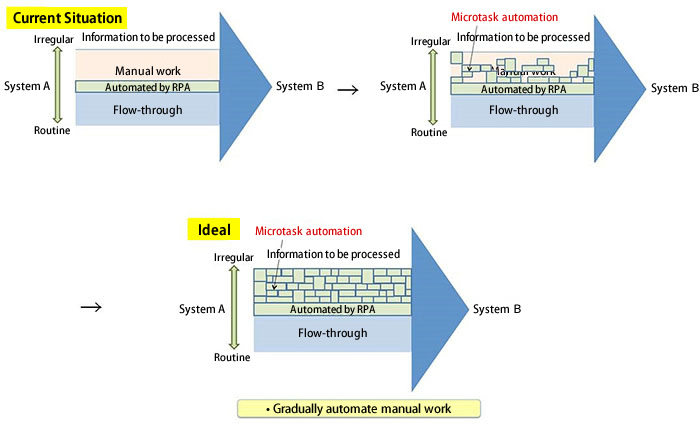
Operation isolation technology enables coordination between man and machine
"We can perform automatic processing in parallel while a person is operating the same computer."
The feature that makes CooBIT different from conventional RPA is its newly developed operation isolation technology. Typically, RPA performs automation on a per-task flow basis. You can only choose to automate the entire workflow or not. Meanwhile, CooBIT enables coordinated work between people and RPA, so it is now possible to automate only the parts of irregular workflow that don't require operators to make decisions. This means we can introduce it gradually, starting with places where there is a high need.
Operation isolation technology is what controls mouse and keyboard events sent to applications and achieves collaborative man-machine work. With existing technology, it's impossible for humans and RPA to operate simultaneously on a single computer. For example, if RPA starts operating while someone is using the PC, the mouse cursor might jump to a strange position, or if a person touches the PC while RPA is operating, the screen might transition without permission, so they get in each other’s way. So when operating, we either show a notification that RPA is running on the screen, or in some cases they installed an RPA-only terminal to ensure that people did not interfere with the RPA work. But with operation isolation technology, CooBIT allows humans and machines to work in an alternating manner. This means that RPA can process in parallel while the person operating the terminal. CooBIT constantly collects logs to observe human work and does not touch applications that are being operated manually. Conversely, while CooBIT is processing, applications that are being automatically operated are displayed semi-transparently and filtered so that mouse and keyboard operations do not reach them. People can't touch the translucent windows, and they don't interfere with each other, so they can even launch the same application and operate it separately.
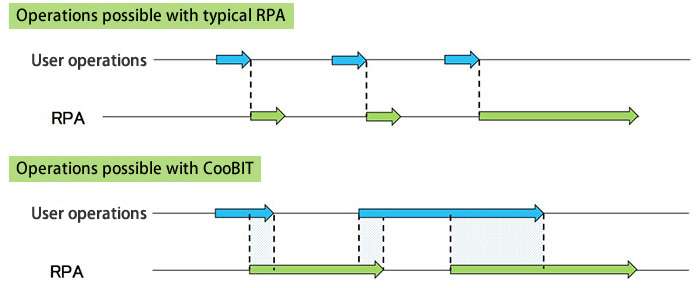
Operation isolation technology is divided into execution and conditional script, allowing for non-interfering operation when work overlaps. Because logs are constantly collected, CooBIT will automatically start RPA processing by execution script when pre-specified trigger conditions (conditions for starting automatic processing) are met, such as entering text in a certain frame, switching windows, or placing the cursor over a certain area. Conventional RPA collected logs, analyzed them, and wrote all execution scripts in advance. CooBIT does not automate the whole process, so it collects logs in the background and divides them into smaller tasks to extract workflow elements. Trigger conditions are specified by the system developer and are designed to execute the script when conditions are met, such as switching windows. Filters allow people to work manually during automatic operation. Right now, we've reached the stage where we can extract and log parts of the operational history that are possible to automate. For our next step, we are aiming for automatic program generation, so we would like to be able to create templates based on similar operations from the operation history, unlike conventional RPA. Right now we're analyzing the broken-down logs for a deeper investigation of the best way to collect logs.
We also want to provide support with script generation in the future. Conventional RPA tools such as WinActor® have a recording mode that observes user interaction and generates script templates. With this method, if branches or loops are needed, a person has to understand the application status and modify a script manually. However, CooBIT does not have the concept of mode. It observes one application from various angles and records a cohesive log. We have a tool that can identify the status of an application, so script is automatically generated based on the log, and wherever that's not possible will be written by people, and the script can be simplified. The observation tool we use is the result of operational process visualization technology.
Another good thing about CooBIT is that it doesn't slow down operations. While everything that happens is logged, investigation of causes is time-consuming, so this can operate when the system is less busy to reduce the load, like when people are not touching the PC. I think the advantages of CooBIT are that it doesn't slow down and that it doesn't interfere thanks to filtering.
Automating areas beyond the reach of conventional RPA has a lot of potential
"We are hoping to find our direction in 2019, and move beyond independent development and deliver results in 2020."
So far with our current technology, we have been able to extract workflow elements for automation. Next, I feel that we need to identify more about how to get the required logs. It is not enough to just record everything in a log. Rather than knowing that the cursor moved to a certain coordinate, it is more important to know things like the file name of a closed window. Info like that is much more important. So we are constantly improving log collection methods and content. Our goal is to figure out the technical aspects of CooBIT within this year. We would like to start independent development in 2020, but we may just share the results of the core technology.
RPA tools are effective for both operational improvement and reducing cost, making them very useful. CooBIT will be able to provide services as a new tool that can automate areas that were not previously explored by RPA. I think that once conventional RPA has become a part of operational efficiency and cost savings, it will be an opportunity for us, and we hope to become a force that gives more energy to the current RPA boom.
Editor's Note
The name CooBIT is meant to be like a helper elf working secretly inside a computer. It makes me smile when I imagine a little elf inside the computer, working hard.
RPA is being used by a variety of companies, and it's already boosting operational efficiency. But CooBIT is a tool that will pave the way for the next generation of RPA by enabling automation of tasks that are not possible with current tools. It's also a breakthrough for humans and machines to be able to work on a single computer at the same time. According to Mr. Nawa, "it's still more like a small part than a tool at this stage," but I'm looking forward to its future development.
Interview by Kanako Kaisho
on January 14, 2020
Reference
- Nagatoshi Nawa, Ikuko Takagi, Kouichi Yamada, Tsutomu Maruyama: "A proposal of scripts reuse technology for automatic operation," Proceedings of IEICE General Conference 2016 Information and Communication Management, 464, 2016-3-16