05/15/2024
Wireless underwater drone with transmission speed of 1 Mbit/s at horizontal distance of 300 meters in shallow watersUnderwater acoustic communication technologyNTT Network Innovation Laboratories
Overview
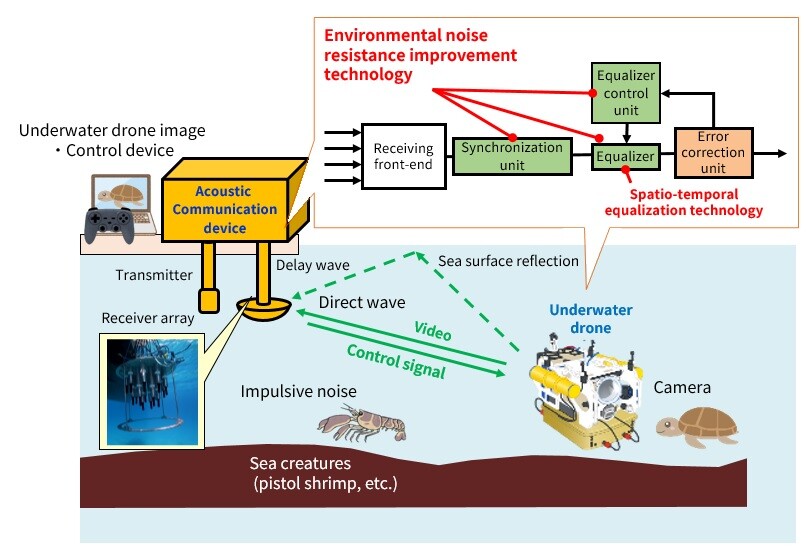
Spatio-temporal equalization technology that compensates for severe waveform distortion was used in acoustic communication, which is not affected by underwater turbidity. This enabled 1 Mbit/s transmission at a horizontal distance of 300 meters in a shallow area with a depth of about 30 meters. This made it possible to transmit video with the image quality of analog television and perform underwater drone radio control while checking underwater images in real time.
Background / Issues
The demand for underwater unmanned devices to carry out remote operation and surveillance has been increasing in areas such as submarine resource development, underwater construction, and fisheries. Since radio waves are easily attenuated and difficult to use for communication in the sea, visible light communication and acoustic communication are used instead. Although visible light communication has a wide frequency bandwidth and high-speed communication is possible, communication distance and speed are reduced due to the effects of turbidity and interference from sunlight. On the other hand, although acoustic communication is not affected by turbidity, it has narrow frequency width. Therefore, the communication speed of commercialized underwater acoustic devices is only about 10 kbit/s.
Advantages of this technology
- Spatio-temporal equalization technology eliminates the effects of delayed waves, which are 200,000 times slower than land-based mobile communications.
- Environmental noise resistance improvement technology suppresses the impact of impulsive noise generated by pistol shrimps and other underwater noise sources.
- Direct wave detection improvement technology reduces the Doppler shift effects of sea surface reflection waves caused by fluctuations in the sea surface.
Use Scenes
- Remote inspection with underwater unmanned devices in the development of underwater resources
- Remote operation of underwater unmanned devices in underwater constructions
- Inspection of fish finders and nets with underwater unmanned devices in fisheries
Explanatory chart
Department in charge
NTT Network Innovation Laboratories - Wave Propagation Laboratory