Update : 05/25/2021
Respond to Any Requests without Expecting Something in Return to Build a Trust Relationship with OthersSeishi Takamura
Senior Distinguished Researcher,
NTT Media Intelligence Laboratories
*The names of the laboratories mentioned in the article may have changed since the time of writing/interview.
Front-line Researchers
Being at the forefront of video-coding technology by taking a different approach
Please tell us about your current research.
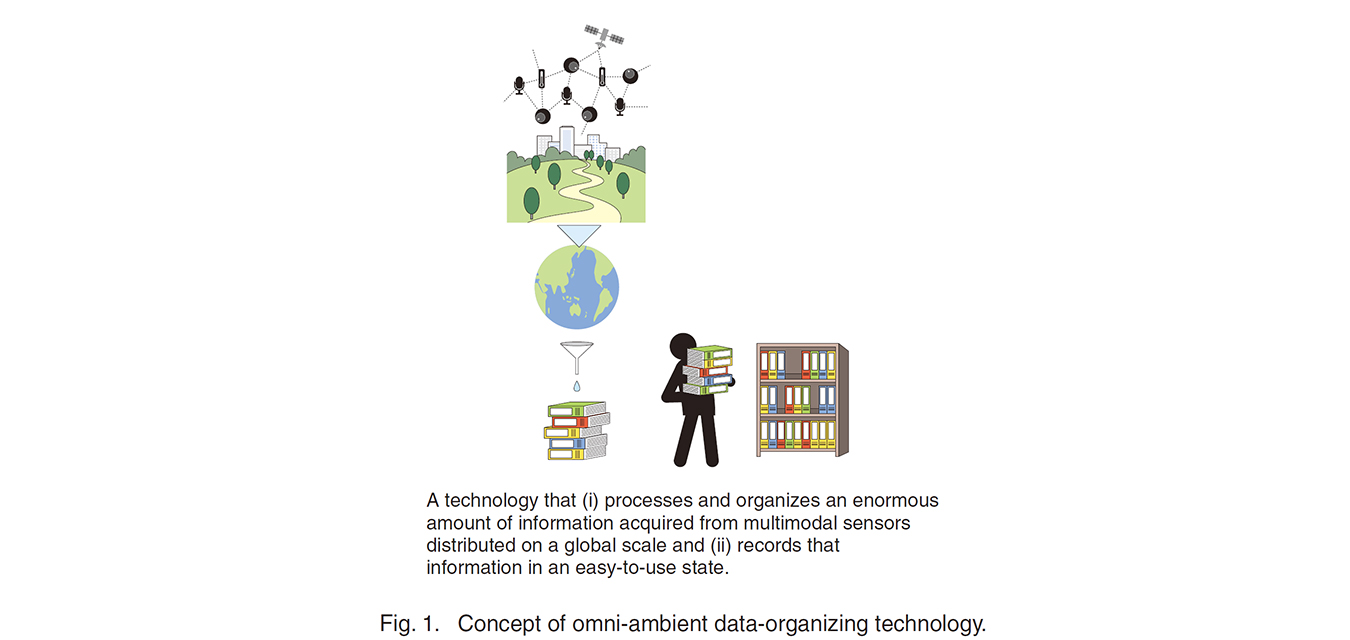
I’m currently researching omni-ambient data-organizing
technology (Fig. 1). This technology is a kind
of ultra-high-compression coding for fully using the
huge amount of globally generated data (i.e., omniambient
data), which is said to increase to 40 YB
(yottabytes; 1 YB = 1024 bytes) around 2040, without
having to discard any. For storing and distributing
such a huge amount of data, an approach based on
information triage (i.e., selection of information)—
which reduces the amount of data to fit into the available
storage capacity and transmission capacity—is
currently the mainstream. With this approach, lowpriority
data are discarded in accordance with the
rules of triage, but valuable data may be included in
the discarded data. In contrast, our omni-ambient
data-organizing technology stores and distributes a
huge amount of data without the need to discard any
by enhancing noise removal and information compression.
It enables compression by 100 to 1000
times while maintaining higher quality than the current
technology. If we use this technology to change
the focus of the data-distribution infrastructure from
data volume to data quality, we believe that we can
develop various applications and create new business.
In particular, omni-ambient data-organizing technology
focuses on video data, which account for more
than 80% of the total amount of data. Since the
amount of video data used is increasing annually,
organizing such data is a major advantage of this
technology.
It seems that this technology will make our lives more comfortable and enjoyable. Please tell us about the key components.
Omni-ambient data-organizing technology is composed
of many technical elements, such as pointcloud
processing and coding, ray-space processing
and coding, error-control coding, 360° video processing
and coding, and coding-oriented video generation.
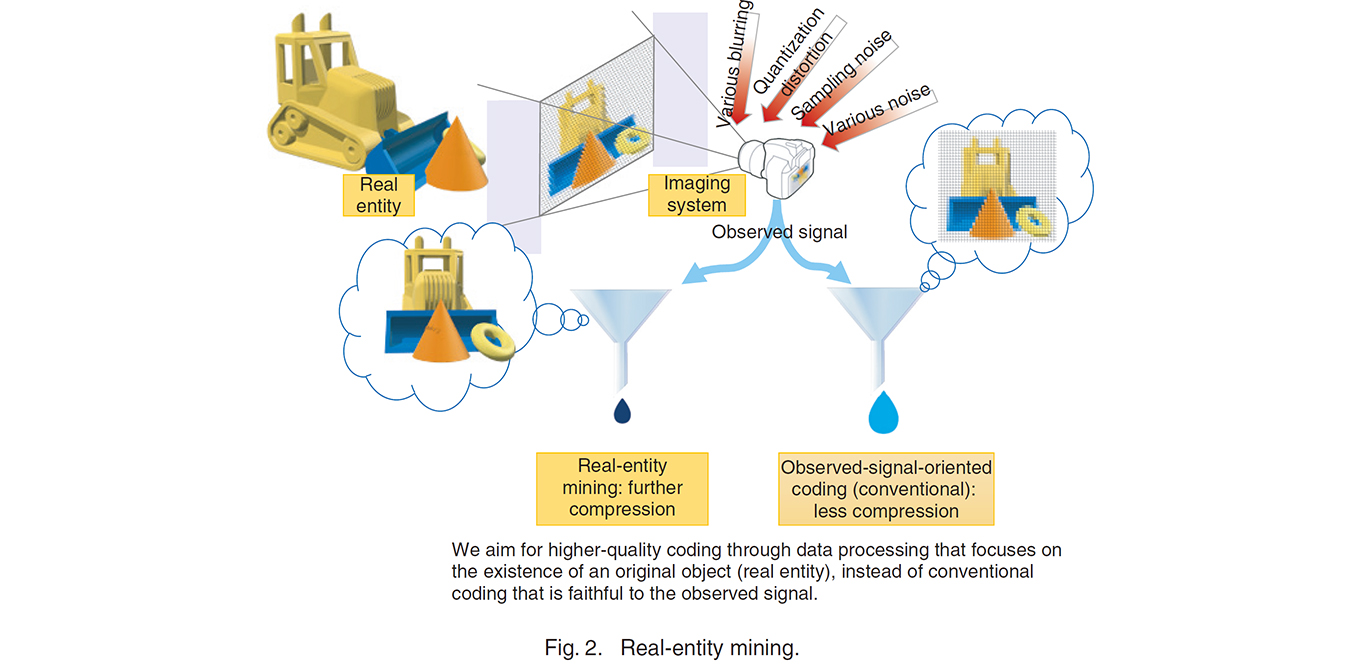
The key technology is real-entity mining (Fig. 2).
Conventional coding technology encodes the captured
video as is. However, real-entity mining
removes disturbances such as noise, distortion, blurring,
and flaws due to the lack of information from a
captured video, infers the original image of the
object, and encodes the inferred image. Since the
state and information of materials and objects are
extracted (i.e., inferred) as faithfully as possible to the
original ones then encoded, the quality of decoded
data exceeds that of the captured video, and an image
that approaches the real object is reproduced. Of
course, the video data can be further compressed
compared with conventional coding.
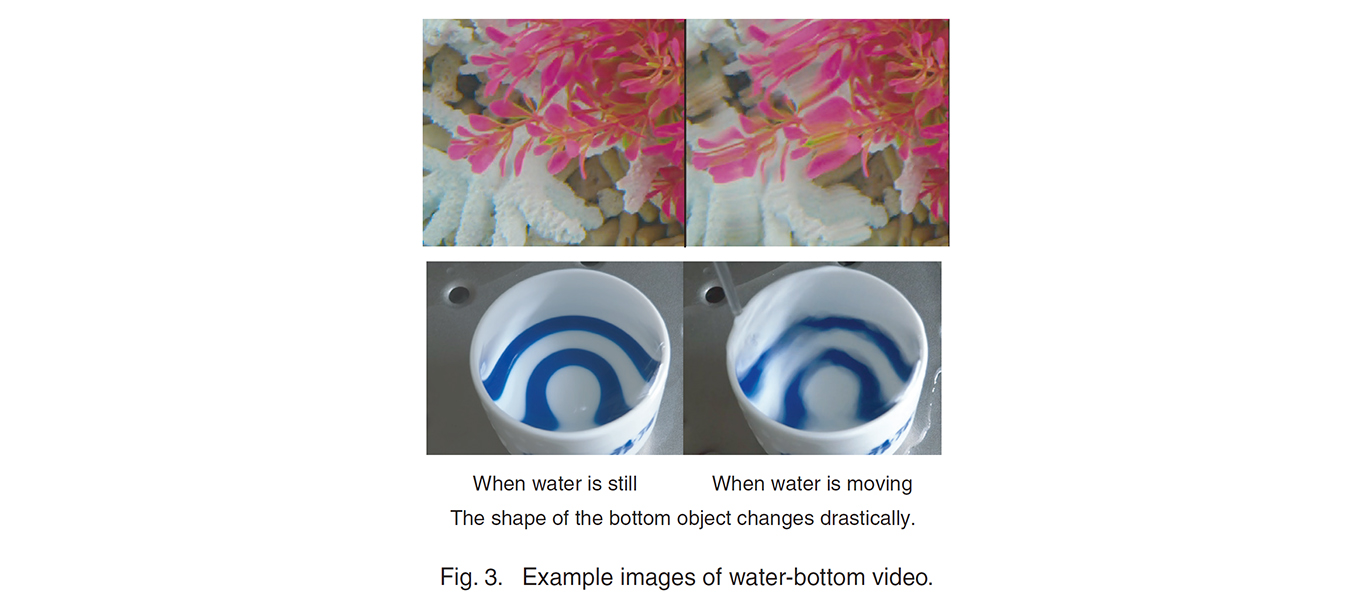
Although real-entity mining has several applications,
we developed water-bottom video coding,
which reproduces an image of the real entity of an
object seen through fluctuation of the water surface
(Fig. 3). A scene containing water is an important element
that gives the video a sense of presence, however,
it is particularly difficult to encode such a scene
by using conventional coding. Our water-bottom
video coding is highly regarded, for example, we
received an award at an international conference, and
we have also been invited to submit a paper for a
prestigious journal. To further evolve this technology
and compare its performance with that of the latest
version of international-standard reference software,
we are conducting an extremely time-consuming
simulation that takes four to five months for one
frame*1.
We are also working on point-cloud coding for
video. Point clouds are a collection of points in a
three-dimensional space that do not follow a grid pattern
(i.e., the points exist at irregular positions), and
they have a very high degree of freedom in terms of
data-point dimension, color in accordance with view
angle, surface normal, etc., and represented by a large
amount of data. Point-cloud coding is already an
internationally standardized coding technology.
However, taking a different approach, namely, lowering
the degrees of freedom to increase compression rate
and integrating information between multiple frames
of video, I’m wondering if it is possible to achieve the
contradictory goals of improving quality and increasing
compression ratio at the same time.
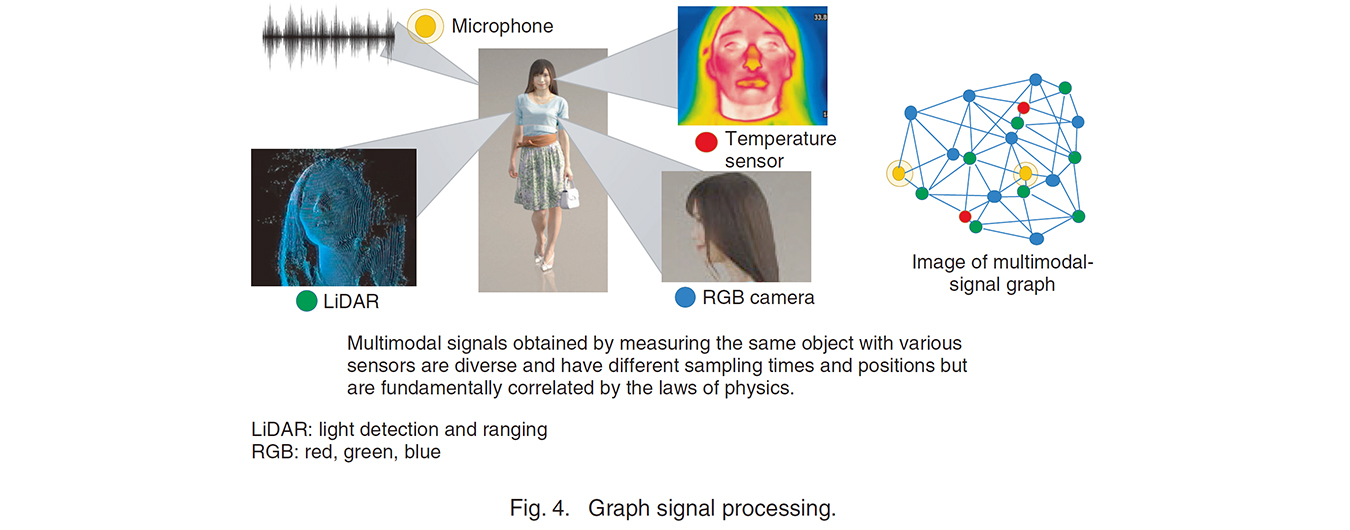
I’m also investigating multi-modal data compression.
The information carried by multimodal signals
acquired from an object to be observed from various
locations with various sensors does not contain the
temporal-sampling position or spatial-sampling position
in a grid pattern, and the dimensions (temperature,
coordinates, color, and sound pressure) also
differ. Since there is only one real object to be
observed, I think that there should be a correlation
between these pieces of information, and finding it
can be useful for reducing noise, predicting the
future, and compressing the amount of data to make
the data easier to use. However, a basic theory for
handling such signals in an integrated manner is currently
not available. Research on the framework
called graph signal processing*2 (Fig. 4) is being
actively conducted for a single-modal signal. The
challenge is to develop a framework for multimodal
signals.
The sensor, which is the source of data generation,
might have sensed too much data for the object to be
observed. Speaking of image sensors, I should mention
a technology called compressed sensing, which
makes it possible to obtain a fairly accurate image
signal by calculation processing in the subsequent
process even if some pixels are thinned out. I believe
that reducing the amount of data before processing
will become more important to reduce power consumption
as Internet-of-Things sensors become ubiquitous.
The key is to restore the signal in the later
calculation process, and the cleverer we are at doing
this calculation, the more accurate the observation
data will be.
I believe that there are two challenges: improving
the accuracy of signal restoration on the basis of a
new calculation principle and developing a cooperative
restoration between different modal signals in a
multimodal-sensor environment. We want to establish
these technologies as international standards
such as JPEG*3 and MPEG*4. However, we have a
long way to go and the hurdles are high, but that’s
why I find these challenges rewarding.
- *1Frame: The unit (i.e., one image) that composes a video. For example, Japanese broadcast video consists of 30 frames per second, and general movies consist of 24 frames per second.
- *2Graph signal processing: Signal processing using graph, which is one of the methods for expressing the structure of information with nodes (points) and edges (lines or edges). It is a relatively new signal-processing technology used to analyze signals from social networks and sensor networks appropriately and efficiently.
- *3JPEG: Standards for still image coding developed by the Joint Photographic Experts Group, a working group of International Organization for Standardization/International Electrotechnical Commission (ISO/IEC).
- *4MPEG: Standards for audio and video coding data developed by the Moving Picture Experts Group, a working group of ISO/IEC.
Besides great successes, there are medium and small success.
Can you tell us the lessons you have learned while working as a researcher?
For several years after joining NTT, I repeated trial
and error without worrying about time. That approach
is a privilege for young people, and I think it should
be taken if time permits. However, as I get older, I
realize that time is not infinite. In 2006, a former NTT
researcher, Professor Hiroshi Ishii of the Massachusetts
Institute of Technology, visited our Yokosuka
Research and Development Center and talked about
his research strategy. Although Professor Ishii told us
to plan our research by superposing our life span on a
research timeline, I didn’t immediately understand
what he was saying. Now that I’m busy and have
limited time for trial and error, I’m keenly aware that
time is a finite resource. Since I have to carefully
examine my research activities and act accordingly, I
began to narrow my research themes. Fortunately, the
direction of my selected themes did not deviate much
from my research activities of the past; in fact, I think
that lack of deviation is because I practiced trial and
error when I was younger. The water-bottom video
coding that I mentioned above is an example of how
that approach worked. To investigate this technology,
I had the rather twisted idea of “daring to increase the
number of frames by one” to compress a given video.
Then, after thinking from the standpoint of an encoder,
I pondered the question of what kind of frame
would be easier to encode, and I subsequently came
up with the idea of letting the encoder generate
(increase number of) frames and not stopping the
generation of frames after one time, but repeating it
many times.
It sounds easy to put it in words, but it took about
15 hours to generate a frame once, so it took a lot of
patience and effort to repeatedly generate frames.
Although this example is the story after narrowing
down the theme, I think I wouldn’t have come up with
the idea without my experience of repeating trial and
error.
I have hosted an international competition specializing
in water-bottom video coding for two years, and
our coding method surpassed the data produced by
the winner of the competition. When I submitted a
paper to an international conference, I had my first
experience in which all three reviewers gave the highest
evaluation and was commended as an “excellent
paper” of the conference. I’m particularly honored
that one of the authorities in this field, a respected
Australian professor said, “It’s an outstanding paper
about a technology that can be used not only for the
bottom of water but also for other purposes.”
I think it is normal in the research world to have
medium and small successes in addition to great successes.
The wider the world you can see, the less
attachments you will have, and the more challenges
you can take on.
What I mean by “success” as a researcher is success
when you obtain the results you originally intended
or it may be success if you get unexpected by products.
On the contrary, I think that “failure” means that
you cannot obtain results even if you spend a long
time trying, the difficult situation continues, or you
stop your research due to external pressure.
Could you tell us what you have cherished as a researcher?
My idea of researching with an attitude of enhancing
strengths rather than overcoming weaknesses that
I talked about in my previous interview has not
changed. Researchers aim to be “one of a kind,” and
if we are not prominent, we cannot survive, so this
attitude is important.
In addition, I now feel the importance of give and
give and not refusing requests as much as possible.
When planning projects or events, you must make a
request to various related parties. It is necessary to
build relationships on a regular basis so that people
will listen to your requests. For that reason, I try to
respond to requests in a sincere manner. You will be
able to understand the feelings of the person being
asked and be less likely to make unreasonable
requests. When building such relationships based on
trust, I think it is very important not to think about
getting something in return. If I receive a request
when I am busy, even though it will take up my time,
I try to respond to the request with an open mind.
On top of what I said above, I think that connecting
with others is everything. I have undertaken quite a
lot of external positions, including at academic societies,
such as IEEE (Institute of Electrical and Electronics
Engineers), and have developed relationships
through those positions. Working as the secretary of
an academic society led me to be invited by a professor
whom I invited to the conference as a visiting
researcher at his university.
Also, when talking to people outside the company,
I am often surprised to hear that people become unexpectedly
connected. Once I found out that the influential
figure who was grateful to me at an academic
society and a younger person in the company who
was helpful to me at work were father and son, and
the relationship with that younger person became
closer. Having said that, I am not perfect, so there are
some people who I don’t get on with very well; however,
I can learn by observing them. Many senior
researchers are still working even as they approach
70, and I want to be like them. At the same time, I
become inspired by communicating with people
younger than me.
The world is always looking toward“What to do next?”
You are nurturing not only research activities but also connections that transcend generations.
I think personal connections are a truly precious
asset. I also think it is important to covet achievements
from research activities. In other words, “Only
those who run after two hares will catch both hares.”
For example, if the deadline for a paper overlaps the
schedule of an event such as a get-together, most
people would prioritize the paper, but I think it is better
to start the paper after attending the event. You will
never catch two hares if you act like as the proverb
actually goes “If you run after two hares you will
catch neither.” Perhaps I came up with this idea
because I am surrounded by many talented people,
and I realize that their achievements cannot be measured
on the scale for ordinary people.
Any achievement will be a thing of the past from
the moment you achieve it. Making great inventions,
writing groundbreaking papers, and winning prestigious
awards are achievements to be proud of. However,
people are always looking at what you will do
next. Therefore, I always keep in mind that achievements
are things of the past to aim for the next target.
Please say a few words to our junior researchers.
You can choose a role model or a person you
admire and emulate them as you move forward; however,
since each person is different, it is quite natural
if you don’t end up like them. Although I was also
aiming to emulate a certain person, when I look at my
own footsteps, I see that I’m taking a different
approach and producing different results from those
of that person.
I think it’s OK to modify your goals from time to
time in a variety of situations and after different experiences;
in fact, you may obtain better results if you
don’t stick to them. However, I feel that if you keep
thinking about what you really want to achieve or
want to be, it will come true unexpectedly, so I think
it’s important to continue. You may be delighted
when that happens, but it’s important to think that it’s
a waypoint, not a goal. They say fortune is unpredictable
and changeable, right?
I also think that many young people these days are
too serious. In the past, there were more off-the-wall
people in the laboratory. Being too serious seems to
go against the present trend towards increasing diversity.
Even though you may cower when you get
caught up in the results and evaluations, I think it is
necessary to be a bit “off the wall” to overcome the
difficult situations that you will one day encounter in
your long research life. Research won’t necessarily
go better even if you think about it logically. If you
are looking for a “hit” among various possibilities, it
might be better to do research while thinking as flexibly
as possible. I want you to take it easy while making
sure to keep your attitude sincere.