Update : 05/25/2021
Photonic Gateway and Related Optical Access Technologies to Achieve the All-Photonics NetworkTomoaki Yoshida
Project Manager, Optical Access Systems Project, NTT Access Network Service Systems Laboratories.
Keynote Speeches/Workshop Lectures at Tsukuba Forum 2020 ONLINE
1. Background of optical access technologies
The communication services provided by optical
access can accommodate the traffic created by the
triple play of telephony, Internet access and video,
and mobile access and Internet of Things. It can be
said that these services are mainly intended to support
human cognition. It is expected that the bit price will
continue to decrease due to improvements in transmission
speed, so it will be possible to transfer more
information rapidly at low cost. Along with this, the
near future is expected to see new communication
applications such as cloud access, augmented reality/
virtual reality, autonomous driving, and e-sports,
which handle a large amount of information and
rapid-service responses beyond human cognition.
Therefore, optical access systems will be required to
offer lower latency while accommodating diversified
services more efficiently.
It has been pointed out that the labor population in
Japan will continue to decline, with a 40% decrease
expected by 2060 [1]. Access systems are distributed
to cover a wide area, so reducing operation overheads
including business trips and improving operation
efficiency are important goals. Considering the
impact of the COVID-19 pandemic, it has become
critical to develop an optical access system that minimizes
operation overheads.
2. Our vision of optical access systems
Current optical access systems were developed for
different types of optical access networks, e.g., for
business, mobile, and consumer use, and consist of
dedicated devices that can efficiently provide specific
communication services optimized for transmission
speeds at the appropriate release time and area expansion
for each use. However, we have to ensure not
only adequate transmission speeds but also multiple
attributes, such as low latency and efficient operation,
to reduce operation overheads and improve flexibility.
To satisfy these requirements, it will be important
for optical access systems to support the separation of
the basic transmission/transfer functions from
additional functions. Our aim is to build an optical
access system that standardizes and commonizes the
basic transmission/transfer functions as much as possible
(Fig. 1). This separation makes it possible to
launch a service quickly with the minimum number
of transmission/transfer functions; add or delete additional
functions in accordance with various service
requirements as they emerge. In addition, by reducing
the number of system types, operation tasks can be
standardized, and the maintenance process can be
made easier and safer. Configuring the transmission/
transfer functions in a simple manner makes it possible
for services to share the optical access infrastructure,
for example, optical fiber, and its devices.
We are developing an optical access system for
achieving high flexibility, low operation overheads,
and infrastructure sharing.

3. The All-Photonics Network and Photonic Gateway for achieving large-capacity, low-latency networks
The Innovative Optical and Wireless Network
(IOWN) announced by NTT in 2019 is aimed to promote
a smart society with the three elements of the
All-Photonics Network (APN), Digital Twin Computing
(DTC), and Cognitive Foundation (CF) [2].
The APN targets 100 times greater power efficiency,
125 times greater transfer capacity, and 200 times
lower end-to-end delay compared with the current
network. Specifically, by using optical device technologies
and wavelength division multiplexing, we
aim to reduce the transfer delay to the limit by providing
full-mesh connection of optical paths end-to-end.
We also aim to create a large-capacity network that is
protocol agnostic.
To provide end-to-end optical paths, the APN uses
the Photonic Exchange (EX) and Photonic Gateway
(GW), which together replace electrical-processing
functions such as exchange, multiplexing, and
switching with optical functions. The Photonic EX
can cross-connect large-capacity paths of 1-Pbit/s
class on the core in full-mesh manner. The Photonic
GW offers the functions of controlling wavelength
allocation to terminals and path aggregation on the
local full mesh (Fig. 2). This makes the best use of the
optical characteristics and enables low-latency transmission
that is independent of specific protocols. We
are researching and developing the Photonic GW.

4. Path aggregation and wavelength management by the Photonic GW
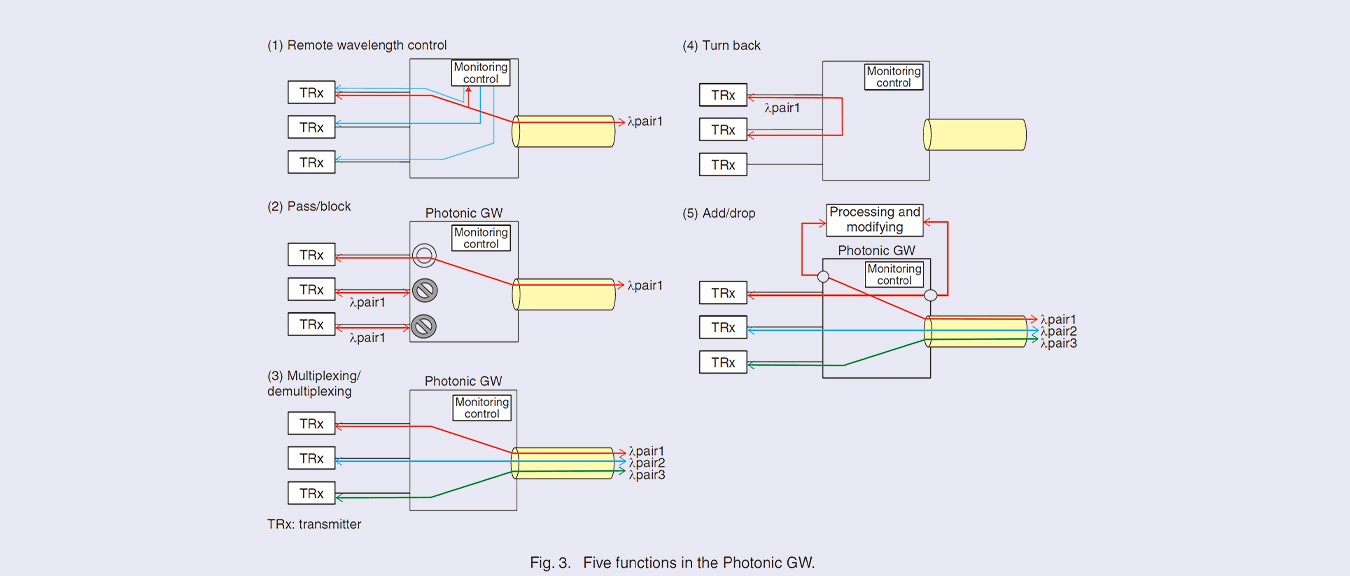
The Photonic GW consists of an optical node that
has optical direct-aggregating and add-drop functions
and a controller that performs automatic configuration.
Specifically, the optical node hosts the following
five functions, enabling low-latency path aggregation
while minimizing the use of electrical processing
(Fig. 3).
(1) Remote wavelength control: specifies and
controls which wavelength the transceiver of a
user terminal uses and monitors the wavelength
of the signal.
(2) Pass/block: passes signals when the path
opens and stops unnecessary signals.
(3) Multiplexing/demultiplexing: aggregates the
signals and transfers them to the core network
in accordance with the wavelength and distributes
the signals transferred from the core
network in accordance with wavelength.
(4) Turn back: enables turn back at the Photonic
GW, rather than at the Photonic EX, for traffic
that requires the shortest route.
(5) Add/drop: enables intermediate processing at
the Photonic GW site for optical repeating.
wavelength conversion, and electrical processing.
The remote wavelength control function uses the
auxiliary management and control channel (AMCC),
which is an in-channel control technology (Fig. 4).
The AMCC is one of the main functions of the Photonic
GW for wavelength management. It multiplexes
the wavelength control signals with the user signal
from the Photonic GW to the user terminal’s transceiver.
Because the frequency band of the control
signal is low, it does not interfere with the user signal.
In addition, wavelength control signal multiplexing is
achieved with an additional simple circuit. By using
the AMCC, it is possible to monitor and control
wavelengths independently of the protocol of the user
signal or the optical modulation format of the signal
and to standardize and commonize the control functions.

5. Example of protocol-free network by the APN
The conventional approach to the transmission of radio frequency (RF) signals, such as television broadcasting service and fixed, mobile wireless services, requires the development and optimization of each transmission specification such as the transmitter, receiver, and relaying system for each licensed frequency. This duplicates the installation, operation, and renewal costs. As a result, the total cost has become excessive. At NTT Access Network Service Systems Laboratories, we put into practice the radioover fiber technology, which converts RF signals into optical frequency modulation (FM) signals and transmits them over long distances, as the FM conversion scheme [3]. Using a wideband FM conversion scheme for the APN composed of the Photonic GW makes protocol-free transmission possible in which analog RF signals in various bands are converted and transmitted over long distances. Since this transmission is transparent to the signal format and modulation method of the RF signals, we can provide a protocol free transmission service that flexibly supports many formats such as digital signal formats, e.g., IP (Internet Protocol), Ethernet, or signal speed.
6. Separation of transmission/transfer functions from additional functions
We are also working on technology that allows
separation of the transmission/transfer functions
from additional functions. In particular, it is important
that the transmission/transfer functions of a
device are simply configured to make the additional
functions easy to add, change, and delete as software
and/or at a user terminal.
One of our activities to achieve separation is to promote
the open development of access systems at the
Open Networking Foundation. In cooperation with
AT&T, Deutsche Telekom, and Turkish Telekom, we
participated in the SEBA (SDN-Enabled Broadband
Access – SDN: software-defined networking) project
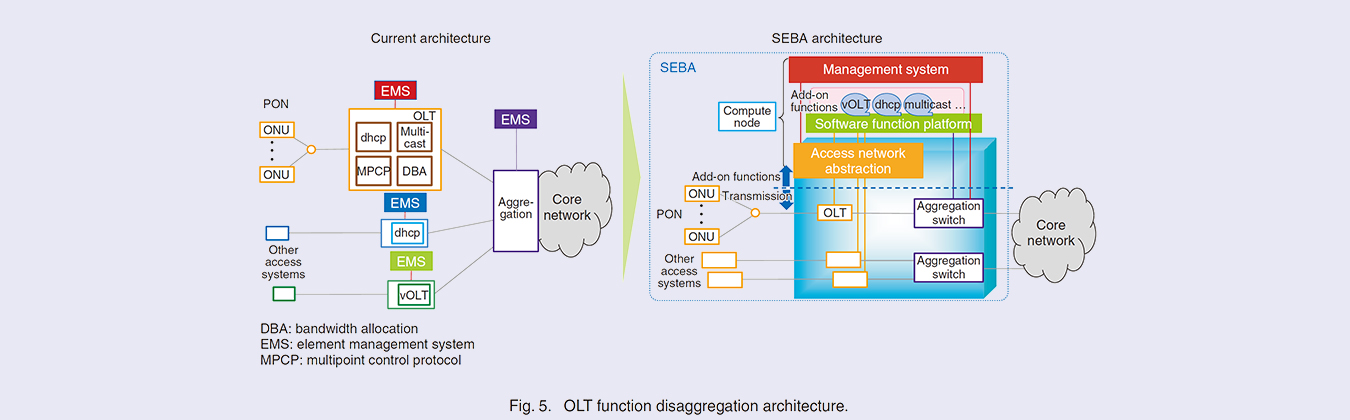
[4], formulated an optical line terminal function
disaggregation architecture, and developed it as open
source (Fig. 5).
To provide optical access services through various
methods, such as point-to-point and passive optical
network (PON), dedicated hardware and an optimized
element management system have to be used
for each type of access system. However, SEBA
makes it possible for access systems to implement
functions and control schemes on a common software
basis and to unify the management system. Since
SEBA is open source, anyone can refer to it and
freely implement and easily add or delete functions
according to the operator’s requirements.
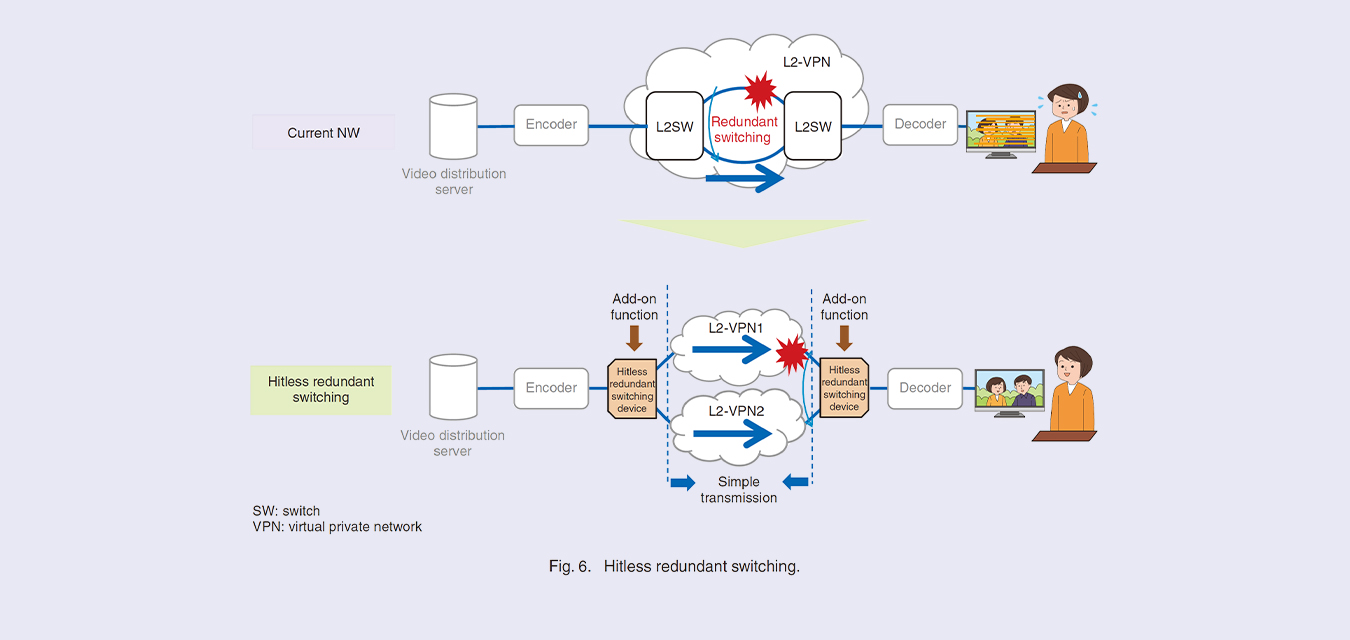
As another example of separating the transfer functions
from additional functions, we developed an
additional function for hitless redundant switching at
the edge device when a route failure occurs (Fig. 6).
Conventionally, when a route failure occurs, a service
experiences momentary interruption due to redundant
switching, and some packets are discarded. With
our technology for separating the transmission/transfer
functions from additional functions, hitless redundant
switching devices are installed at both ends of
the network, signals are transmitted along both
routes, and the signal is selected on the receiving side.
This makes it possible to switch routes without interruption.
This technology has been in use for a long
time, and the unique feature of this technology is that
the simple L2 (layer 2) transfer function is used as a
network service, and the function for achieving hitless
redundant switching is located at the edge device,
not the network. Therefore, it is possible to quickly
provide hitless redundant switching to those users
who need it. Users simply add the hitless redundantswitching
device, and no change to the network is
needed.
7. Future plans
We will continue our research and development activities on optical access system technology to achieve high bandwidth and low latency networks. We will also promote our technology for separating the basic transmission/transfer functions from additional functions to achieve high flexibility and low operation overheads. These technologies will be strongly leveraged in achieving IOWN and specifically the APN.
■References
- [1]N. Horie, “40% Decrease in Labor Force due to Declining Birthrate and Aging Population,” Mizuho Insight, 2017 (in Japanese).
- [2]A. Itoh, “Initiatives Concerning All-Photonics-Network-related Technologies Based on IOWN,” NTT Technical Review, Vol. 18, No. 5, pp. 11–13, 2020.
- [3]T. Shitaba, T. Yoshida, and J. Terada, “Optical Video Transmission Technique using FM Conversion,” IEICE Tech. Rep., Vol. 119, No. 323, CS2019-84, pp. 97–101, 2019.
- [4]ONF