Update : 05/25/2021
R&D of Innovative Optical Transmission Line TechnologiesKazunori Katayama
Project Manager, Access Media Project, NTT Access Network Service Systems Laboratories.
Keynote Speeches/Workshop Lectures at Tsukuba Forum 2020 ONLINE
1. Promotion of efficient and sophisticated optical access networks
NTT Access Network Service Systems Laboratories
has been leading the research and development
(R&D) of optical transmission line technologies from
fundamental research to practical application development
toward sustainable development of telecommunication
network services by economizing and
upgrading optical access networks. Figure 1 shows
the technologies that make up an optical access network.
An optical access network is composed of
many products and technologies such as optical fiber
cables, optical connectors, and overhead structures.
We developed and installed various products and
technologies to deploy efficient and sophisticated
optical transmission line facilities, e.g., for simplified
installation, and intelligent maintenance technologies.
This article introduces our recent developments
in optical transmission line technologies.
High-density and high-count optical fiber cables
have been receiving increasing attention for installing
a large number of optical fibers in a restricted space.
NTT has proposed and developed an extremely highdensity
optical fiber cable by using the rollable ribbon
and slot-less optical cable structure. By optimizing
this cable structure, we developed the world’s
highest-density optical fiber cable, which is equipped
with 2000 fibers with the same cable diameter as a
conventional 1000-fiber cable. We have also developed
a thin, high-density, high-strength (HS) optical
fiber cable that is resistant to damage by wildlife. By
applying and modifying the slot-less optical cable
structure, we developed a smaller-diameter and
lighter-weight cable structure with improved workability,
which will become the mainstream for optical
fiber cables in all network equipment.
The demand for optical fiber connection in datacenters
has increased. Optical wiring conditions under
raised floors is often unknown, which induces cable
congestion and degrades air conditioning efficiency.
NTT developed an estimation method of cable-stacking
height by considering the cable type and number
of laying cables and established an optical wiring
technology to improve air conditioning efficiency
and reduce power consumption.
Next, we describe our efforts in maintenance technology
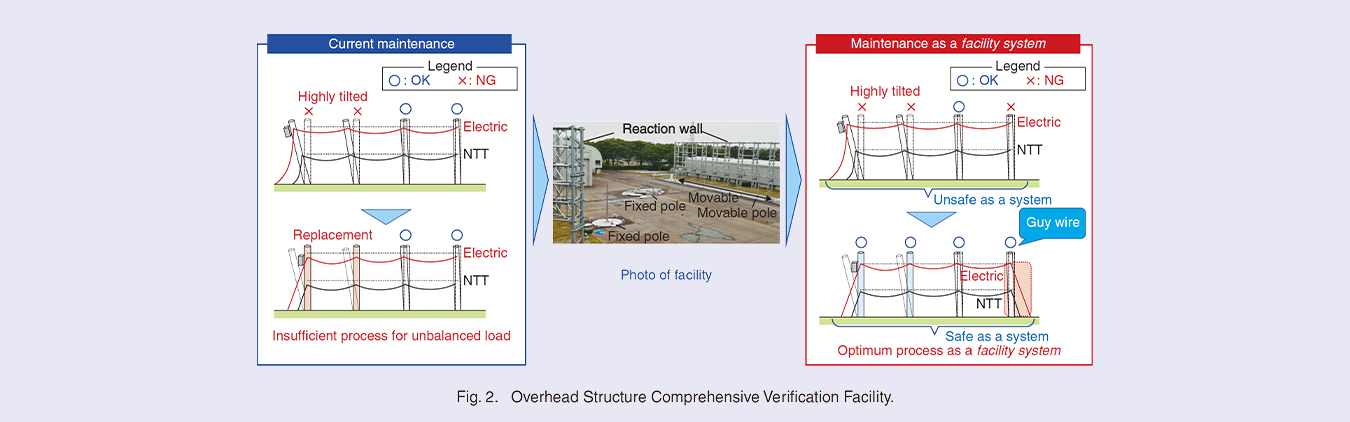
for overhead structures. Figure 2 shows the
Overhead Structure Comprehensive Verification
Facility. It has been clarified that unbalanced loads
must be considered during the safety evaluation of
utility poles, cables, and other components supporting
overhead structures, which are considered to be
one facility system of multiple utility poles connected
by various cables. However, as shown on the left in
Fig. 2, the conventional maintenance procedure of
utility poles and other components do not provide a
solution to this unbalanced load. NTT has constructed
the Overhead Structure Comprehensive Verification
Facility to verify the overhead structure as a
facility system. At this facility, which simulates an
actual environment, the fundamental cause of
unbalanced loads are clarified and optimal measures
are devised and implemented, as shown on the right
of Fig. 2, achieving long-term safe use of the entire
system. This approach is also very effective as a
countermeasure against severe natural disasters.
The above are our latest developments in optical
transmission line technologies for economization and
upgrading optical access networks. NTT Access Network
Service Systems Laboratories will continue to
develop safe and secure optical transmission line
technologies to support the sustainable development
of telecommunication network services.


2. IOWN and future optical access networks
In 2019, NTT proposed the concept of the Innovative
Optical and Wireless Network (IOWN) to overcome
the processing limit and power-consumption
increase in the smart society and the delay limit of the
Internet. IOWN consists of the All-Photonics Network
(APN), which uses photonics technology from
networks to equipment to achieve large capacity, low
latency, and low power consumption; Digital Twin
Computing, which digitizes real space and creates
new value in cyberspace; and the Cognitive Foundation,
which optimally operates information and communication
technology resources that comprise the
above two components. NTT Access Network Service
Systems Laboratories is conducting R&D to
establish innovative optical transmission line technologies
needed to implement the APN.
Figure 3 shows the future of the optical transmission
line facilities we have proposed. Optical transmission
line facilities are premised on long-term use,
and it is necessary to ensure technical neutrality and
openness for passive optical facilities. It is also necessary
to respond to the diversification and advancement
of services in a smart society and the development
of high-speed wireless communications such as
fifth/sixth generation mobile communications systems
(5G/6G). To construct optical transmission line
facilities that support such next-generation communications
services, we established the following three
directions and are promoting R&D on the basis of
them: “Overcoming the limitations of existing optical
fibers,” “Providing flexible fiber resources without
restriction of existing architecture,” and “Expanding
the optical service area to new destinations.”
With regard to “Overcoming the limitations of
existing optical fibers,” there is concern that demand
for transmission capacity will increase exponentially
every year and that by the late 2020s the required
transmission-system capacity will exceed the transmission
capacity limit of existing single-mode fibers
(SMFs), which is considered as approximately 100
Tbit/s. Space division multiplexing (SDM) technology,
which provides the space domain as a new multiaxis
in addition to time and wavelength domains, has
recently attracted interest worldwide. SDM transmission
requires SDM fibers with multiple spatial channels
in a fiber. An overview of SDM fibers is shown
in Fig. 4. SDM fibers are roughly classified into
multi-core with multiple core regions, multi-mode
with multiple spatial channels in one core, and multimode
multi-core, which achieves ultrahigh density
SDM. NTT has recently proposed an SDM fiber
cable that is compatible with existing optical fiber
standards and optical equipment and is actively
studying methods of accelerating the practical
deployment of multi-core fiber lines. We are also
conducting R&D on ultrahigh-density SDM optical
fiber cable technology and its related technologies to
further increase density and capacity.
Figure 5 shows an optical fiber cable with ultrahigh
density SDM fibers. In such SDM fibers, optical
signals are generally transmitted while being intermingled
between spatial channels and demodulated
by signal processing at the receivers. It is known that
the transmission-delay difference between spatial
channels deteriorates transmission characteristics.
We have demonstrated for the first time that the transmission
characteristics of an SDM fiber cable can be
controlled by the simultaneous optimization of the
optical fiber and optical cable structure by minimizing
the transmission-delay difference through the
structural design of SDM fibers and by controlling
their bending and twisting in an optical cable.
With regard to “Providing flexible fiber resources
without restriction of existing architecture,” considering
the future deployment of 5G/6G base stations, the
conventional provision of fiber resources based on
household distribution will not be sufficient, and a
network configuration that can flexibly provide the
necessary amount of fiber resources will be required.
It is also important to ensure network reliability by
assuming services that do not allow service interruption
such as self-driving cars. We have started R&D
on an access network design with concatenated loop
topology (Fig. 6). This network configuration is
equipped with a new remotely operated optical fiber
switching node that can switch the optical path
remotely at the fiber level. By overlaying this network
configuration on the existing access network, it
is possible to effectively use the fiber without services
and to improve reliability by making the network
redundant.
Regarding “Expanding the optical service area to
new destinations,” 5G base stations will be deployed
not only in urban areas but also in rural areas with
industrial potential. However, there are rural areas
where optical equipment is not provided; thus, a
method for economically and efficiently installing
optical equipment will be essential. In urban and suburban
areas, the expansion of base stations is expected
to increase, and in non-residential areas, the
demand for optical services is expected to expand.
However, the cost burden of installing new optical
equipment is particularly high in areas where optical
equipment is not yet available. For this reason, we
have started R&D on an economical and efficient
method of installing optical fiber cables in areas that
were not previously considered.



3. Future perspectives
NTT Access Network Service Systems Laboratories
is committed to continuous R&D and establishment
of safe and secure optical transmission line
technologies to contribute to the sustainable development
of the information and communications industry.
In particular, it is necessary to consider natural
disasters, which have become increasingly severe. To
actualize IOWN, we are promoting innovative R&D
of optical transmission line facilities that can be connected
anytime and anywhere as well as smart facility operation technologies.