Update : 05/25/2021
NTT Group’s Initiatives for a Post-COVID-19 SocietyJun Sawada
president and chief executive officer of NTT
Keynote Speeches/Workshop Lectures at Tsukuba Forum 2020 ONLINE
1. My involvement with Tsukuba R&D Center
To begin with, I would like to talk about the special
place I have in my heart for Tsukuba R&D Center. I
first entered the company in 1978 (then, the Nippon
Telegraph and Telephone Public Corporation) as an
engineer assigned to the telephone line division (now
the access division). In my first assignment, I made
many visits to what is now the Joso City area near the
Tsukuba R&D Center. Then, in my third year, I was
assigned to what was then the technology section and
put in charge of structures. It was at this time that I
undertook the research and development of construction
technology at the Technology Construction Center
(now, NTT Access Network Service Systems
Laboratories). At this research laboratory, the soil
experimental building had facilities for driving a
trailer with a 20-ton load at speeds of up to 60 km/h
that could be used to conduct experiments on road
loads and measuring their effects on manholes, conduits,
and cables. Actually, this research had already
been completed, but the last person to drive that
trailer was me. As the person in charge of structures,
I also experienced first-hand the hard work performed
by those involved in disaster recovery.
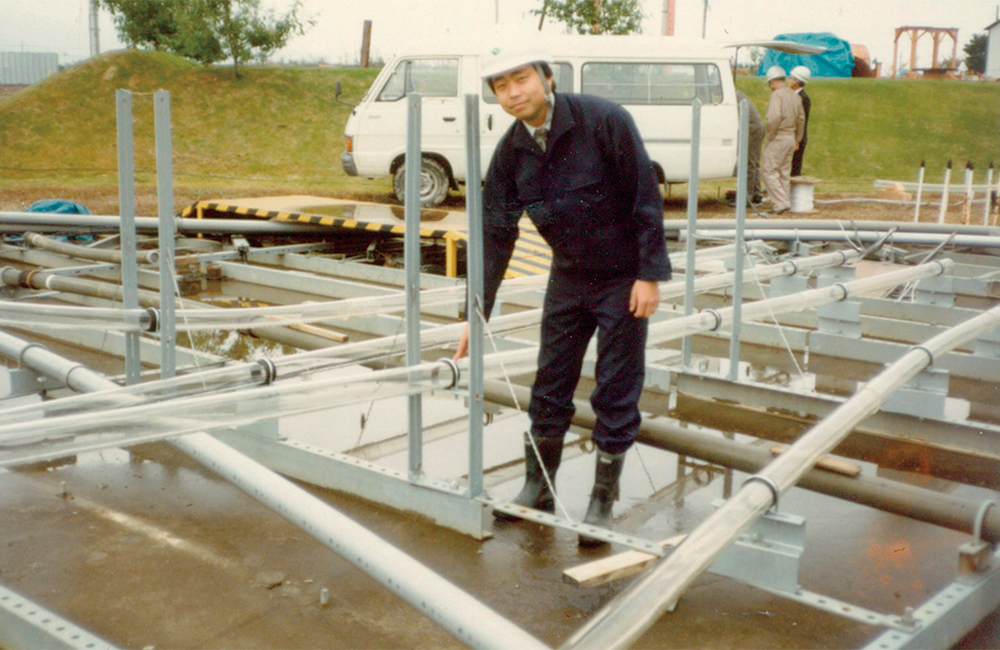
This photo that I carry around with me relates to
experiments conducted at that time on freeze-proof
polyethylene (PE) pipes with which problems had
been occurring during cable laying (Photo 1). It
shows how we would pull transparent PE pipes on
land to emulate pulling within a conduit. These
experiments examined the correlation between strain
and the behavior of cables and PE pipe, tensile
strength, number of cables, etc. I came to understand
that conducting a series of such practical experiments
enables us to operate our telecommunication facilities
in a stable manner within a severe natural environment
from several tens of degrees below to
several tens of degrees above freezing. In the second
half of this article, I will talk about the Innovative
Optical and Wireless Network (IOWN), but let me
say that even amazing technologies will not be
accepted by society without such steady and dedicated
research.
2. Global spread of COVID-19
The novel coronavirus (COVID-19) continues to
spread. While people are still practicing social distancing
and signs of a slight economic recovery are
appearing, the number of infected individuals is
growing again. In Japan, COVID-19 is classified as a
designated infectious disease, so an individual that
tests positive is basically quarantined in a hospital,
which increases the load on the medical care system.
While the results of analysis have shown that an
infected individual is most likely to spread the virus
during the first week or so after the onset of symptoms,
even an asymptomatic person can infect others.
The number of new infections in Japan is lower than
that in the United States and major European countries
by about two orders of magnitude. While this
reason is not yet fully understood, further research
into explaining this state of affairs may uncover elements
other than a vaccine or method of treatment
that can change the effects of such an infectious disease.
The NTT Group is not involved in this research,
but I feel that steady research efforts must be made in
making changes in society.
The total number of infected individuals in the NTT
Group is about 2400 as of October 29, 2020, which
breaks down to about 400 in Japan and 2000 abroad.
Unfortunately, 13 individuals have passed away, 2 in
Japan and 11 abroad. I feel that we must be concerned
about COVID-19 while dealing with it in an appropriate
manner.
Amid this increasing number of infected individuals
due to COVID-19, what sort of impact is this
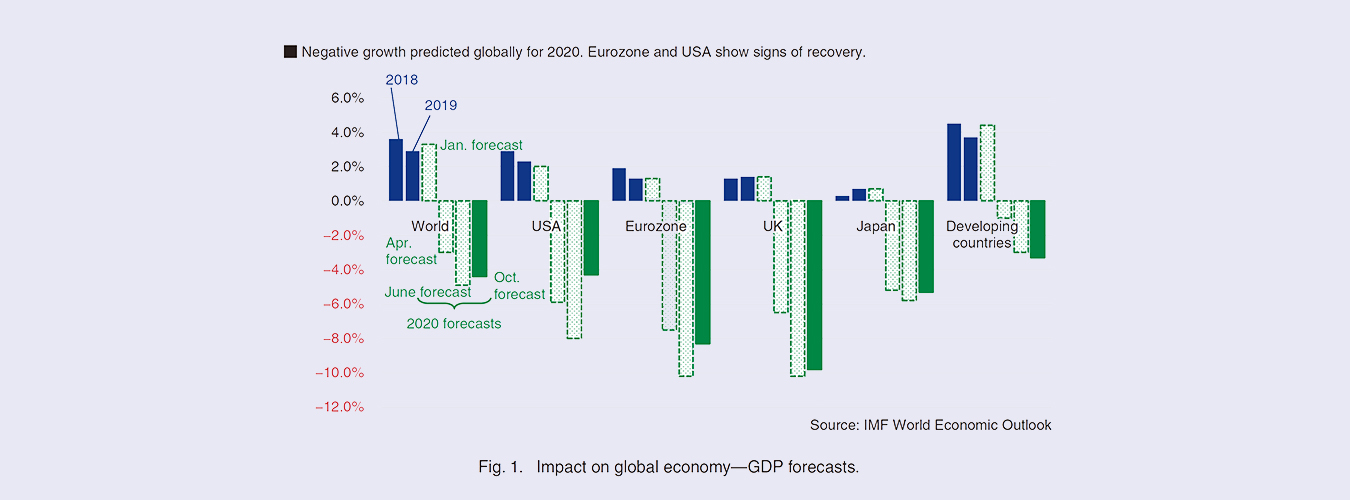
pandemic having on the global economy? The gross
domestic product (GDP) forecasts by country
announced by the International Monetary Fund
(IMF) show a somewhat slow recovery in the UK and
Japan and signs of a recovery in the Eurozone and the
United States with only China showing positive
growth. The world on the whole shows signs of a
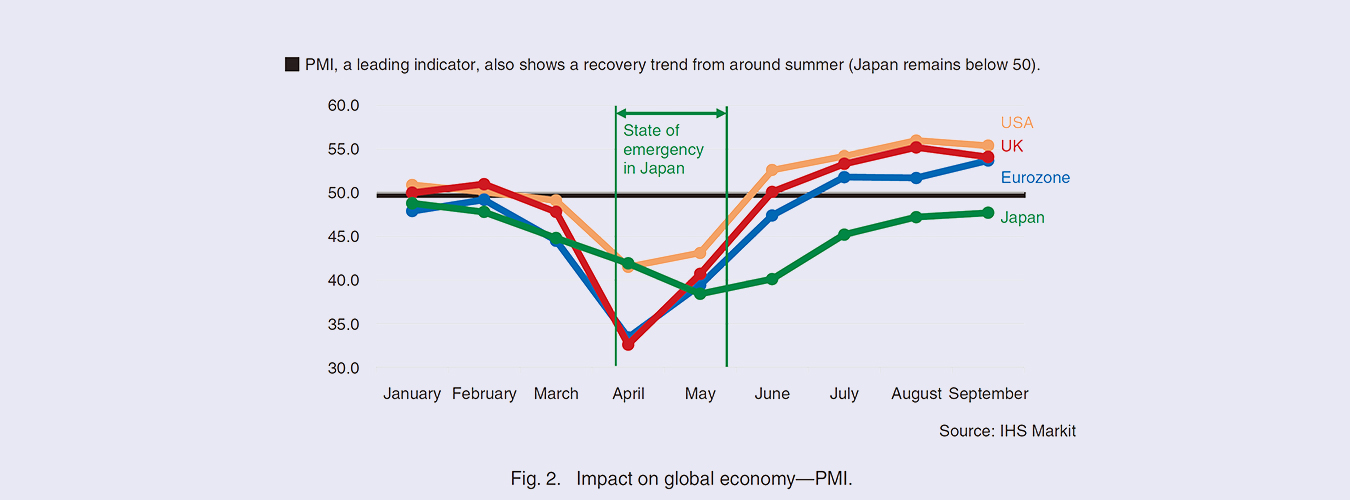
recovery from negative growth (Fig. 1). At the same
time, the purchasing managers’ index (PMI) shows
that economic conditions in Japan fell during the
country’s state of emergency (in early 2020) with a
similar drop in other countries, and that developed
countries other than Japan have moved into the positive
side as of September 2020. These indices indicate
that only Japan has yet to make an economic
recovery, which may reflect the cautious traits of
Japanese people (Fig. 2).
3. Creating a remote world
Next, I would like to take a look at trends for a post COVID-19 society. One trend involves revitalizing the economy while achieving social distancing. I believe that achieving both simultaneously in a paraconsistent manner will lead to the creation of a remote world (dispersed society). In such an environment, could not the NTT Group offer some help from the perspective of information and communications technology (ICT)? This is one issue that we are now taking up.
4. Rise of new glocalism
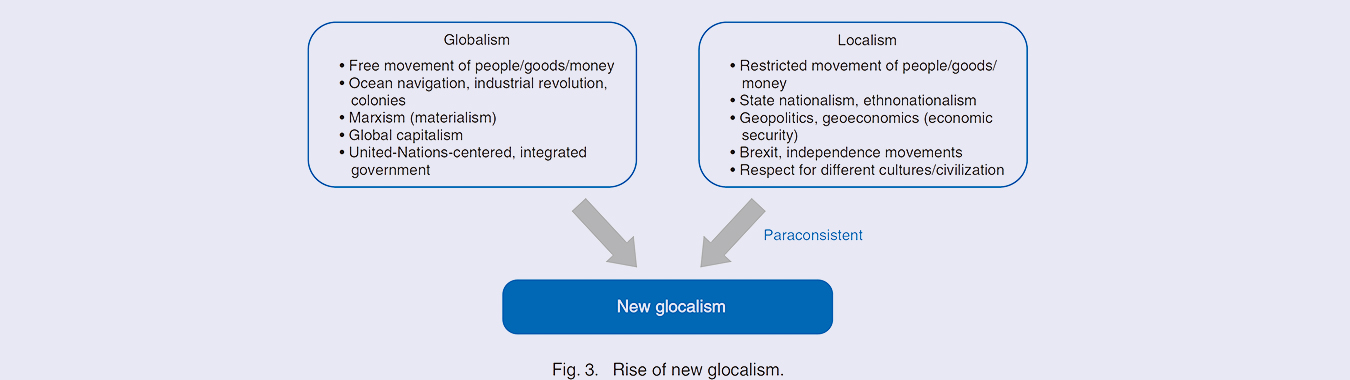
Up to now, we have come to consider the global
free movement of people, goods, and money as natural.
However, the situation is now changing. People
can no longer move about freely, and we cannot move
goods freely. This signals a strong emergence of
localism (Fig. 3). Culture has been locally rooted, so
it’s a concept contradictory to globalism. From here
on, though, I think that both localism and globalism
will be simultaneously achieved to create a world of
“new glocalism.” Even in Japan, the expression “economic
security” is beginning to be used, and such a
trend will have a significant impact on the world of ICT.
5. Changes in the environment surrounding the telecommunications market
I have mentioned that creating a remote world and
rise of new glocalism are two key trends for a post
COVID-19 society, but I would also like to point out
two important changes that are now taking place in
the telecommunications market against the background
of those trends.
One is the launching of fifth-generation mobile
communications system (5G) services and technological
development toward the sixth-generation
mobile communications system (6G). With 6G, I
believe that the barrier between fixed and mobile
communications will become smaller or disappear
altogether, so it will be necessary to provide integrated
and seamless services.
The other change is the coming of severe market
competition beyond the telecommunications layer,
that is, a change in competing players. For example,
over-the-top providers will cover vertically integrated
services from the application layer to the infrastructure
layer, and terminal manufacturers will provide
communication services using an embedded subscriber
identity module (eSIM)* as a trigger. With this
change in structure, borderless market competition
will become all the more severe.
- *eSIM: An SIM card integrated in a mobile terminal.
6. Road to IOWN (future directions)
In 2019, we announced the concept of IOWN as a
new information and communication infrastructure.
The road to IOWN will be driven along four key
directions: development/provision of new services
that consider the remote world, concentration of
resources and promotion of digital transformation
(DX), implementation of research and development
on a global scale, and enhancement of new businesses.
In this article, I would like to discuss these future
directions.
6.1 Development and provision of O-RAN + vRAN
In the development/provision of new services that
consider the remote world, we announced a business
and investment tie-up with NEC Corporation in June
2020 for joint research and development. I will introduce
the directions that we envision this tie-up will
take.
The first direction is the acceleration of the Open
Radio Access Network (O-RAN). This is a model
advocated by NTT DOCOMO to accelerate multivendor
interoperability in partnership with NEC. It
promotes a transition from the existing vertical integration
model that is highly dependent on specific
vendors to an O-RAN/vRAN (virtualized RAN)
model to support white-box equipment and generic
software in a multi-vendor environment. Therefore,
both NTT and NEC plan to drive the spread of open
architecture (Fig. 4). The next direction is collaboration
on manufacturing devices and equipment. Our
goal is joint development of a digital signal processor
having both the world’s highest level of performance
and low power consumption as well as informationcommunication
equipment that will embed the processor.
In the long run, we would like to connect these
initiatives to our efforts in making IOWN a reality.

6.2 Development of mobile/fixed seamless services
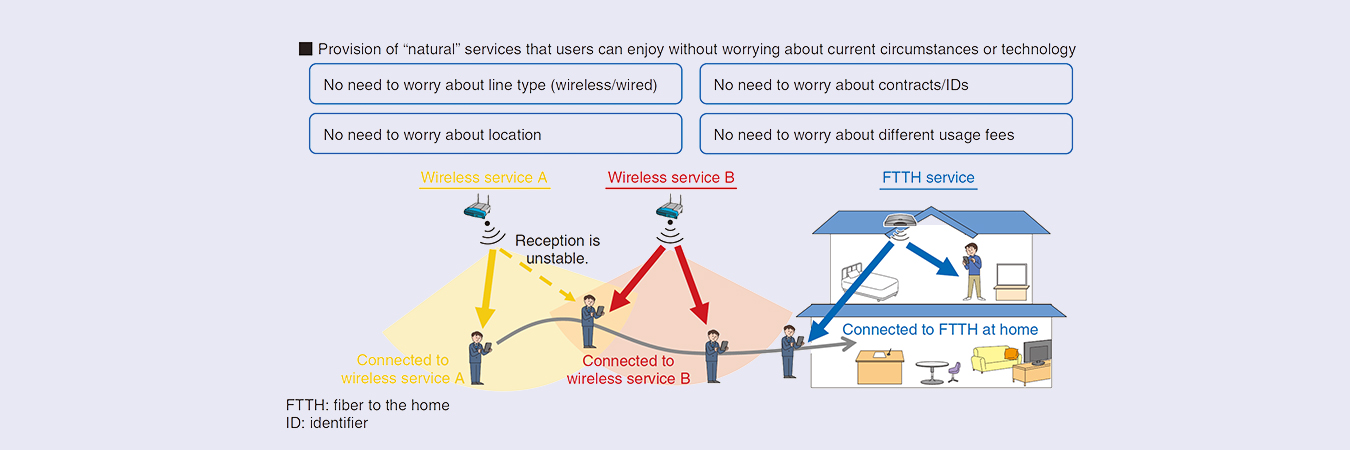
Beyond our promotion and development of the O-RAN/vRAN model, we would like to achieve cognitive communication that manages user presence (Fig. 5). From the user’s point of view, this means the ability to connect in a seamless manner using the most optimal communication environment regardless of location without having to worry about line type (wireless/wired), separate contracts, usage location, or different fees. In short, our goal is to achieve “natural” services.
6.3 Objective of converting NTT DOCOMO into a wholly owned subsidiary
Next, as part of the second key direction of concentration of resources and promotion of DX, we announced the conversion of NTT DOCOMO into a wholly owned subsidiary of NTT. The objective of this move is to enhance the competitiveness and growth of NTT DOCOMO and promote the growth of the entire NTT Group. By leveraging the power of NTT Communications and NTT Comware, we aim to promote new services and solutions and a 6G-oriented communications infrastructure in the form of mobile/fixed seamless services as I just described and to drive the further evolution of NTT DOCOMO into a comprehensive ICT enterprise that extends as far as upper-layer businesses.
6.4 IOWN
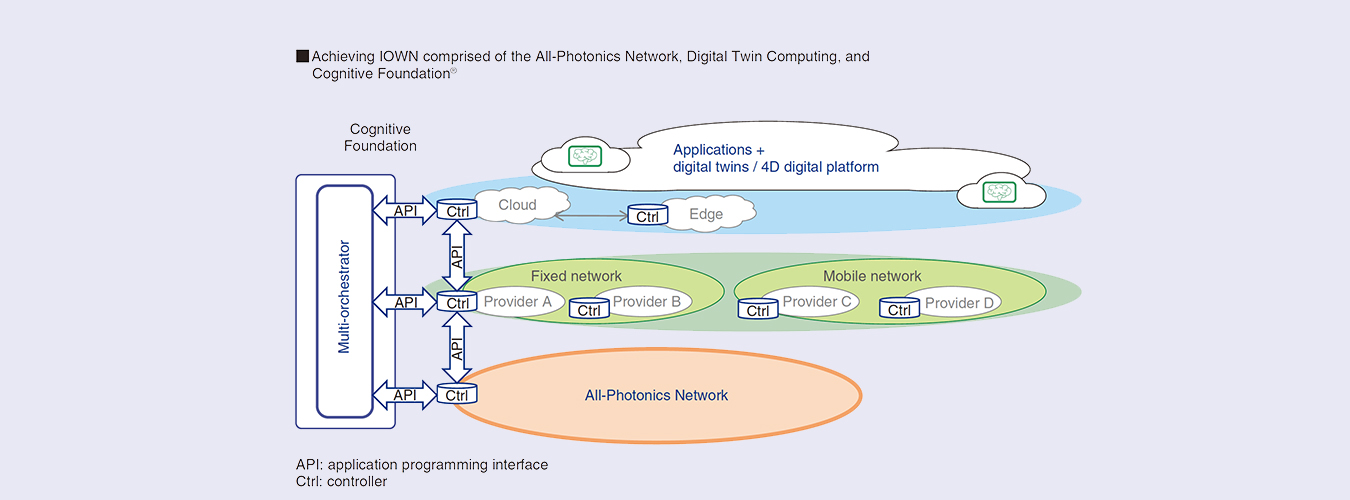
IOWN can be expressed as a three-layer model
(Fig. 6). In the middle of this model lies the network
layer, which is currently divided into the fixed and
mobile networks. In the future, though, the configuring
of services will be centered about this layer. Supposing
that 6G will be able to handle a communication
capacity of more than ten times that of current
5G, the performance and capacity of optical fiber,
fixed network, etc. that lie behind the scenes will
naturally have to be raised. On a chip level, however,
problems related to heat and efficiency present a
strong barrier to these enhancements. The coming of
the All-Photonics Network featuring photonics-electronics
convergence as a key technology will help
solve these problems. However, it will be Digital
Twin Computing on an upper layer where many services
using big data will be born. The All-Photonics
Network and Digital Twin Computing will take on a
cooperative existence. In addition, considering that
efficiency is poor in the case of distributed networks,
they will have to be connected. This is why an element
called Cognitive Foundation® will be needed.
These three elements—All-Photonics Network, Digital
Twin Computing, and Cognitive Foundation—
will become the basic framework of IOWN.
I believe that the convergence of core networks will
be a prime driver in this development effort. The idea
is that core-network components must work together
to achieve a seamless connection between the mobile
and fixed networks. At present, however, there are
many nodes, systems, and networks that are being
discussed in terms of voice communications and data
communications, whether they should be consumeroriented
or business-oriented, etc., and research is
needed to determine to what extent and in what form
these elements should be converged. For this reason,
close collaboration between NTT laboratories and the
research laboratories of NTT DOCOMO is indispensable.
Furthermore, if large volumes of data come
to be processed using an open model, it will be necessary
to study whether software and computer systems
can operate under a disaggregated model. This, in
short, means a migration to a serverless format by
incorporating photonics-electronics convergence
technology on the computer side as well. I also see
the need for white boxes to support ultra-large-capacity,
high-speed processing on such a platform.
In the United States, we have established a company
called NTT Research, Inc. composed of three
research laboratories. The research conducted there
includes topics in medical and health science, and
going forward, I think there will be increasing interest
in discussing how medical ICT can support everyone’s
healthcare in the form of digital twins. Such a
development will involve questions on how to deal
with various types of wearable and implantable
devices, so I think that the aforementioned fields of
medical ICT strategy, mobile/fixed convergent core,
disaggregated computing/operating systems (OSes),
O-RAN/vRAN, and devices will attract attention as
next-generation research and development themes
from within IOWN (Fig. 7).

6.5 All-Photonics-Network use cases
As an official partner of Major League Baseball
(MLB), NTT has been working to provide Ultra Reality
Viewing experiences using its Kirari! technology,
but in 2020, the effects of the COVID-19 pandemic
put this initiative on hold. Spectator-based events
have recently been changing into digital events, so we
expect to be able to hold such events based on a dispersed
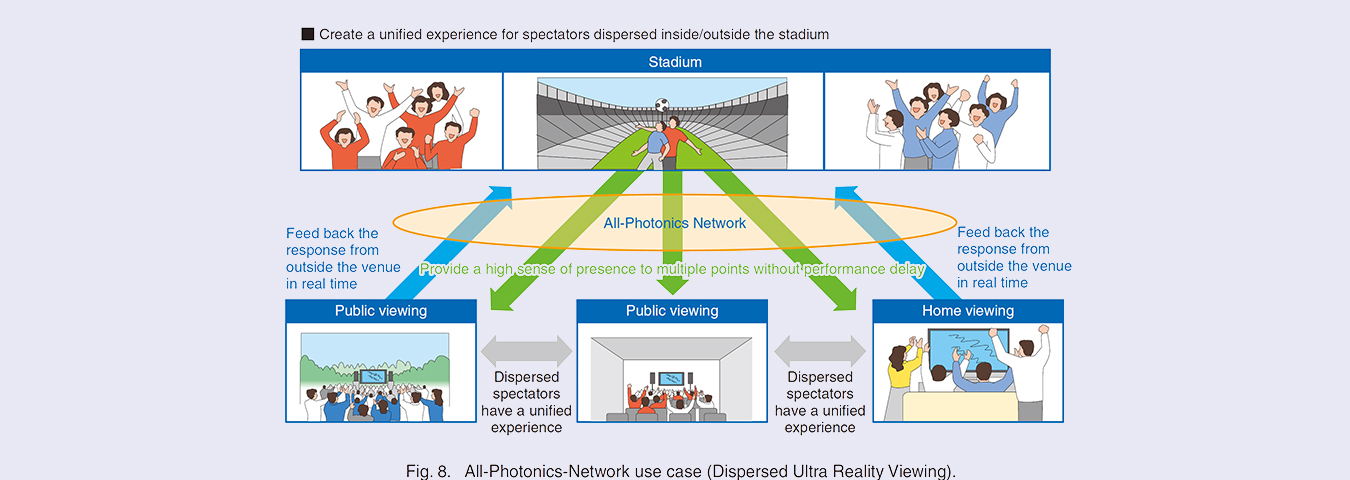
remote world. Specifically, we would like to
create a unified experience for spectators dispersed
inside/outside the stadium. This will require the
transmission of stadium information without delay to
home-viewing or public-viewing sites and the feeding
back of the reactions of those spectators to the
stadium, likewise without delay. This, in turn, will
require the All-Photonics Network to have extremely
low delay (Fig. 8). We can treat such an event as an
All-Photonics-Network use case.
In addition, quantum cryptography and quantum
communication are two fields that are increasingly
being taken up, and the All-Photonics Network will
expand the range in which quantum cryptography can
be applied by approaching optical end-to-end
communications. In fact, the development of the All
Photonics Network simultaneously takes into account
support of quantum cryptography and quantum communication.
7. Access network on IOWN
I would like to see NTT Access Network Service
Systems Laboratories enhance the access network
toward IOWN. They have been researching and
developing various elements and systems, but from
here on, I think it’s necessary that they go beyond
today’s research and development stage and study
means of dealing with demand that optical fiber in the
field today would not be able to cover. For example,
a decision must be made on whether to overlay or
replace the present access network with a new system.
Looking ahead ten years, I see an end to today’s
basic design model of fiber to the home (FTTH) in
which optical fiber is allocated in single-wavelength
format or fixed wiring intervals from the perspective
of planned economics. I can imagine a hybrid access
system that, depending on the demand, provides
access by a base station’s backhaul or fronthaul or by
direct connection to a building, or that provides services
in terms of wavelength or by conventional
FTTH. A transition period and transition scheme
must be studied to decide on how to absorb new infrastructure
while having it coexist with existing equipment.
The fixed access network, in particular, will
continue to be provided to both individual and corporate
customers.
I think the era is coming in which mobile communications
or the customer’s local 5G infrastructure
system can be used for access. I would like to research
and develop such technologies and promote research
and development and business on a global scale so
that we will be able to provide NTT Group systems
throughout the world.
8. Concluding remarks
At the beginning of this article, I talked about the hardships we faced 40 years ago in development work. The research themes that I managed were often directly connected to work in the field, and I was often reprimanded for problems in the field when I went to regions throughout Japan. It would sometime happen that some procedure was done in a way different from the usual way causing, for example, stripped threading in equipment. Then, while thinking of how to develop a system or equipment technology that could reliably handle such irregular events, I would always be trying to overcome the thinking of “it must be done this way” or “this is the way it’s always been done.” I hope that we, the NTT Group, can work with our partners to overcome this thinking within us and create a world in which we can make new technologies.