05/01/2020
Network Design Technologies Supporting the All-Photonics NetworkNTT Network Technology Laboratories
*The names of the laboratories mentioned in the article may have changed since the time of writing/interview.
Mika Ishizuka, Yasuharu Kaneko, Kohjun Koshiji, Saburo Seto, and Seisho Yasukawa
Introduction
NTT Network Technology Laboratories is conducting studies on network design technologies toward the implementation of the All-Photonics Network (APN).
In a current network, multiple users and services share a single optical path; however, the APN achieves high quality and low latency by allocating an optical path to each user or service. However, such a massive number of optical paths require wavelengths, and it is known that efficiently allocating wavelengths in a large-scale network is difficult [1].
Against this background, we are studying network design technologies that will enable a network to efficiently accommodate a massive number of optical paths by combining a variety of optimization techniques.
Issues in optical full-mesh network design
Allocating wavelengths to optical paths requires that the same wavelength be allocated end to end. Additionally, within the same link, only one wavelength can be allocated to one optical path. For example, in Fig. 1(a), we consider the case of allocating a wavelength to optical-path 3. Wavelength λ1 is unused in link A, but since it is already being used in link B, wavelength λ2 is allocated to optical-path 3 while leaving wavelength λ1 unused in link A. Therefore, allocating wavelengths to optical paths in a sequential manner results in wavelength fragmentation. In contrast, allocating wavelengths in the manner shown in Fig. 1(b) can reduce the number of wavelengths needed. In other words, efficient accommodation of optical paths can be achieved by establishing rules for allocating wavelengths in anticipation of demand in combination with demand prediction technology.

Optical full-mesh network architecture
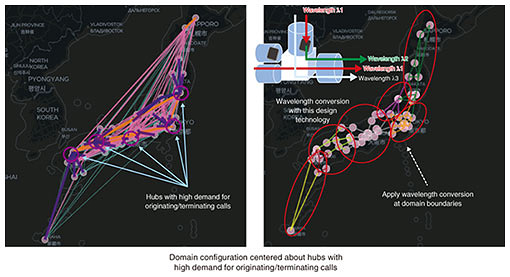
As described above, an increasingly larger network makes efficient end-to-end allocation of wavelengths difficult while also driving a computational explosion that makes the computation of optimal wavelength allocation difficult. Consequently, to use wavelengths efficiently and reduce the scale of the problem, we adopted architecture that divides the network into domains (Fig. 2). In this architecture, photonic gateways and photonic exchanges are deployed at domain boundaries and wavelength conversion is performed at this equipment. Partitioning the network into domains can reduce the number of wavelengths needed while also reducing the scale of the problem to a level that allows for the application of wavelength-allocation optimization techniques. The number of paths crossing domain boundaries will be set to be as small as possible according to a demand distribution.
Topology/wavelength design in optical full-mesh networks
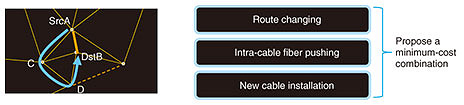
We will apply topology design and wavelength optimization to make effective use of wavelength resources within a domain. Regarding topology design (Fig. 3), we will apply such means as route design, intra-cable fiber pushing, and addition of new fiber routes that minimize cost and equalize as much of the level of demand as possible in each fiber within a domain. Regarding wavelength optimization (Fig. 4), we will apply the flexgrid wavelength-allocation optimization technique with respect to the combinations of start/end points within a domain to achieve optimal wavelength allocation. Quantum computing (LASOLVTM [2]) can be applied to this wavelength-allocation optimization problem.

Simulation results
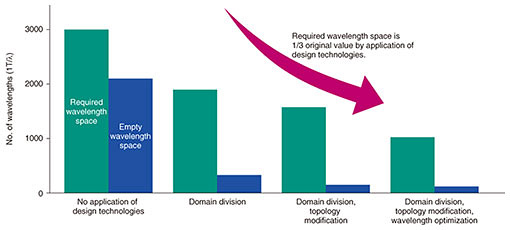
Targeting Japan Photonic Network Model JPN48 [3], we introduce the results of simulations on accommodating a traffic model (communications among datacenters deployed in prefectures, cloud-based remotely operated applications, corporate communications) envisioning services of the Innovative Optical and Wireless Network (IOWN) era. When not applying the design technologies from NTT Network Technology Laboratories, a capacity of 3 Pbit/s per fiber is required to accommodate the above types of traffic. However, when applying these technologies, a capacity of only 1 Pbit/s per fiber is needed, reflecting a dramatic improvement in fiber-use efficiency (Fig. 5).
Future outlook
This article introduced architecture, topology-design, and wavelength-design technologies toward the implementation of an all-photonics full-mesh network that can efficiently accommodate a wide variety and large number of optical paths. Going forward, we plan to further develop these technologies to satisfy a variety of network requirements in a flexible manner while aiming for early rollout in real-world applications and fields.
References
- [1]L. Velasco, A. Castro, M. Ruiz, and G. Junyentm, "Solving Routing and Spectrum Allocation Related Optimization Problems: From Off-Line to In-Operation Flexgrid Network Planning," J. Lightw. Technol., Vol. 32, No. 6, pp. 2780-2795, 2014.
- [2]Coherent Ising Machine: LASOLV,
https://www.rd.ntt/e/ - [3]Japan Photonic Network Model,
https://www.ieice.org/cs/pn/jpn/jpnm.html