05/15/2024
Visualization of deterioration status and extension of service life of telecommunication infrastructure equipment and materialsTechnologies for sensing and preventing material degradation to support telecommunications infrastructureNTT Device Technology Laboratories
Overview
We developed an "equipment and structure sensing technology" based on advanced electromagnetic sensing technology and the utilization of machine learning. This technology predicts deterioration status for equipment that cannot be inspected visually. Further, by visualizing structures and abnormalities, the technology contributes to the reduction of risks and improvement of efficiency in facility maintenance. We also developed a "deterioration countermeasure technology" based on the understanding and analysis of material degradation phenomena. The technology estimates and extends the life of equipment and contributes to maintaining safety and improving economic efficiency.
Background / Issues
Telecommunications infrastructure facilities are installed in various outdoor environments throughout Japan. Many of them are difficult to inspect visually, such as those located underground, underwater, in high places, and inside concrete structures.
Maintaining the safety of these outdoor telecommunications infrastructures requires a technology to understand their deterioration state. Also, in order to economically maintain, extend, and refurbish deteriorated equipment, technologies for predicting material deterioration, for equipment repair, and for selecting equipment materials with longer service life are required.
Advantages of this technology
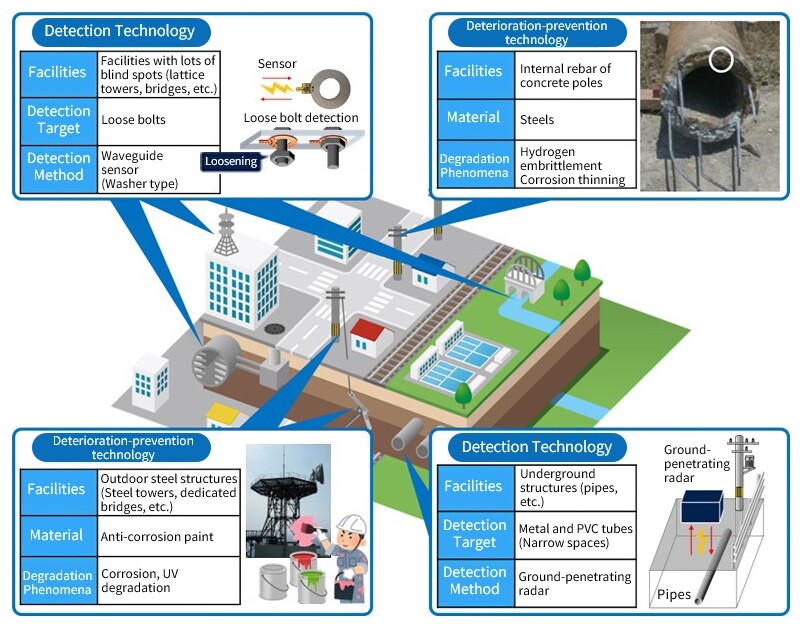
- Sensing technologies such as ground-penetrating radars, etc. that use more sensitive, higher-resolution electromagnetic sensing for localized exploration enable accurately determining the location of underground and in-structure equipment, contributing to the efficiency of maintenance inspections and renovation work.
- Sensing technology using advanced practical waveguide structure sensors that capture structural deterioration and abnormalities contributes to the efficiency of maintenance and inspection work for equipment that is difficult to visually inspect due to having many blind spots.
- Electrochemical elucidation of the corrosion phenomena of metals used in equipment facilitates the development of service life prediction and repair technologies and contributes to the efficiency of inspection work and the extension of equipment life.
- Chemical elucidation of the deterioration mechanism of polymer materials such as paints and plastics used in equipment facilitates the development of repair technology and long-life materials and contributes to extending the service life and longevity of equipment.
Use Scenes
- By accurately knowing the location of underground structures prior to underground construction, we can minimize the construction area while avoiding other underground structures, thereby reducing the risk and increasing the efficiency of construction work.
- Constructing a sensor system for remote monitoring and surveillance enables reducing risks and increasing efficiency of maintenance and inspection work of equipment with many blind spots.
- For wireless steel towers, dedicated bridges, and other outdoor steel structures, anti-corrosion coating is carried out to prevent corrosion of steel materials and ultraviolet deterioration of paint coating.
- For concrete pillars (CP), which may undergo hydrogen embrittlement and corrosion thinning of internal rebar, estimating the service life of the rebar enables optimal facility maintenance in accordance with service life.
Explanatory chart
Department in charge
NTT Device Technology Laboratories - Social Device Technology Laboratory