02/26/2021
The new NTT Bio-Medical Informatics Research Center is a unique center that is approaching the possibilities of cutting-edge bio and medical informatics technology.
Bio-Medical Informatics Research Center,
NTT Basic Research Laboratories
The modern human lifespan can be as long as 100 years old. Countries and companies are beginning to take a variety of initiatives toward big themes like maintaining and improving health. In July 2019, the NTT Group established a research organization dedicated to the fields of bioscience and medical health. It’s called the NTT Bio-Medical Informatics Research Center. What kind of research do they conduct in the highly anticipated wellness and healthcare sectors? To find out, we spoke with Dr. Nakashima, the center’s director, about the background of the center’s establishment and expectations about its work. In addition, we spoke with Dr. Teshima about the achievements in the bioscience research that contribute to regenerative medicine, as featured on the cover of the journal, Nanoscale, published by British Royal Society of Chemistry.
Interviewee
- Dr. Hiroshi Nakashima
-
PhD in Engineering,
Director of the NTT Bio-Medical Informatics Research Center.
Executive Research Scientist,
Molecular and Bio Science Research Group,
Multidisciplinary Materials Design and Science Laboratory,
NTT Basic Research Laboratories.
- Dr. Tetsuhiko Teshima
-
Ph.D. in information science and technology,
Research scientist, Molecular and Bio Science Research Group,
Multidisciplinary Materials Design and Science Laboratory,
NTT Basic Research Laboratories.
*Current affiliation: NTT Research, Inc.
Background of the NTT Bio-Medical Informatics Research Center
Aiming for Real Smart Healthcare
Nakashima: The NTT Bio-Medical Informatics Research Center (BMC) was established in July 2019. The background behind this is the "Real Smart Healthcare" vision described in the NTT Group's mid-term management strategy “Your Value Partner 2025.” NTT Labs has several laboratories that deal with topics related to bioscience, healthcare and medical data analysis, and medical devices. The new organization was established to horizontally link the activities of each laboratory, consolidate their wisdom and know-how, and accelerate the quality and progress of research and development. The primary role of BMC is "Basic and elemental research and development of ICT-based medicine and health." We are conducting basic medical research on diagnosis and treatment in collaboration with Medical and Health Informatics Laboratories (MEI Labs.), which is run by NTT Research Inc. in Silicon Valley. In addition, NTT Hospitals, NTT operating companies, NTT group companies, and external partner companies, will work together to achieve research results. We will continue to strengthen our connections with university hospitals and medical institutions, and to cultivate human resources with medical knowledge.

Nakashima: Next, let me tell you more about the direction BMC is aiming for. We want to embody new healthcare (data-driven healthcare) by collecting and analyzing a wide variety of data, including medical health data, sensing data, and life log personal data. Although we don't directly perform diagnosis and treatment, we want to utilize NTT’s expert data collection skills, AI analysis and ICT to assist medical doctors and health care workers in diagnosis and treatment. We will also contribute to providing information that is easier for patients to understand. We want to create a future where everyone can equally enjoy the satisfaction of having a healthy mind and body.
BMC's research fields are divided into three pillars: The first pillar is precision medicine. The goal is to collect and analyze data on things like genomes, annual health checkups, and living environments in order to suggest customized optimal living habits, and provide optimal care for individuals. For example, diabetes is said to be a risk factor for causing related diseases like kidney disease. To predict the risk of kidney disease in patients with diabetes, we are trying to enable analysis which includes the relationship between factors and the timing of prescribing, using past prescription records, and updates on the presence or absence of development.
The second pillar is real-time biomonitoring. This provides real-time insight into physical conditions like heart disease and blood glucose levels, and uses advanced AI analysis techniques to provide feedback on vital signs. It can help prevent, diagnose, and treat immediately.
The third pillar is innovative basic bioscience technology. This is a technology that can support health naturally in daily life through wearing a device that provides sensing and feedback in our bodies. Specifically, we are conducting research on new biocompatible materials, complementary implant devices for biomedical functions, and molecular-level nano-biosensing. It might be a little bit difficult to image what innovative basic bioscience technology could be, so I will let Dr. Teshima describe the actual research that is being conducted.
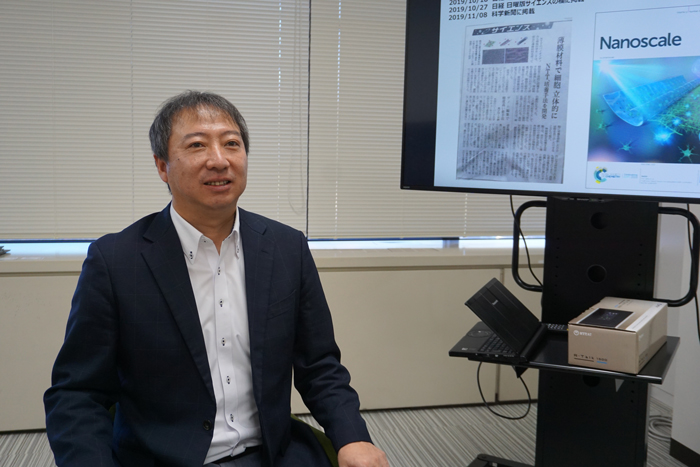
Research findings of innovative basic bioscience research
Creating a New Biological Interface for Regenerative Medicine Tech
Teshima: My research is dedicated to helping people who are suffering from injury or illness. We have developed a 3D structure that can be used as a bio-interface using a cell-friendly material called graphene, and succeeded in creating an artificial nerve network. We expect these achievements will help with regenerative medicine technology in the future.
Let's get a little more technical. The material we use is a sheet-like material composed of carbon atoms called graphene. Graphene is quite stiff, flexible and non-toxic. It is also electrically conductive. Because it’s a conductive material, graphene has been studied in a variety of research to confirm if it can be implanted in the body and used as a bioelectrode. However, conventional studies never achieved to freely change its two-dimensional structure to a three-dimensional structure. So why is a two-dimensional structure problematic? When cells are transplanted into the body in regenerative medicine, they need a tube-shaped (three-dimensional) interface to ensure that the cells stay together and don't get separated. I worked through trial and error using graphene/parylene bilayer membranes that stack polyparaxylene (parylene) on graphene, and successfully made freestyle 3D structures of graphene electrodes.
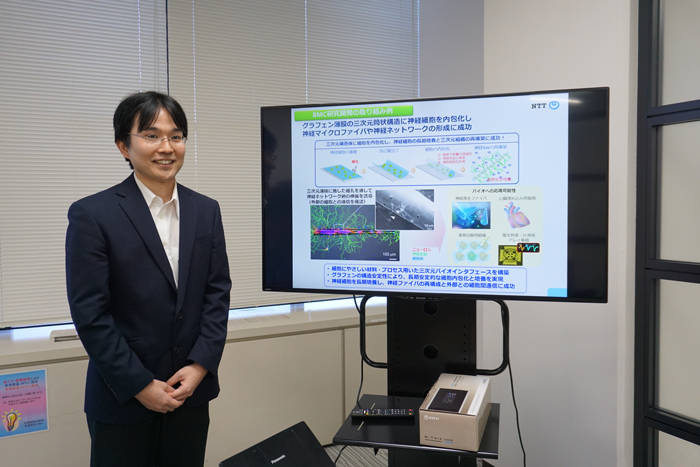
Next, we wanted to recreate a neural network with the graphene/parylene membrane, so we kept on doing the experiments. In fact, after placing multiple cells on a graphene/parylene membrane and building a 3D structure resembling an egg roll, the system was able to stabilize the culture for more than two weeks and create an artificial tissue-like structure with functions seen in neural tissue. In the meantime, oxygen and nutrition passed through the membranes, and the long protrusions of nerve cells called axons were also extended to reach outside. Interaction between the cells through the axons was also observed, and this means that a neural network could be rebuilt on the outside surface of a 3D structure. In the diagram below, the bottom right picture shows the nerve cell axons (green) extending outside the three-dimensional structure.

We will continue this research and eventually support the treatment of problems like spinal injury, Parkinson's disease, and epilepsy. Since a graphene/parylene membranes are conductive, they could, for example, be used as an electrode for pacemakers, an electrode to prevent epileptic seizures, or for other new treatment methods.
What's Next at NTT Bio-Medical Informatics Research Center
We want to bring together the power of NTT Group to support Japanese healthcare
Nakashima: The challenges related to maintaining and improving health are a major social issues not only in Japan, but also in the rest of the world. Imagine yourself 20 years later and you'll see that this is not just a problem of others. I think we should focus on these fields to create new value in the medical and health sectors, and to contribute to society. BMC is a virtual organization that was recently established, which connects multiple labs in different locations. We would like to accelerate research and development in the future in cooperation with relevant national and international medical and health institutes while developing our organization. To do this, we also need cooperation from people with medical expertise. I hope that we can do more than provide information processing and engineering knowledge, and I would like to become make deep relationships with people like doctors and clinical lab techs. From the research and development of basic technologies that lead to the next generation, we will be firmly responsible for providing bio information data that will help the medical, treatment and health care fields.
Recently, NTT Group healthcare personnel gathered in Otemachi to hold the Healthcare ICT Working Group. Each company reported on their efforts to achieve Real Smart Healthcare and it made me believe that the NTT Group companies can collaborate to create new value based on ICT and AI technology in the medical and healthcare sector. We would like to collaborate together. Thank you for your continued support and cooperation.
Editor's Note
I wonder when our smart phones started automatically tracking healthcare data like daily steps. Now we are already used to recording biometric data. I personally don’t make use of my biometric data, but ways to leverage personal healthcare data are being discussed everywhere. This interview with the NTT Bio-Medical Informatics Research Center showed me that the use of biometric data has spread indefinitely. Some studies have also found ways to collect biological data that was previously unmeasurable, and this could be used to treat and prevent a variety of diseases. As the trends of our era change from treatment to prevention, the knowledge and technology of the NTT Bio-Medical Informatics Research Center will prove to be very useful. And anticipation is sure to rise higher and higher for the regenerative medicine technology that Dr. Teshima is studying. We'll keep a close watch for updates on the work of the NTT Bio-Medical Informatics Research Center and progress toward Real Smart Healthcare. I hope the day will come when everyone can equally find joy through physical and mental health.
Interview by Natsuo Toyama
on December 4, 2019
References
Article Information:
- "Graphene-based Neuron Encapsulation with Controlled Axonal Outgrowth", K. Sakai, T. F. Teshima, H. Nakashima, Y. Ueno, Nanoscale, vol. 11, no. 28, pp. 13249-13259, 2019
- "Self-Folded Three-Dimensional Graphene with a Tunable Shape and Conductivity", T. F. Teshima, C. S. Henderson, M. Takamura, Y. Ogawa, S. Wang , Y. Kashimura, S. Sasaki, T. Goto, H. Nakashima, Y. Ueno, Nano Letters, vol. 19, no. 1, pp. 461-470, 2019