05/06/2022
Mobile gadget to transmit a sensation of being pulled: Buru-Navi 4Transmitting directional force sensation by illusionNTT Communication Science Laboratories
Overview
"Buru-Navi 4" is not only equipped with the same downsizing technology of "Buru-Navi 3," which transmits pulling force through asymmetrical vibration, but also features newly developed technology to further increase force transmission efficiency and technology to generate multi-degree-of-freedom haptics. Its battery can also be integrated to eliminate cables and the shape can be assembled to suit a variety of configurations. Thus far, we have succeeded in making a shell force model that can be attached to a smartphone as a shell, a cubic model that can generate haptics in six degrees of freedom, and a finger force model that fits in the hand and can be operated by pinching with the fingers. This enables uses such as virtual reality, route guidance, and game interfaces where force sensation is desired. It is expected to be widely used as a third means of providing communication information in addition to visual and auditory information that are traditionally used.
Background / Issues
Information interfaces designed for "watching" and "hearing" are ubiquitous in society. When people interact physically with the outside world, or with each other in real space, the physical sensations of pushing, pulling, and touching also provide valuable information. In the past, however, the interfaces that convey these sensations were limited to remote-controlled robots and those equipped with special devices. In order to pull a person's hand from the outside world, it is necessary to physically connect the hand to a device fixed to the outside world, or to attach a device that can exert force, such as electromagnetic force or air pressure, even when not connected to the outside world. In addition, even if it is not connected, an additional external device is required, and with these conventional devices, it is not possible to easily use them with mobile terminals. To overcome these limitations, NTT has been investigating methods and devices for generating the sensation of being pulled using an illusion. Although we achieved a significant reduction in size with "Buru-Navi 3," to enable more applications, it was not possible to install a battery, attach it to devices such as smartphones, and generate haptics in various directions.
Advantages of this technology
- Ungrounded haptic interface based on the nonlinear perceptual characteristics of humans
- A compact gadget designed based on the characteristics of the tactile receptors at the fingertips
- Technology clearly conveys haptics with multiple degrees of freedom and enables rapid and continuous changes in the magnitude and direction of force
- Enhanced force sensation transmission efficiency, built-in battery capability, capable of mobile use
Use Scene
- Hand-pulling for route guidance: Travel, airport/station guidance, guidance for people with visual impairments, etc.
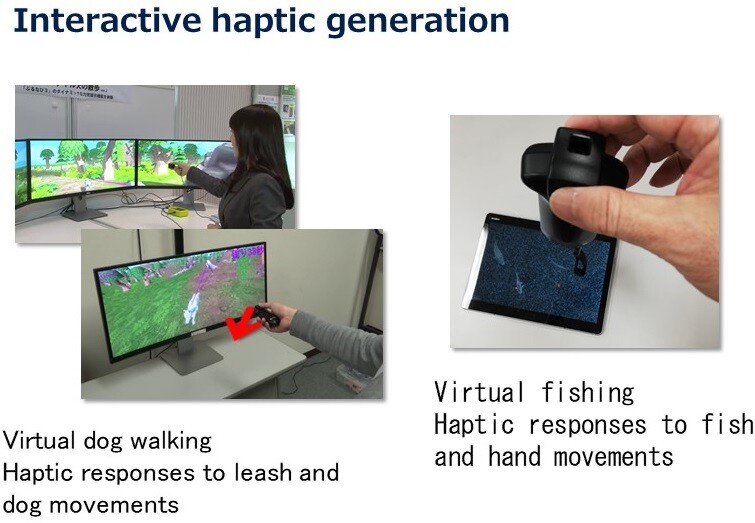
- Game interfaces with force sensations (e.g., fishing, walking a dog)
- Expressing force sensations in virtual reality
- Kinesthetic communication
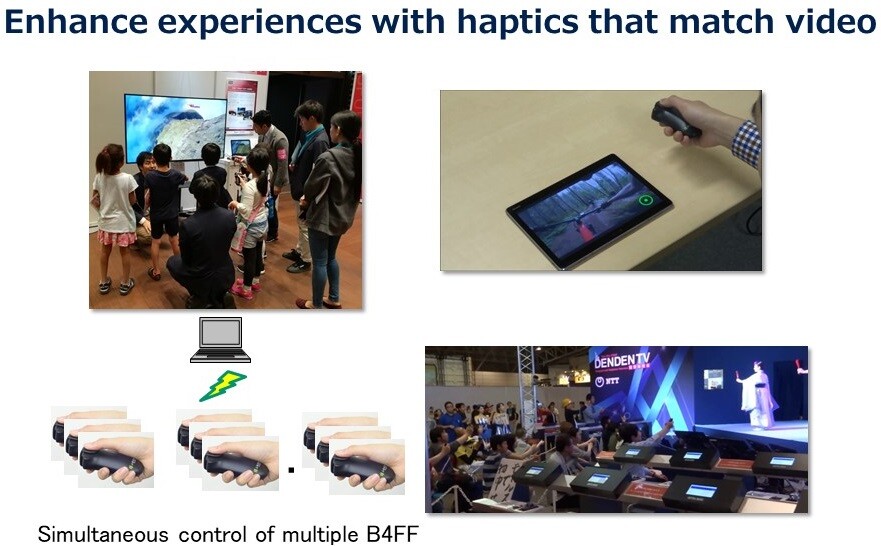
- Expressing force sensations with video in theaters, etc.
Explanatory chart

Department in charge
NTT Communication Science Laboratories - Human Information Science Laboratory