2020/10/30
Hitless Redundant Switching Technology Able to Be Added on NetworksNTT Access Network Service Systems Laboratories
Overview
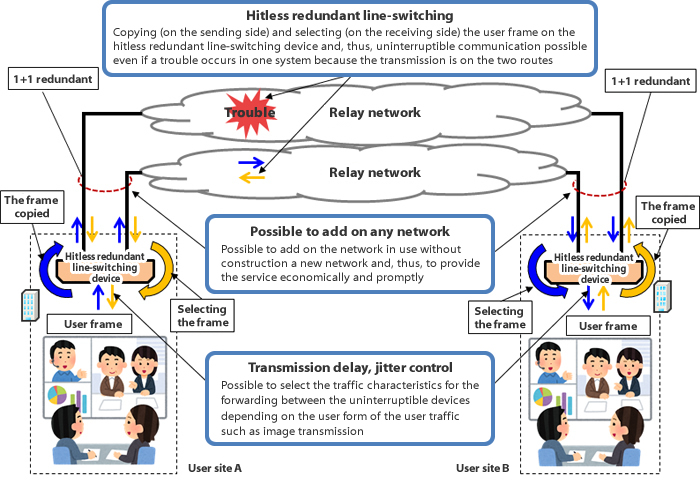
To realize stable telecommunications without any momentary interruption (frame loss "0") by executing the 1+1 switching control between user sites for, as the targets, the users wanting a short switching time such as switching lines at the time of trouble on a legacy dedicated line. In addition, to realize the telecommunications suitable for the use form of the users by adjusting the transmission delays and the jitters in the traffic to be forwarded. Furthermore, to economically and promptly provide the function not by constructing a new network to integrate the function but by making it integrative for the applicable users only
Background and existing issues
Some users need a short switching time such as digital dedicated lines depending on the user scene of a network. However, such conditions used not to be satisfied in general services such as wide-area Ethernet. The switching time at trouble is among the characteristics concerning the foundation of network control; some overall modification in the network type and/or large-scale investment in facility will be required to reduce switching time. On the other hand, the users place importance on the requirements concerning switching time are not in the majority; it used to be difficult to realize it in terms of economy because the demand and supply is not in balance.
Advantages of this technology
- Redundant line-switching possible without momentary interruption (Possible to avoid the frame loss resulting from line-switching at the time of a trouble occurrence etc.)
- Possible to control the delay and jitter of the traffic forwarded between uninterruptible devices depending on the characteristics of the user traffic (image transmission, security-related telecommunication, and other applications)
- Possible to add the function on any network without any overall modification in the network type or large-scale investment in facility and, further, to economically and promptly provide the service because the function can be applicable to specifically limited users
Use Scenes
- Image transfer service between broadcasting stations
- High quality data communication service (financing service, information security, etc.)
Explanatory chart
Glossary
1+1 switching control
The fact that two communication routes are prepared and the frame is copied from the device on the sending side in the network configuration connected to the both routes at terminals to be transmitted to both routes and that one of the frames arriving from the two routes is selected on the device on the receiving side. If a frame loss occurs on one route, it is complemented by the frame received from the other route.
Frame loss
The fact that the frame transmitted from the device on the sending side is lost halfway on the communication route and does not reach the device on the receiving side specified as the destination.
Transmission delay (delay)
The delay from the standard transfer time at the time when a frame is transmitted from the device on the sending side to the device on the receiving side.
Transmission jitter (jitter)
The fluctuation in the transmission time at the time when a frame is transmitted from the device on the sending side to the device on the receiving side.
Department in charge
NTT Access Network Service Systems Laboratories - Optical Access Systems Project