05/15/2024
A new service concept that improves the experience of interactive applications and the QoS technology for making the service possibleRealizing the Maximum Jitter Guarantee ServiceNTT Access Network Service Systems Laboratories
Overview
In order to enhance the physical feelings in the operation of bidirectional telecommunication type application programs such as remote desktops, Cloud games, and remote robot operations, it is necessary to suppress the delay in telecommunication and its fluctuation.
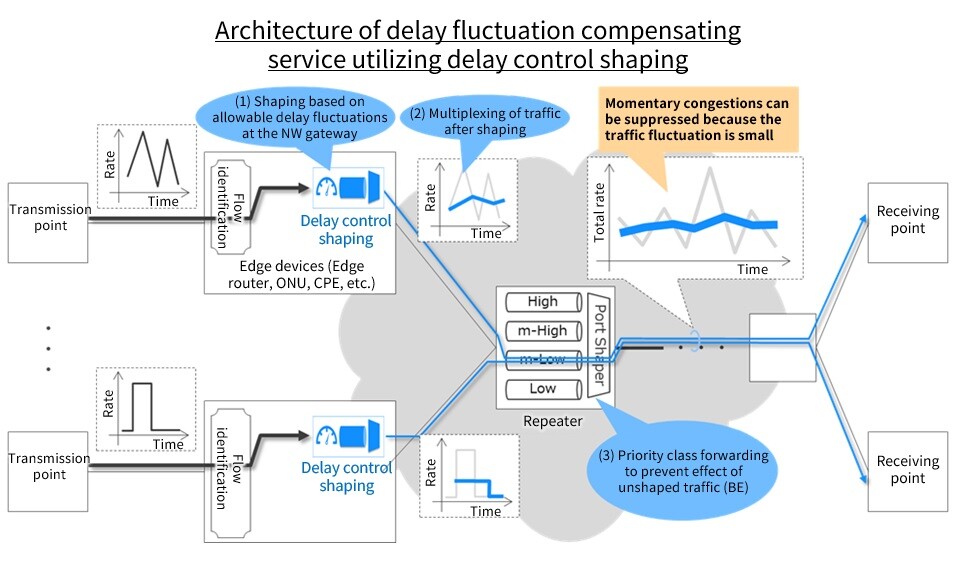
A new telecommunication service is realized to compensate the jitter by preventing the occurrence of momentary congestions by using the delay control shaping, the new QoS technology in which the amount of request delay is considered.
Background / Issues
The demands for bidirectional telecommunication type application programs are getting higher. In this field, the response time has a strong influence over the users' physical feelings. What occupies a large part of response time is the processing of the incoming/outgoing telecommunication of image signals.
The requirements of the jitters wanted with the networks for reducing that become severe; the best effort services, which is currently in the mainstream, have difficulty in supporting. On the other hand, it is assumed that there are response time conditions specific to each of application programs in the cases of bidirectional telecommunication type application programs.
In this technology, the purpose is to realize the jitter compensating service to satisfy the jitter requirements wanted in networks with consideration to the conditions specific to each of such application programs.
Advantages of this technology
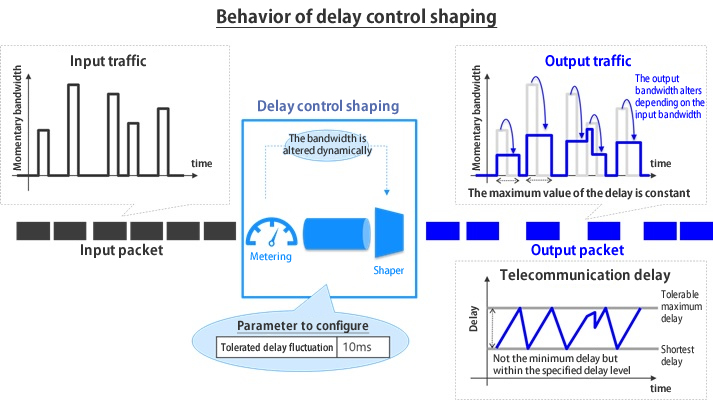
- The technology to perform shaping on the basis of jitters (delay control shaping) is newly devised as a new QoS structure different from conventional bandwidth control. With this technology, it is possible to efficiently reduce the load on a network as the jitter is suppressed to a certain level or lower.
- In the case of the telecommunication that causes data in every frame period like image signals, a temporary delay occurs as the alteration of the bandwidth in the network is large if a packet is multiplied without shaping. On the other hand, if a packet is multiplied after conventional bandwidth control shaping, it is possible to suppress the bandwidth alteration in the network, but it is not possible to control the amount of the jitters that occur in shaping per se. With this technology, it is possible to control the amount of jitters while the bandwidth alteration in the network is suppressed because shaping is performed to the upper limit of the specified jitter.
- By suppressing the bandwidth alteration in a network, it becomes possible not only to suppress the occurrence of temporary congestions but also to confirm the integrity of the jitter compensating service with the scheme of the facility management based on the current monitoring of the average amount of traffic while an excessive augmentation of facility is prevented.
Use Scenes
- Remote desktop: By suppressing the jitter in telecommunication to a certain level or lower, it becomes possible to stabilize the response time of a remote desktop and to perform remote operation at a high level such as graphics or images editing or the like.
- Cloud game: By suppressing the jitter in telecommunication to a certain level or lower, it becomes possible to stabilize the response time of a Cloud game and to provide the Cloud games in which the competition is made over one frame such as fighting games and FPS's (First Person Shooter).
- Remote control of robots or heavy equipment: By suppressing the jitter in telecommunication to a certain level or lower, it becomes possible to stabilize the response time of remote operation and to perform remote operation at a high level.
Explanatory chart
Technical explanation
With bidirectional telecommunication type application programs such as remote desktops, Cloud games, and remote robot operations, as the operation is made such that "the user make operation based on an image received from a remote terminal and the user recognizes it by receiving the result of the operation as an image," the response time between the operation and the return of an image has a strong influence over the users' physical feelings.
What occupies a large part of response time is the processing of the incoming/outgoing telecommunication of image signals. To reduce that, it is necessary to suppress the compression with a codec and/or to reduce the buffer; however, the requirements of the jitters wanted with the networks at that time become severe and, thus, it is difficult for the current best effort services, which are in the main stream, to support those.
On the other hand, it is assumed that there are response time conditions specific to each of application programs in the cases of bidirectional telecommunication type application programs. For instance, in the case of this form in which 60 images are shown in images in one second, there may be a case in which there is no problem if 1/60, an equivalent to one image, is 16.6ms or shorter. Furthermore, depending on the proficiency of the user, there may be a case in which there is no problem if 2/60, an equivalent to two images, is 33.3ms or shorter.
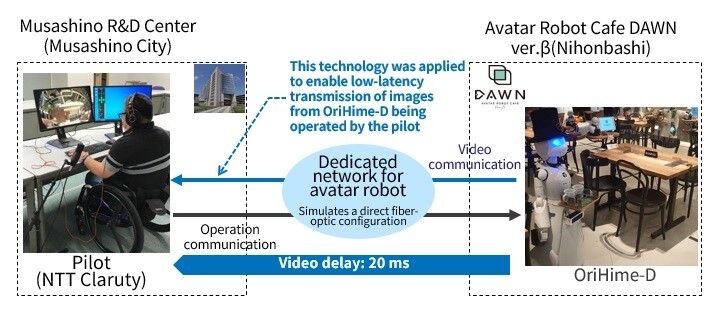
In November 2021, a demonstration experiment was conducted using OriHime-D, an avatar robot used in DAWN | Avatar Robot Cafe ver. β, a permanent experimental shop opened by OryLab Inc. (“OryLab"). The technology was used to dynamically control the transmission timing of video communications in accordance with the robot's status and attributes to enable low-latency remote robot operation with no time lag for the operator. In this demonstration experiment, which was conducted with the cooperation of NTT CLARUTY Corporation (“NTT CLARUTY"), a person with disability served as the pilot operating the robot and performed service staff operations at the avatar robot cafe. Results showed that the technology enabled smooth robot movement through narrow passages and stress-free robot operations.
Department in charge
NTT Access Network Service Systems Laboratories - Access Network Service Systems Project