05/15/2024
Learning from Maintenance operator's Know-how, Quickly Finding Fault PointsKonan: Self-evolving failure event analysis technology for identifying cause of failureNTT Access Network Service Systems Laboratories
Overview
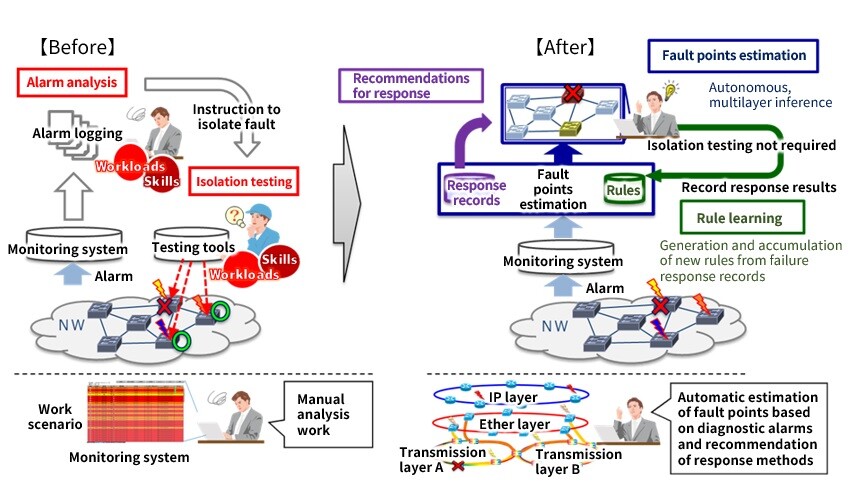
NTT is engaged in R&D of technology to automatically derive "causal relationships between fault points and alarms" as rules for network failures. Rules are learned on the basis of daily responses to faults, and are thus adapted to the target network. Learned rules improve decision accuracy and enable instant visualization of candidate locations for fault causes. Furthermore, the system registers the history of implemented fault responses and presents optimal recovery methods (recommendations for response) that take into account recovery records and estimated work times.
Background / Issues
In the event of a large-scale network failure, a maintenance operator skilled in fault response needs to analyze a large number of alarms and use continuity testing to isolate the location of the fault. There is, therefore, a need to reduce the burden on maintenance operators by improving the efficiency of fault response, including shortening the analysis and isolation operations that conventionally require several hours or days.
Advantages of this technology
- Using rules that describe the causal relationship between fault points and alarms, this technology can instantly infer and visualize suspected fault point candidates on a topology map.
- It accumulates daily records of fault responses conducted by maintenance operators and automatically optimizes rules as needed, enabling adaptation to the target network and improving decision accuracy.
- Records of recovery methods and results are accumulated for individual fault cases defined by learned rules
- The optimal recovery method is presented after calculating priority from the accumulated recovery result records, which include equipment attributes of the fault points and the estimated work time.
Use Scene
- Reduction of workload required for analysis of alarms and for isolation of faults in daily maintenance operations, and creation of a knowledge base
- It can be applied to a range of networks including carriers, data centers, and universities
Explanatory chart
Department in charge
NTT Access Network Service Systems Laboratories - Access Operations Project