Exhibition Report
Exhibition Summary
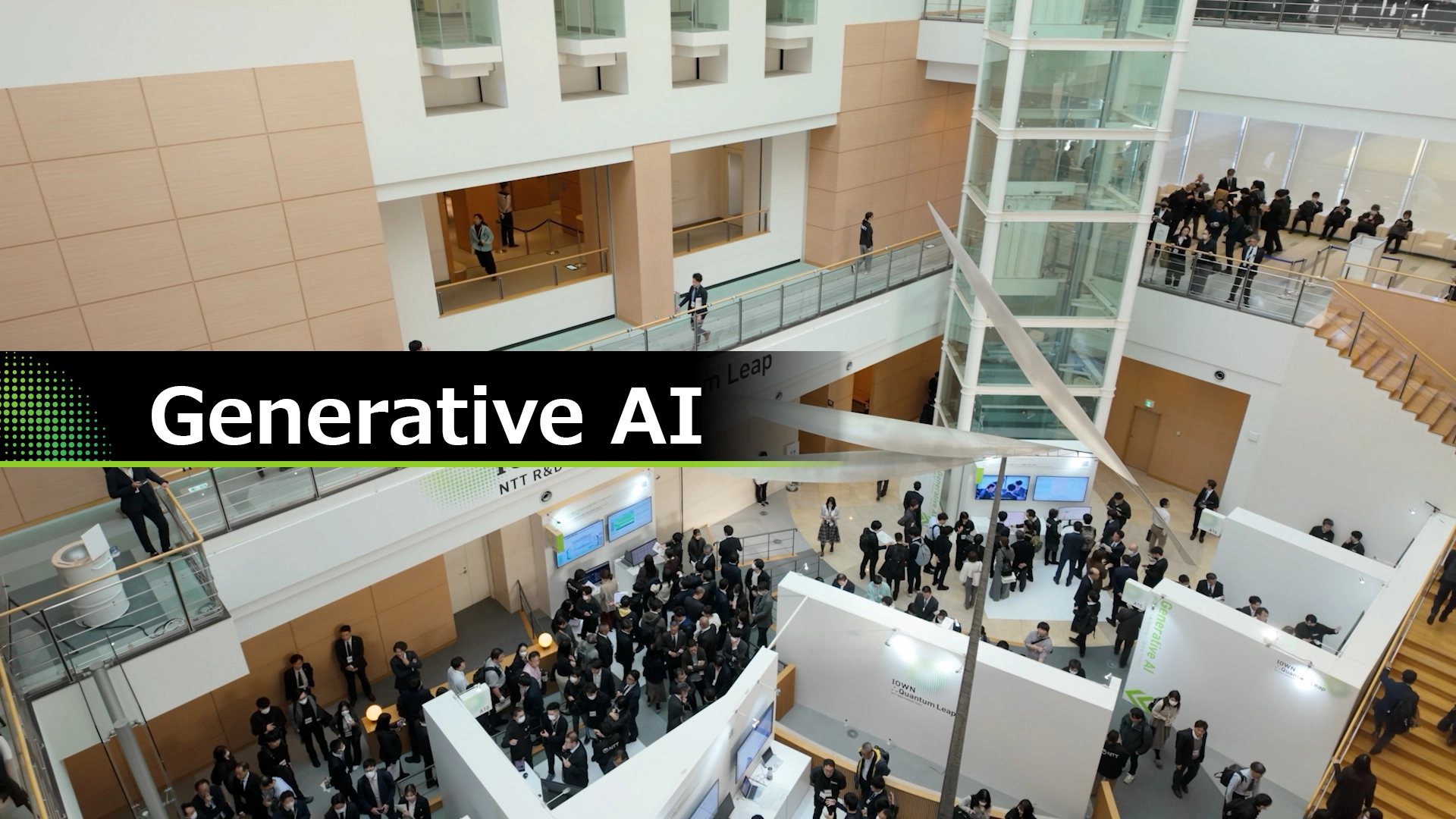
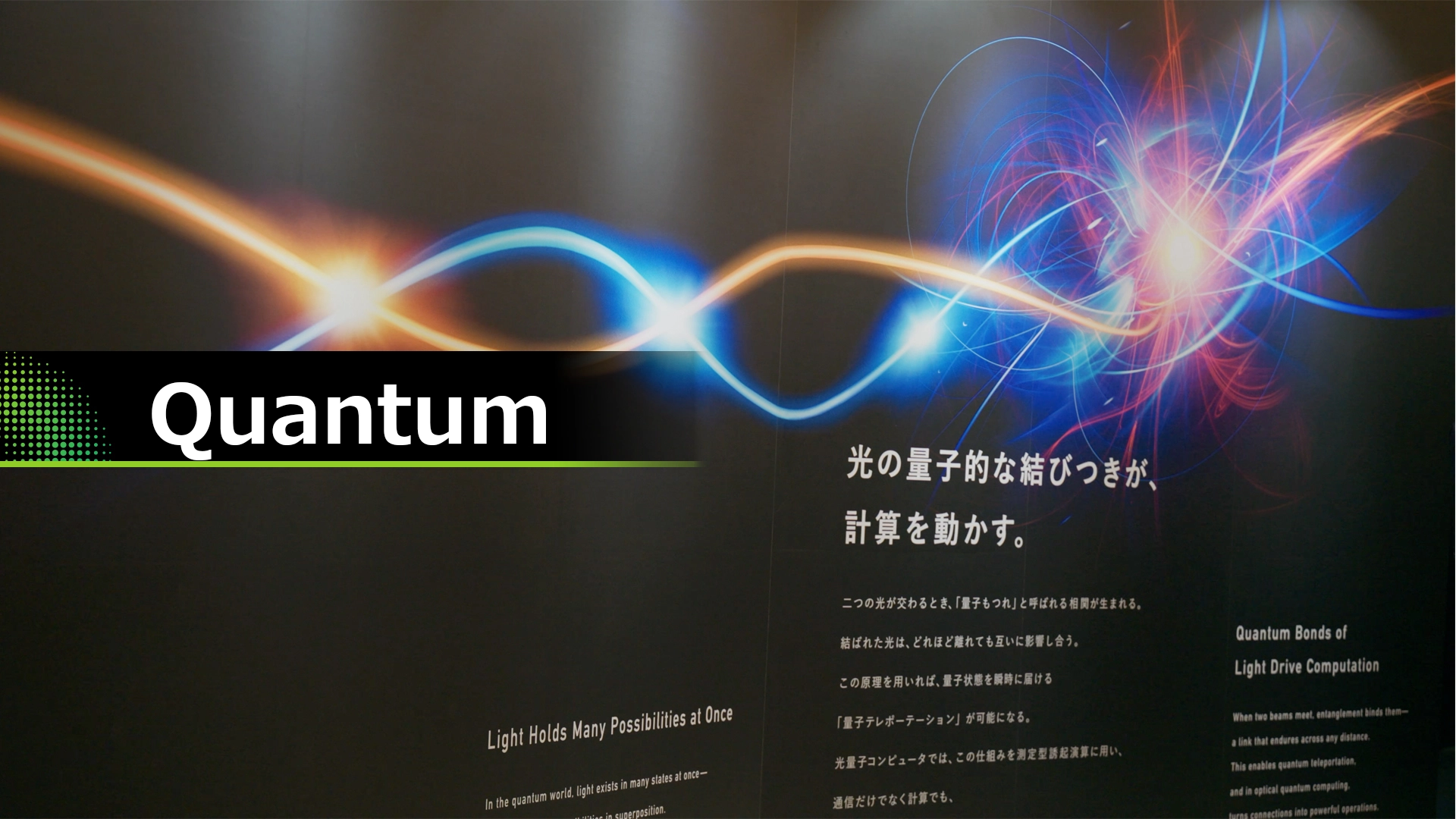
The technology exhibits at NTT R&D FORUM 2025 were organized into 10 themes: "Generative AI," "IOWN," "Quantum," "Sustainability," "Mobility," "NW (Network)," "Security," "Space," "Digital Twin," and "UI/UX." They occupied five areas on the first and second floors of the venue. Furthermore, each exhibit was linked to a website, which recommended exhibits based on usage scenarios and industry allowing visitors to view exhibits that attracted their interests.
Exhibition Area Digest Video
EXHIBITION
HIGHLIGHTS
Evolving large-scale language model tsuzumi2

NTT has released a new version of its large-scale language model, "tsuzumi2." While it is a lightweight model that can run on a single GPU, it is cost-effective and achieves, in Japanese language, world-class performance that approaches that of ultra-large models. Its first feature is its enhanced capabilities, which are frequently used in business situations. It is particularly powerful in document Q&A tasks, which account for 80% of usage, while document information extraction and summarization tasks have been significantly strengthened.
In addition, since it was developed to run on GPUs with 40GB or less of memory, it is relatively easy to operate on a closed circuit within a single company or organization. This allows highly confidential information to be handled with peace of mind, significantly reducing the risk of trade secret leaks and ensuring extremely high security. Additionally, since it has been trained with a particularly large amount of knowledge in the fields of finance, local government, and medicine, it will demonstrate excellent performance in many cases in other areas such as economic security, eliminating the digital deficit, and strengthening the AI industry.
A distinctive feature of the system is its inclusion of an "orchestrator" function. As the name suggests, this function operates like an orchestra conductor; we call it "tsuzumi." NTT has complete control over the learning capabilities of "tsuzumi2." For example, if it is given a task such as "What measures should be taken to address the decline in sales at branch XX this fiscal year?" it will collect a variety of information, such as past sales data and the details of customer complaints, to derive an answer. If there is insufficient information, the "orchestrator" will, at its own discretion, use the chat function to directly engage with the person in charge to gather the missing information.
While other companies have announced a number of AI variants, "tsuzumi2" is a purely domestic model developed by NTT from scratch. As a result, reliability was prioritized throughout the development process, making it truly an AI made for the Japanese market.
Fake content countermeasures

To protect the authenticity of photos, we have developed a technology that effectively combats fake content. Currently, photos can be easily taken by anyone using a smartphone or tablet PC, and the Coalition for Content Provenance and Authenticity (C2PA) assigns provenance information to the data of each photo. C2PA is the abbreviation of a standardization organization that develops technical solutions for authenticating the origin and provenance of photo data. The term is used synonymously with the provenance and authenticity of content. However, metadata such as the location, date, and equipment used can easily be tampered with using various applications. Furthermore, anyone can easily alter images using generative AI. In other words, C2PA data assurances are no longer guaranteed. There is no guarantee that the images we see every day have not been tampered with. Our technology simplifies data assurance by users by signing the image with authenticity-verifying metadata at the time of capture. End users are supported with an "authenticity check module" and an "authenticity check tool," which allows not only checking of the authenticity of information such as the date and time of the photo and location, but also determines the authenticity of the photo as a percentage. In addition, if the photo data has been edited, it is possible to reproduce the original image before editing. Even if the photo has been cropped, it is possible to check the angle of view of the original image before it was cut. This function makes it easy for individuals to fact-check the fake images that are flooding the internet. One current issue is that when "C2PA" misidentifies the location of a photo taken inside a high-rise building or under a highway overpass, the reliability of the photo may be determined to be low, even if it has not been tampered with. One goal is to reduce the false recognition rate and achieve more accurate reliability assessments.
Ultra-fast software development technology using generative AI

This technology utilizes generative AI to achieve ultra-fast, low-cost, and high-quality output when developing new and incremental software; it can shorten software development operations and processes by 40%. Currently, developing high-quality software that reflects individual user needs requires a lot of manual effort. Moreover, each developer must have an understanding of the entire project, which has many disadvantages in terms of cost and time. While generative AI is being used in coding (implementation) processes, it has difficulty understanding the full context of software projects (e.g., situation, context, and sequence). Software development, in particular, requires project-specific knowledge, making it difficult for general-purpose generative AI with only general knowledge to accomplish this advanced task, which in turn requires human intervention. To address this issue, we developed a technology that performs multifaceted analysis of the full spectrum data required for software development, identifies dependencies, and builds a truly complete knowledge database. By having the generative AI autonomously select the data necessary for each task from this knowledge database and carry it out appropriately and accurately, it is possible to minimize the amount of human labor required in developing high-quality, cost-effective software.
Automating equipment failure repair decisions with generative AI

Currently, when a problem such as an internet outage occurs in a private dwelling, the customer contacts a call center, and after learning of the situation, the center visits that customer to resolve the issue. However, approximately 50% of these visits involve minor issues, such as a cable connection to the ONU (Optical Network Unit) that has come loose. Our solution is to utilize highly accurate AI known as VLM (Vision-Language Model) and LLM (Large Language Model) to enable users to check the status of equipment such as ONUs and repair minor issues themselves.
Unfortunately, current AI systems such as LLM/VLM are general-purpose, and so lack specialized domain knowledge, making it necessary to develop AI specialized for determining faults in communications equipment. NTT has built an AI agent capable of multimodal input, and by combining image processing and other technologies with peripheral technologies such as a user-friendly UI (user interface) for VLM, we have achieved automated device fault determination and repair. Currently, support is provided over the phone or online, but we aim to eventually provide it as a smartphone application.
Real-world sensing and robotics AI

Japan is facing the threat of a declining population due to factors such as a declining birthrate, and labor shortages are gradually becoming a reality, especially in primary industries. To address this issue, we are organically combining sensing devices, AI, and robotics technology to replace the know-how and precision work of skilled workers and reduce labor inputs. By deliberately combining low-resolution thermal sensors with dedicated AI, we are able to achieve a high level of anonymity as no video or images that might reveal human faces are needed while replicating the judgment of skilled workers, something that conventional AI is unable to handle. This makes it possible, for example, to control robots that can navigate precisely across rows of fields, even within a few centimeters of furrows. A concrete example is the "automatic weeding robot" (Photo 3) exhibited at this event. Crops such as Japanese mustard spinach are grown in relatively narrow rows or in greenhouses, where it is difficult for humans to reach them. Inexperienced workers often end up trampling the crops themselves. This robot was developed to remove weeds in these confined spaces. Furthermore, since the AI component allows it to operate completely autonomously, it can also respond to damage caused by pests such as raccoons and deer on farms. In an actual experiment conducted at a campsite in Fukui Prefecture, it was demonstrated that the prototype robot could actually scare away pests by patrolling at night.
The current goal is to develop robots that can reduce the labor required for such maintenance and management work in the real world, such as in primary industries, and in the future, to be useful for precision work in places that pose risks for people, such as the site of the nuclear accident in Fukushima Prefecture.
World model for the transportation sector

World models allow AI to efficiently learn and predict environmental changes and the outcomes of actions, offering highly accurate estimates of future situations a few seconds ahead based on a given video input. There are two main model types: those for human behavior and those for physical movement. Because AI predicts real-world states and behaviors learned from observational data, it can flexibly respond even when faced with unknown situations that were not included in the training data. NTT focuses on "human behavior prediction models" and plans to utilize them in the transportation field. Predicting complex human behavior (both intentional and unintentional) is difficult. For example, if a pedestrian is waiting at an intersection for the red light to change to green, it is natural to assume that they will not enter the road while the light is red. However, there is a possibility that two pedestrians, engrossed in their conversation, may not notice the light and begin crossing the street without even realizing it.
Our technology makes it possible to predict human behavior and object movement with high accuracy and in real time by simultaneously processing at high speed an AI model that explicitly processes the world as perceived by humans and an AI model that takes into account the physical laws that apply to each object. This technology has demonstrated high accuracy, particularly in estimating the future positions of pedestrians and cyclists at intersections up to five seconds in the future, and in estimating changes in physical movement when objects fall, collide, or tip over. This will contribute to reducing traffic accidents caused by such unpredictable behavior and phenomena, and realize a safer and more secure society.
Dynamic Watt Bit Link

Watt-bit collaboration is a technology that utilizes AI to maximize the effective use of renewable energy sources. Several renewable energy power generation facilities are active in Japan, including solar power generation sites. "Watt-bit collaboration" refers to a new infrastructure concept that integrates electricity and communications by integrating these renewable energy sources via communications and information infrastructure such as data centers. NTT is taking this "Watt-bit collaboration" concept a step further, by using AI to predict surplus renewable energy and the market price of electricity, and developing and establishing technologies for the IOWN APN that dynamically and optimally control workload placement, destinations, and amounts of energy?? movement between data centers nationwide, as well as the charging and discharging of storage batteries. Meanwhile, domestic electricity demand fluctuates seasonally over the course of a year, even hour by hour. An appropriate supply of electricity that reflects these fluctuations is needed. In the case of renewable energy, various ever-changing meteorological phenomena, such as weather and temperature, which vary from region to region, must also be constantly monitored, and the power supply must be determined accordingly. It is also necessary to optimize the placement of workload facilities based on such power demand predictions. AI will be trained to comprehensively learn not only the amount of power used in each region, but also economic factors such as prices, and optimize each, maximizing the use of renewable energy, contributing to the stabilization of domestic power supply and demand and the achievement of carbon neutrality.
Long-distance real-time data synchronization

This technology combines the IOWN APN with "long-distance virtual storage" with the goal of synchronizing multiple remote storage devices in real time and realizing virtual single storage devices.
Conventional communication lines limit the distance for "long-distance virtual storage" to 100 km. This is largely due to communication speed issues. To synchronize multiple disparate storage devices, a communication speed of 20 ms/s or less is required. With conventional lines, this was only possible over distances under 100 km. Using the IOWN APN (All-Photonics Network), NTT became the first in the world to demonstrate storage device synchronization over a distance of 600 km. Specifically, a communication speed of 7.5 ms/s was achieved over a distance of 600 km (between Tokyo and Osaka). During this demonstration, experiments were conducted in stages at 200 km, 400 km, and 600 km, and it was discovered that speed was proportional to distance. This shows that, in theory, using the IOWN APN, it is possible to synchronize different storage devices over a distance of 1,600 km. If Tokyo is taken as the starting point, this distance is sufficient to cover Hokkaido in the north and Okinawa in the south. In the exhibition, we demonstrated real-time synchronization between Tokyo and Osaka, intentionally shutting down the Tokyo system and backing it up and recovering it from Osaka.
We expect this technology will make a significant contribution to the IT infrastructure that will realize "distributed data centers" for financial institutions, social infrastructure providers, and other companies that need robust data security. The advantage of a distributed data center is that, for example, if a bank's data in one region is lost due to a large-scale natural disaster or power outage, data can be quickly restored using synchronized data from another region, without the need for switching or recovery, thus safely protecting the deposit information of individuals who use that bank.
IOWN × Video Production DX.

"IOWN x Video Production DX" is a technology that uses the IOWN APN (All-Photonics Network) and DCI (Data-Centric Infrastructure) to distribute processing jobs to better handle increases in demand for computing resources and power consumption that can result from advanced video editing at video production sites (such as film studios). The exhibit also featured a virtual video demonstration in which footage of people captured at the R&D Forum venue was composited in real time into a virtual space created in Taiwan, 3,000 km from the venue.
Specifically, this technology is a system that makes it possible to simultaneously shoot footage of a subject, such as a person, and the background of a virtual space using a single camera. This is sometimes referred to as "virtual production." Until now, TV programs have been filmed in studios with large-scale sets. Creating composite footage with virtual spaces required a large number of GPUs and other equipment for each virtual space. Our technology makes it possible to ease dependence on such sets and dedicated equipment. All that is needed for each virtual space image is a video rendering server and one or a few remote GPUs. By connecting these to the IOWN APN, video production becomes possible with low latency and at low cost.
Furthermore, using the IOWN APN enables high-volume, low-latency, and jitter-free video rendering and time synchronization. In this demonstration, the virtual space GPU was placed in Taiwan, and the transmission delay was kept to just 84 milliseconds (0.084 seconds), which virtually eliminated any sense of discomfort.
In this way, power consumption can be moved to cheaper locations, which means this is a future of video production that promises further cost reductions and economic benefits.
Cavity estimation using optical fiber sensing

In a press release prior to this R&D Forum, we unveiled a technology that utilizes existing communication optical fiber to estimate ground cavitation. This technology is a solution to the ground cavitation problem, which has been a hot topic in recent years and is a major cause of road collapse. The recent accident in Yashio City, Saitama Prefecture is typical. Previously, manual surveys using vehicles equipped with electromagnetic waves or ultrasonic radar were the norm. However, due to cost issues, this method is inadequate and could only be conducted on key sites once every few years. Furthermore, it had drawbacks, such as being limited to areas within 3 meters of the surface. What was needed was a monitoring technology for deep underground areas (more than 3 meters). This led the National Institute of Advanced Industrial Science and Technology (AIST) to develop a geotechnical approach of individually placed special arrays and NTT to create its "optical fiber sensing" technology. Collaborative research between AIST and NTT demonstrated that both methods produce roughly equivalent results. However, AIST's arrays must be individually installed at each desired location, whereas NTT's optical fiber cables are already installed underground throughout the country for communication purposes. Using these existing optical fibers as sensors, surveys can be conducted remotely, making it extremely cost-effective. Furthermore, ground cavitation progresses gradually, and frequent, near-constant monitoring is required to catch its progress. In this respect, optical fiber sensing has a clear advantage. Demonstration experiments of this technology will be carried out in cooperation with local governments across the country in fiscal 2026, with plans to launch pre-service in 2027. NTT hopes to further improve the accuracy of the technology, enabling early detection of ground subsidence, and contribute to the safety and security of local communities.
Under-road inspection technology using SAR satellites

This technology utilizes the electromagnetic wave transmission and reception capabilities of synthetic aperture radar (SAR) satellites to monitor abnormalities in the ground and infrastructure under roads over wide areas more efficiently and comprehensively than is possible with conventional on-site surveys. Our technology resolves the deficiencies posed by current ground surveys. Since surveyors must travel to each location to inspect the approximately 1.15 million kilometers of water supply and sewerage pipelines, regular inspections of all of them incurs enormous human and financial costs. This is particularly true in rural mountainous areas, where the distances between infrastructure sites are great, making this work even more inefficient and costly. This technology was originally developed to prevent landslides in mountainous areas by monitoring soil moisture content. We also hope to apply it to recent social issues, such as road collapses caused by aging infrastructure, such as the road collapse in Yashio City, Saitama Prefecture. This technology's unique feature is its ability to simultaneously inspect conditions in relatively shallow depths (approximately 50 cm to 1 m) over a wide area, making it easier to identify areas of high risk. This technology can also be used to detect things like water leaks, so it can be fully applied to urban areas.
In the future, we will explore methods for monitoring even greater underground depths, but for now we are considering collaboration with NTT's optical fiber sensing technologies. We believe that a realistic approach would be to inspect the ground over a wide area using a SAR satellite, detect and identify risk areas early, and then use optical fiber sensing to investigate and respond in detail. In fiscal 2026, we will continue to conduct demonstration experiments in cooperation with various local governments, and through these experiments clarify the depth from underground electromagnetic waves can be captured by satellites in orbit.
The future made possible by photonic quantum computers

One of the highlights of this year's R&D Forum was the "optical quantum computer," a large-scale exhibit spanning four booths: "The Challenge of Optical Quantum Computers," "The Operating Principles of Optical Quantum Computers," "The Calculation Mechanism of Optical Quantum Computers," and "The Future Created by Optical Quantum Computers."
Quantum computers are currently being developed in various countries, but for them to be put to practical use, three goals must be attained: first, performance (computing power), second, usability (can meaningful calculations be performed), and third, feasibility (are the calculation results accurate?). Among the quantum computers currently under development, no model can demonstrate all three goals. However, the development of quantum computers that significantly surpass the performance of current supercomputers is now seen as the essential proposition for the future.
Quantum computers currently under development include superconducting, neutral atom, ion trap, and semiconductor types. The quantum computer that NTT is developing in collaboration with the University of Tokyo, RIKEN, and OptQC is a different type known as the "optical quantum" computer. The characteristics of the "photon quantum" computer include its ability to operate at room temperature and pressure by taking advantage of the properties of light, its space-saving features through time and wavelength multiplexing, attributes that are different from other systems, and its high speed due to its operation at optical frequencies. Furthermore, it has an extremely high affinity with optical communications technology, giving it the advantage of being able to utilize the technology that NTT has cultivated over many years, and boasting overwhelming scalability (the ease of increasing the number of quantum bits). The final system is expected to be extremely compact for a quantum computer, measuring approximately 60 cm wide x 1250 cm high x 80 cm deep.
By leveraging the high-speed, low-power characteristics of the "photon quantum" concept, which utilizes NTT's optical communications and optical transmission technologies, we aim to realize a general-purpose large-scale system by around 2030 and use it to solve societal challenges that have been, up to now, seen as intractable.
NTT Group's Hydrogen Piping Technology

NTT is developing unique piping technology that allows hydrogen to be integrated into the existing energy infrastructure alongside electricity and gas. While hydrogen has the potential to become the ultimate green energy source, its widespread adoption faces major barriers, including a lack of hydrogen stations and the difficulty of transporting it. When hydrogen is transported through pipelines or cylinders, hydrogen bonds with carbon, causing metal corrosion known as "hydrogen embrittlement." To prevent this, pipes and cylinders must be made of special metals and materials that are resistant to hydrogen embrittlement. NTT has developed a special double-walled pipe to address this issue, utilizing NTT's existing communication cable routes to reduce costs. The core of this technology is establishing a system for safely supplying hydrogen by burying the pipeline.
A key feature of our piping technology is its safety. One proposed safety measure would be to add an odor to the hydrogen to detect leaks, similar to those for city gas. However, the odorous components can cause breakdowns in fuel cells and other equipment. Fuel cell failures are a frequent cause of hydrogen-powered vehicle breakdowns. Therefore, we have developed a new pipeline that enables odorless hydrogen supply. Safety is ensured by running an optical fiber through each pipe to detect leaks and threats to pipe integrity. In the unlikely event of a hydrogen leak, remote "dry air devices" will purge the hydrogen from the affected pipes. The goal is to establish a hydrogen supply chain using these anomaly detection technologies and safety measures, thus realizing a society that can safely use hydrogen as the main energy source.
Spatial data infrastructure: Low-cost large-scale 3D

NTT has established technology that enables the easy and low-cost creation of high-precision 3D models of large-scale environments such as buildings and train stations. Drone-based LiDAR (LiDAR, or laser surveying) is highly accurate, fast, and extremely useful for surveys and construction progress management in the construction industry, but its high cost and application issues make it difficult to implement. Our technology differs from conventional LiDAR in that it allows users to create high-precision 3D maps from videos and images taken with commercially available 360-degree cameras (including smartphones). Another advantage is that the use of thermal cameras allows it to visualize information invisible to the naked eye, such as radio waves and temperature. For example, drones can be used to photograph buildings such as factories from above and determine the location of solar panels based on the temperature distribution on the roof. Furthermore, it can also be used to identify abnormally high temperatures and faults among the large number of solar panels installed at mega-solar power plants. Furthermore, omnidirectional cameras can be used to photograph office floors and examine the distribution of radio wave strength within the office, making it easier to determine the location of Wi-Fi modules. We have also received requests from users in the construction industry for surveying and memo functions, and are currently working on implementing these functions. The ability to easily create 3D maps in a short amount of time will enable improved work efficiency in a variety of industries.
Data security technology with robust key management

By developing a cost-effective and convenient encryption key NTT has reduced the threats posed by cloud encryption management and data security. An encryption key is a string of characters used by an encryption algorithm to convert confidential data into a format that cannot be understood by third parties. It is used for data protection, authentication, digital signatures, and other purposes. While encryption keys are typically protected and managed within the cloud service, security could be compromised if the provider's encryption system suffers a key management problem such as human error or internal fraud. Specifically, the generation and operation of encryption keys are centrally managed in the cloud's Trusted Execution Environment (TEE), ensuring robust security while also supporting quantum-safe cryptography. It is noteworthy that NIST, an organization in the United States tasked with evaluating and certifying security algorithms, is also required to certify the trustworthiness of key libraries. Currently, NTT is the only company in Japan that possesses encryption key technology that passes NIST evaluation tests. Government agencies and companies manufacturing critical materials can use these encryption keys to rigorously protect and ensure the safety of important data, including national and trade secrets.
Digital Identity Wallet Global Infrastructure

NTT is proposing a digital ID that can be loaded onto smartphones and is valid not only in Japan but also around the world. Digital identity refers to electronic personal information. A wallet stores all basic personal information, such as address, name, date of birth, and age, as well as occupation and work history, and acts as a certificate for stress-free online service use and commercial transactions. By implementing our proprietary encryption technology, we have created a safe, secure, and highly reliable digital identity wallet. While this technology has already been implemented by many major companies in Europe and Japan, its adoption in the private sector in Japan remains limited. The benefit of this wallet is that, for example, when opening a new account with a securities firm, you must fill out a form with personal information such as attendants, name, and bank account details, and submit it along with copies of identification such as your driver's license. If there are no issues, the application process takes about a week to pass, and only then is the account opened. If a European securities firm supports the digital identity wallet, you can open an account on the same day by submitting the VC information (verified personal information) entered in the wallet. Security is still insufficient in the field of electronic money such as stablecoins, and there is a need to improve security levels, but one of the features of this wallet is that it is compatible with MPC (Mobile Passport Control: a service provided by the U.S. Border Patrol to simplify the process of entering the United States and reduce waiting times for immigration inspections).
In an increasingly globalized society, we believe that technological infrastructure that allows individuals to manage and control their own personal data will become essential not only for business people working abroad, but also for those traveling abroad or on working holidays.
Utilizing IOWN devices for space communications

Inter-satellite communications is undergoing a technological revolution from radio waves to laser communications. This optical communication is called OCT (Optical Communication), and because there is no medium in space, such as air, light is more effective than radio waves. To deploy an IOWN device developed for Earth use in space, NTT has developed an optical communications terminal that enables high-speed, high-capacity, long-distance communications between satellites. This terminal uses optical modulation technology that can accommodate a wide range of data rates and so can accommodate various satellite orbits, from short to long distances. Digital coherent transmission technology is used to establish high-speed optical links that exceed existing inter-satellite optical communication speeds and also reduces power consumption.
NTT's inter-satellite optical communications system has two features. The first is a "low-speed mode," which improves communication stability when the communicating satellites have extremely high relative speeds. The second feature is a wide-range "frequency shift (Doppler shift) correction technology." When two satellites pass each other, the laser beam also suffers the Doppler effect. It is equipped with a function to correct the frequency modulation caused by the Doppler effect. This will enable further improvements in communication quality, making it a true space version of IOWN.