2024/01/16
Demonstration of Electron Flying Qubit Operation
-Manipulation of quantum superposition states of propagating single electron in graphene-
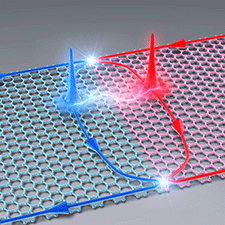
Tokyo -Jan. 16, 2024 - NTT Corporation (NTT), CEA-Saclay, National Institute for Materials Science (NIMS), and Korea Advanced Institute of Science and Technology (KAIST) have successfully demonstrated electron flying qubit operation. In this research, we succeeded in controlling quantum superposition states of propagation single electrons in a graphene device. This achievement is a breakthrough towards on-demand generation of quantum entangled pairs*1, which is essential to link distant quantum computers.
The results have been published in the Science journal on Dec. 15, 2023.
>Quantum Solid State Physics Research Group
Background of the Study
While quantum computers based on the principles of quantum mechanics have been studied using superconducting circuits, a different approach using photons as flying qubits is also being studied2. A flying qubit is a qubit whose manipulation can be performed by sending it to spatially distributed logic elements and enables to transfer quantum information.
Research for flying qubits of electrons propagating in solid-state devices is also being conducted. For electron flying qubits, theory points to the possibility of on-demand generation of quantum entangled pairs using interactions between electrons. Research on electron flying qubits has been conducted for about 20 years and one of the most widely studied methods is controlling orbital states of single electrons injected into electronic Mach-Zehnder interferometer*3 formed in a high-mobility gallium arsenide (GaAs) semiconductor. While required elements such as electron beam splitter, one-dimensional conduction channel with low dissipation, and single-electron source, have been developed, weakness of quantum interference properties against heat and voltage as well as energy fluctuations of injected electrons have made the demonstration of electron flying qubit challenging.
Research Results
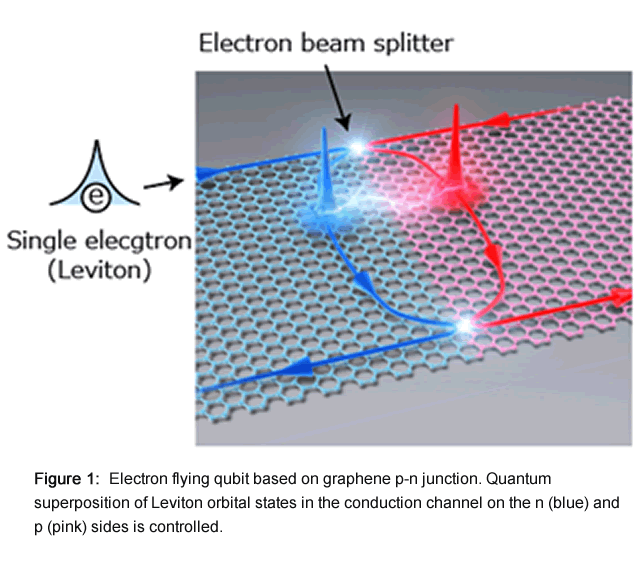
By combining an electronic Mach-Zehnder interferometer formed in graphene with a single electron source called Leviton, we succeeded in demonstrating electron flying qubit operation.
Key points of the Technology
- Electronic Mach-Zehnder interferometer formed in graphene
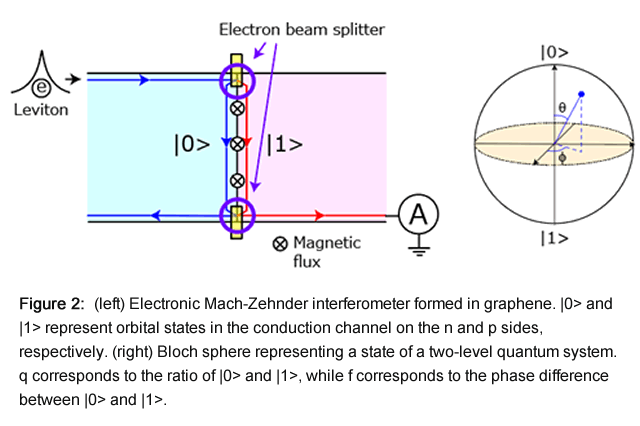
We fabricated a graphene p-n junction*4 and electrodes by stacking and fine processing graphene, hexagonal boron nitride*5, and metal electrodes. Small gate electrodes at the entrance and exit of the p-n junction controls the transmission and reflection at the beam splitters, forming a Mach-Zehnder interferometer around the p-n junction (Figure 2). - Single-electron source (Leviton)
Lorentzian voltage pulses for Leviton generation are created by adding multiple harmonics with finely tuned amplitudes and phases.
Overview of the Research
We overcame the problems that exist in GaAs systems by utilizing graphene p-n junction to form electronic Mach-Zehnder interferometer [Key point of the Technology (1)] and a different type of single-electron source named Leviton [Key point of the Technology (2)]. When a magnetic field is applied to graphene, one-dimensional conduction channels are formed on both sides of the p-n junction. In this case, the entrance and exit of the p-n junction serve as electron beam splitters, and a Mach-Zehnder interferometer is formed around the p-n junction. We showed that the temperature and voltage tolerance of this graphene-based interferometer is about one order of magnitude better than conventional GaAs-based interferometers. Furthermore, energy fluctuations of injected electrons were suppressed by using Levitons, which can be excited on the Fermi energy*6 by applying Lorentzian voltage pulse on a graphene electrode.
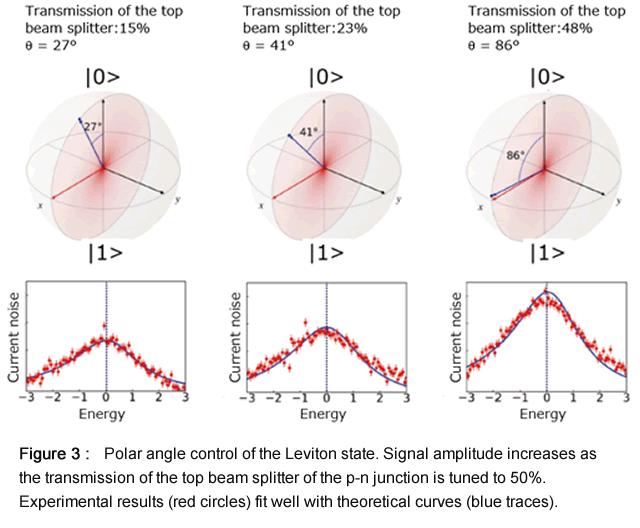
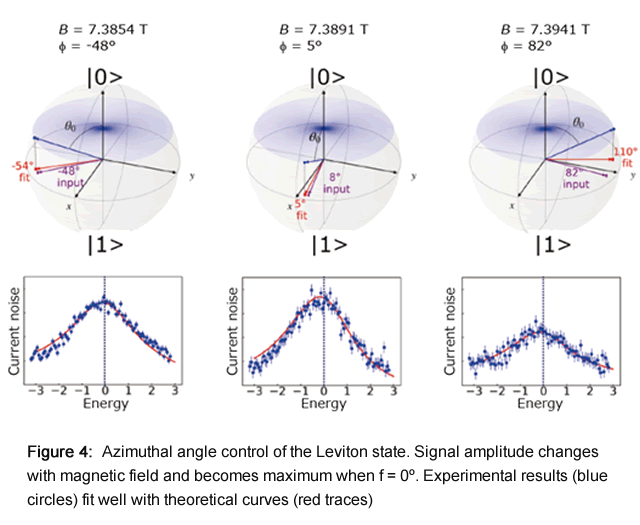
Electron flying qubit operation was demonstrated by controlling the superposition of Leviton orbital states |0> and |1>, where |0> and |1> represent orbital states in the conduction channel on the n and p sides, respectively. Polar angle q, which corresponds to the ratio of |0> and |1> in the superposition state, was controlled by tuning the transmission of the beam splitter at the entrance of the p-n junction (Figure 3). On the other hand, azimuthal angle f, which corresponds to the phase difference between |0> and |1>, was controlled by the magnetic field (Figure 4). Full control of q and f indicates that arbitrary superposition state can be obtained.
Outlook
The results demonstrating the electron flying qubit operation are the breakthroughs for quantum information transfer in solid-state devices. We will aim to realize on-demand generation of quantum entangle pairs by two-flying-qubit operation. In parallel, we will develop technology for shortening the Leviton pulse, aiming for the realization of time multiplexing.
Publication Details
Journal: Science
Title: "Emission and coherent control of Levitons in graphene"
Authors: A. Assouline, L. Pugliese, H. Chakraborti, Seunghun Lee, L. Bernabeu, M. Jo, K. Watanabe, T. Taniguchi, D. C. Glattli, N. Kumada, H.-S. Sim, F. D. Parmentier, and P. Roulleau
Glossary
- *1 ... Quantum entangled pair
- Quantum entanglement is a state at which two (or more) particles have strong correlations that cannot be explained by classical physics. Entangled pair keeps the correlation no matter how far apart they are spatially, and useful to link distant quantum computers.
- *2 ... Photon flying qubit
- https://group.ntt/en/newsrelease/2023/03/06/230306b.html
- *3 ... Mach-Zehnder interferometer
- An interferometer often used for optical experiments. It consists of two beam splitters. First beam splitter divides a beam into two paths. Second beam splitter measure the interference results according to the phase difference between the two paths.
- *4 ... Graphene p-n junction
- Graphene has no band gap, which results in the formation of a special p-n junction where the p- and n-regions are spatially connected.
- *5 ... Hexagonal boron nitride
- Atomic layer material composed of boron and nitrogen. Thin hexagonal boron nitride layer is often used as a flat insulator for graphene.
- *6 ... Fermi energy
- Highest energy of occupied single-particle states of Fermions.