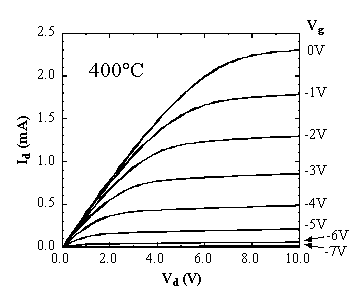
 Fig. 1:I-V
characteristics at 400 °C.
Fig. 1:I-V
characteristics at 400 °C.High-Temperature Performance in AlGaN/GaN Heterostructure Field Effect Transistors
Narihiko Maeda, Tadashi Saitoh, Kotaro Tsubaki, Toshio Nishida, and Naoki
Kobayashi
Physical Science Laboratory
The GaN-based material system is very promising for high-temperature,
high-voltage, and high-power microwave applications, because of the large
breakdown electric field and the large electron saturation velocity in this
material system. We have fabricated AlGaN/GaN heterostructure field effect
transistors (HFETs) whose I-V characteristics have exhibited both excellent
current saturation and sufficient pinch-off characteristics up to a high
temperature of 400 °C.
The layer structure of fabricated HFETs was 300 A Al0.15Ga0.85N/1 mm GaN/1000 A
AlN/SiC(0001) [see Frontispiece]. The gate length and gate width were 2 and 20
mm, respectively. Since a large piezoelectric effect exists at the AlGaN/GaN
heterointerface, unrelaxed AlGaN/GaN heterostructures with large lattice strains
are capable of containing very high two-dimensional electron gas densities
larger than 1 ´ 1013 cm-2 [1]. Figure 1 shows the I-V characteristics of the
fabricated device at 400 °C. Sufficient pinch-off characteristics have been
obtained as well as excellent current saturation characteristics. Obtaining
pinch-off characteristics are indispensable for practical uses of the devices,
because reported insufficient pinch-off characteristics should lead to
degradation in the RF performance, that in the breakdown voltage, and increase
in the noise figure. Pinch-off characteristics shown in Fig. 1 have been
obtained as the result of reduced crystal defects and reduced etching damage in
the devices. Figure 2 shows the temperature (T) dependence of the
transconductance (gm). Although gm decreases with increasing T, the degradation
rate in gm is shown to be relatively small above 300 °C, which is a favorable
feature for high-temperature applications. We are especially interested in the
application of the devices for satellite microwave communications.
[1] N. Maeda, T. Nishida, N. Kobayashi, and M. Tomizawa, Appl. Phys. Lett.
73(1998) 1856.
[2] N. Maeda, T. Saitoh, K. Tsubaki, T. Nishida, and N. Kobayashi, to be
published in Jpn. J. Appl. Phys., Part 2 (1999).
Fig. 1:I-V
characteristics at 400 °C.
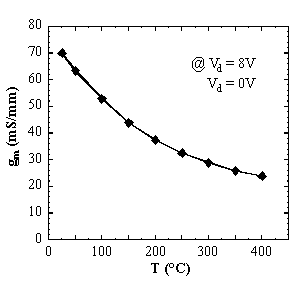 Fig. 2:Temperature
(T) dependence of transconductance (gm)
Fig. 2:Temperature
(T) dependence of transconductance (gm)
 Contents