| Magnomechanics |
| Recent Activities |
|
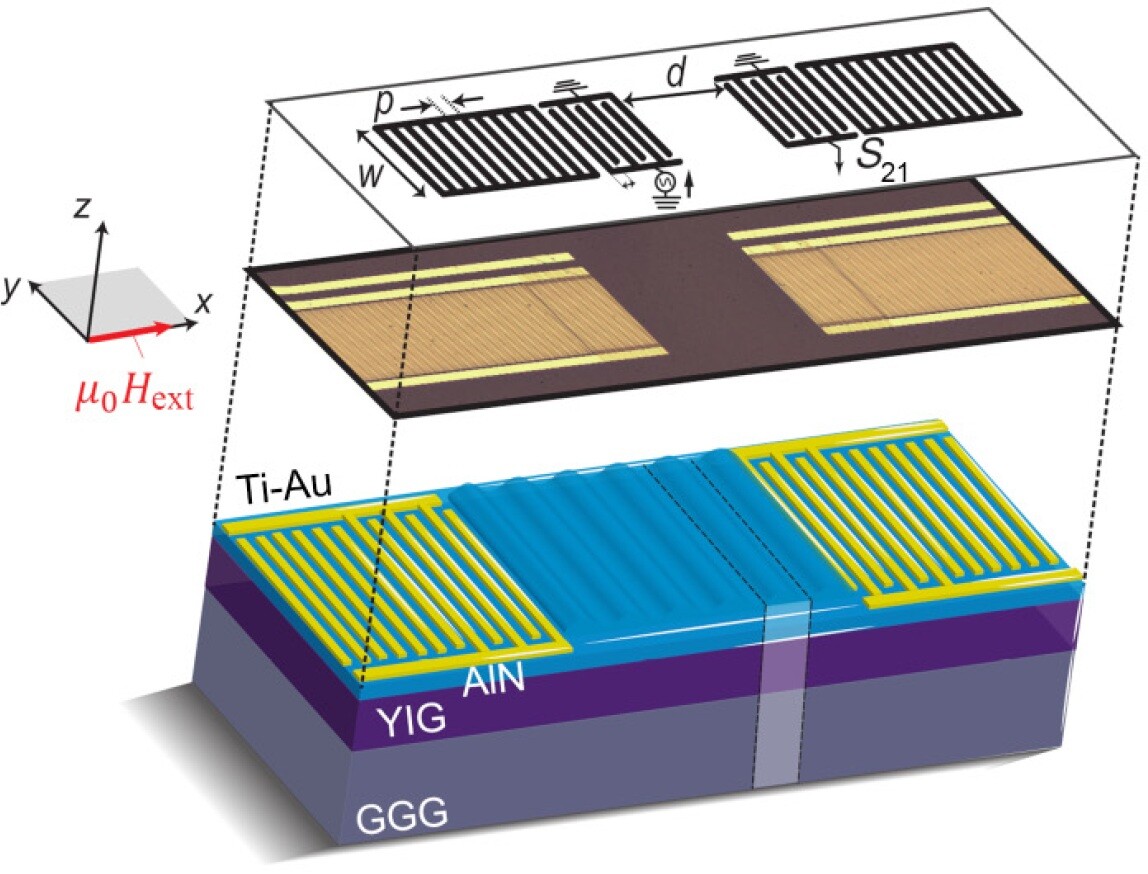
On-chip magnon-polaron generation in mode-matched cavity magnomechanics D. Hatanaka, M. Asano, M. Kurosu, Y. Taniyasu, H. Okamoto, and H. Yamaguchi, Phys. Rev. Applied 24, 064053 (2025) |
| The generation of magnon polarons, which are hybridized states resulting from strong magnon-phonon coupling, is key to enabling coherent manipulation in acoustic and spintronic devices. However, the conventional device configuration, a magnetic thin film on a thick piezoelectric layer, often has difficulty achieving large magnon-phonon coupling due to very small spatial-mode overlap. Here, we demonstrate the generation of magnon polarons by using a mode-matched on-chip magnomechanical system. A configuration with a thin piezoelectric film on a magnetic layer with a thickness of several micrometers has been found to sustain deeply distributed magnon modes that enable magnetoelastic coupling to phonons over almost the entire mode volume. The enhanced spatial-mode overlap has generated magnon polarons the spectra of which have shown distinct avoided crossings. This magnomechanical system will facilitate the utilization of coherent magnon-phonon conversion and their hybrid states in functional phononic devices. |
|
|
Cavity magnomechanical coupling with coupled magnon modes in a synthetic antiferromagnet M. Asano, H. Matsumoto, M. Hayashi, and D. Hatanaka, Phys. Rev. B 108, 064415 (2023) |
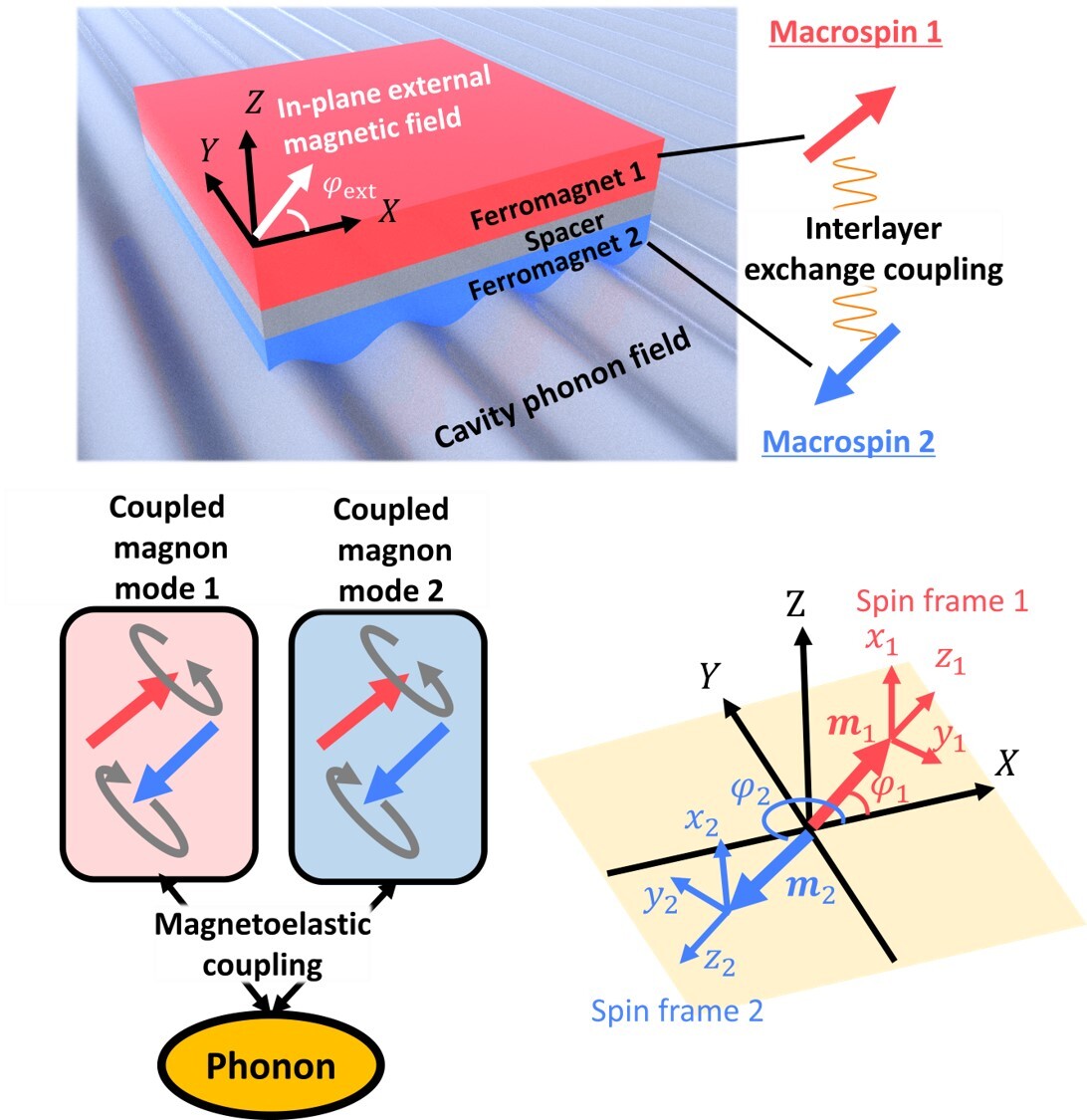 |
On-chip cavity magnomechanics is an emerging field exploring acoustic and magnonic functionalities of various ferromagnetic materials and structures using strongly confined phonons. It is expected that such cavity magnomechanics can be extended to multilayer ferromagnets, especially synthetic antiferromagnets (SAFs) that exhibit zero net magnetization through interlayer exchange coupling. However, the conventional theoretical framework for a single ferromagnet cannot be used directly because of the antiferromagnetic magnetization dynamics associated with the interlayer exchange coupling. In this paper, we theoretically investigate phonon-magnon coupling with a three-layer SAF. Our formulation of the phonon-magnon coupling constants reveals that the acoustic (optical) magnon mode dominantly couples to the cavity phonon when the magnetization angles in the two ferromagnetic layers are antiparallel (near orthogonal). Moreover, numerical calculations including the effects of dipole-dipole interactions and in-plane uniaxial magnetic anisotropy allow us to predict phonon frequency shifts and linewidth broadening that can be detected in experiments. These theoretical insights would greatly help us to make a strategy for bringing the system into the strong coupling regime and to devise control protocols in analogy to cavity quantum electrodynamics and cavity optomechanics. |
|
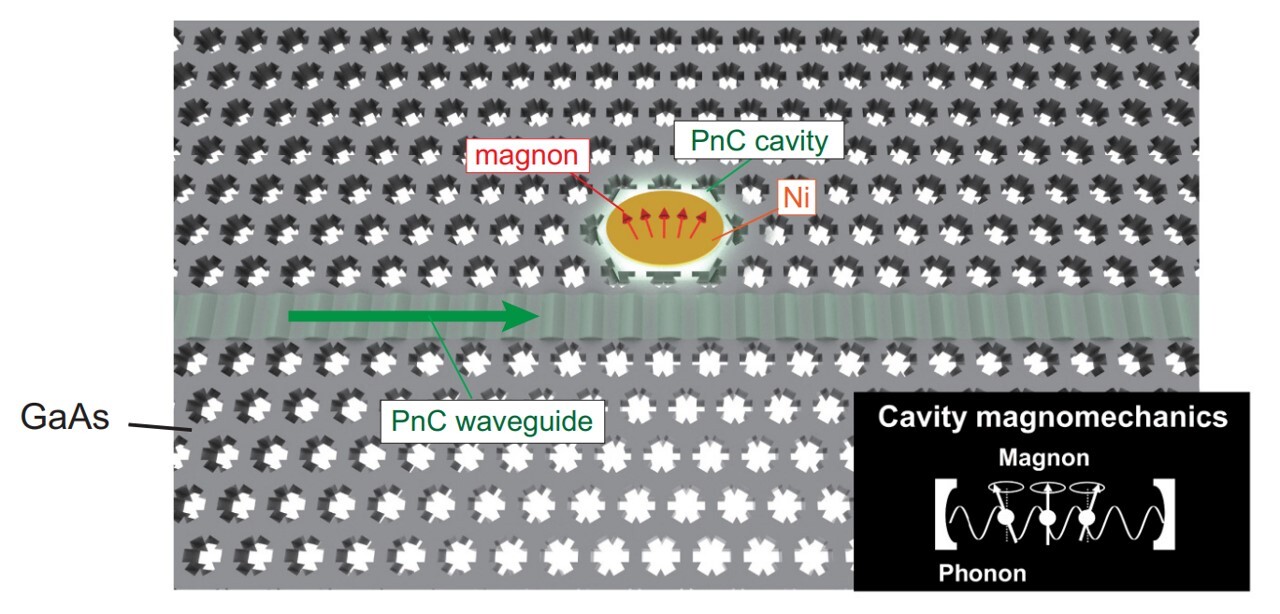
Phononic Crystal Cavity Magnomechanics D. Hatanaka, M. Asano, H. Okamoto, and H. Yamaguchi, Phys. Rev. Applied 19, 054071 (2023) |
| Phononic crystal (PnC) enables strong confinement of phonons in a wavelength-scale tiny area due to a band gap, which can enhance the interaction with different physical systems. Here, we utilize the PnC to demonstrate local manipulations of magnons by using ultrahigh frequency phonons confined in a phononic cavity, where the tiny and low-loss vibrations excite magnons in a micromagnet via magnetostriction. Moreover, we find that the magnetoelastic interaction is modulated by selectively exciting the cavity resonant modes. The results open up a realm of PnC cavity magnomechanics and will provide universal controls of ultrahigh frequency magnons and phonons with PnC circuits. |
 |
|
On-Chip Coherent Transduction between Magnons and Acoustic Phonons in Cavity Magnomechanics D. Hatanaka, M. Asano, H. Okamoto, Y. Kunihashi, H. Sanada, and H. Yamaguchi, Phys. Rev. Applied 17, 034024 (2022) |
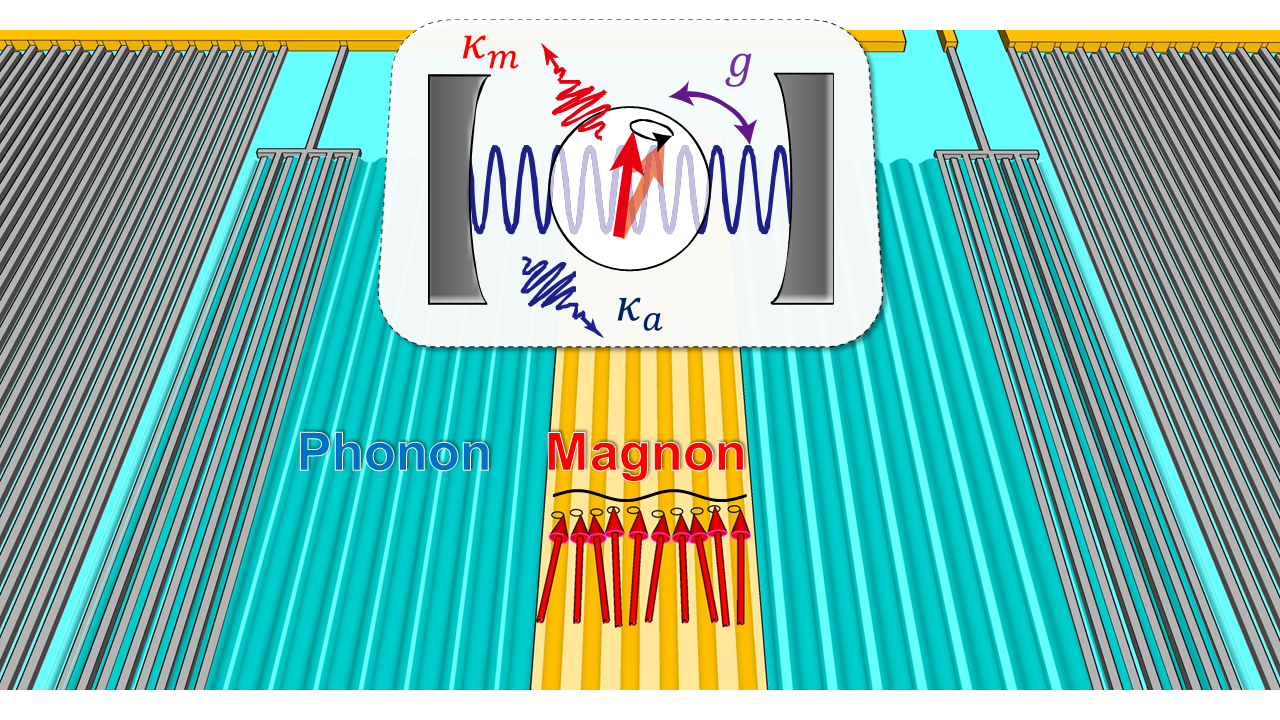 |
Coherent control of collective spin excitations (magnons) with acoustic phonons is a key technology for future hybrid spintronics devices. Surface acoustic waves (SAWs), owing to their high frequency, short wavelength, and low radiation loss, could provide an appropriate platform for integrating the devices on a chip. However, the tiny coupling efficiency in previous experiments using traveling SAWs limits the availability of this prospect. We report a planar cavity magnomechanical system, where standing acoustic waves (i.e., a SAW cavity) enhance the spatial and spectral power density to implement magnified magnon-phonon coupling. Excitation of spin-wave resonance involves significant acoustic power absorption approaching 90%, whereas the collective spin motion exerts hybridization force on the cavity dynamics, leading to coupling cooperativity exceeding unity at room temperature in such a chip-scale device. The cavity magnomechanical system paves the way to the coherent acoustic control of magnons and the development of alternative spin-acoustic technologies for classical and quantum applications. |
|
Mode-sensitive magnetoelastic coupling in phononic-crystal magnomechanics D. Hatanaka, and H. Yamaguchi, APL Materials 9, 071110 (2021) |
| The acoustically driven spin-wave resonance in a phononic-crystal cavity is numerically investigated. The designed cavity enables confinement of gigahertz vibrations in a wavelength-scale point-defect structure and sustains a variety of resonance modes. Inhomogeneous strain distributions in the modes modify the magnetostrictive coupling and the spin-wave excitation susceptible to an external-field orientation. In particular, a monopole-like mode in the cavity having a near-symmetrical pattern shows a subwavelength-scale mode volume and can provide a versatile acoustic excitation scheme independent of the field-angle variation. Thus, the phononic-crystal platform offers an alternative approach to acoustically control the spin-wave dynamics with ultrasmall and inhomogeneous mode structures, which will be a key technology to integrate and operate large-scale magnomechanical circuits. | 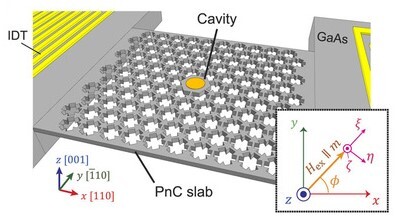 |